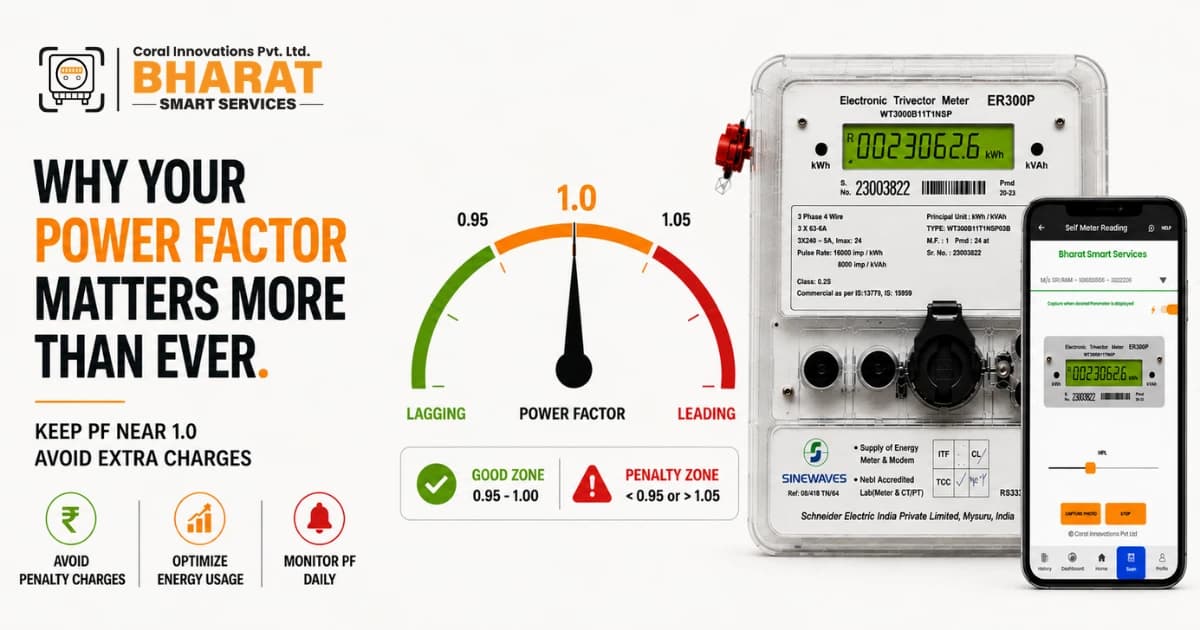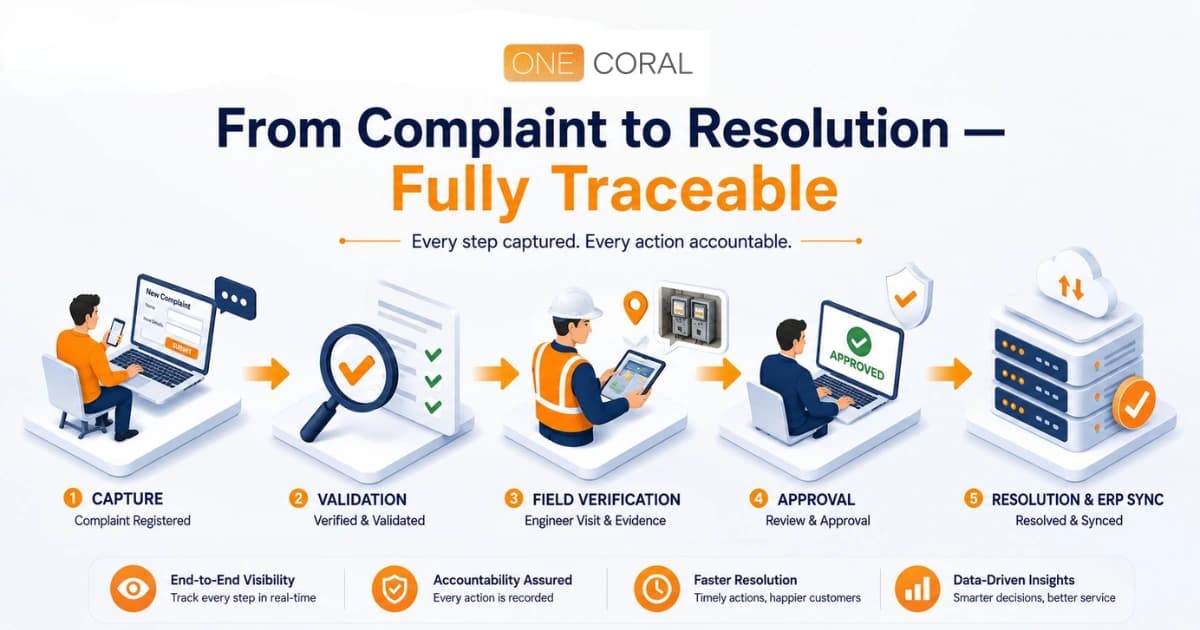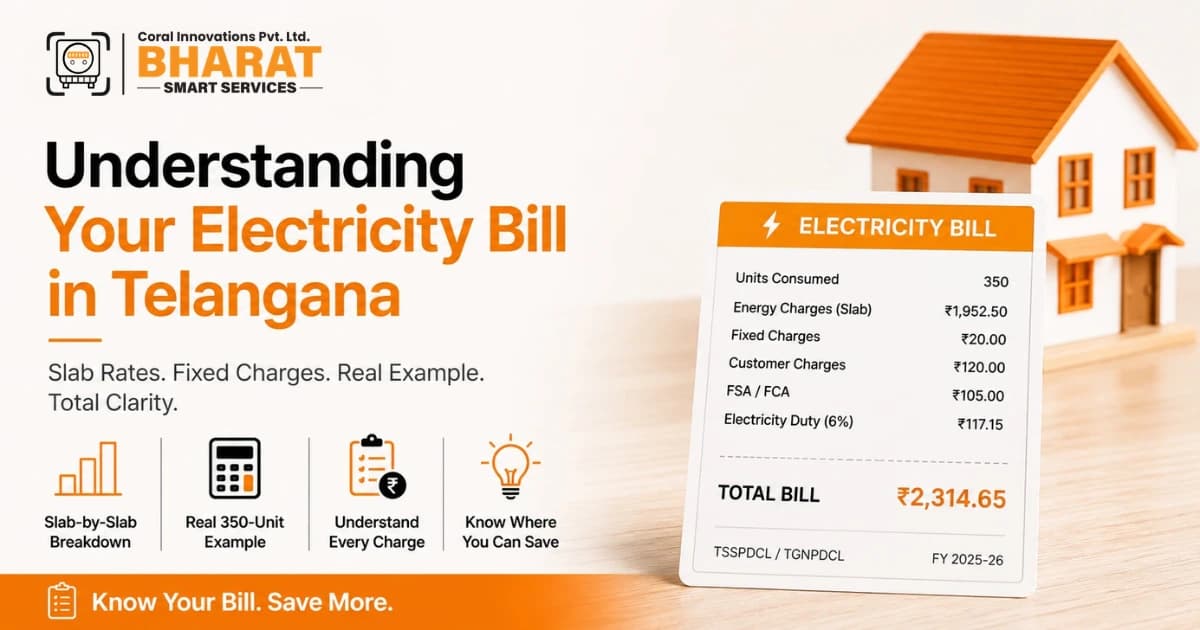
Our Latest Blogs
Stay updated with the latest news, trends, and insights from our experts.
Little Climate Yodha Energy Anthem Contest 2026
Bharat Smart Services × Magic 106.4 FM
Little Climate Yodha
Energy Anthem Contest 2026
Sing, rap, or jingle your way to a greener tomorrow! š Open to all school kids — totally free to join.
š¶ Join the Contest
šµ
What's the Contest About?
Record a fun 30–60 second video — a song, jingle, rap, or any musical message about saving energy. No registration fees just kids using their voice for a good cause!
šÆ Pick a theme:
Saving Electricity Climate Change Energy Conservation Smart Energy Habits Future of Energy
š
Looking for a singing contest near you that actually means something? This one builds confidence and teaches kids to care for the planet - all in one fun video!
Four Easy Steps
š
STEP 1
Register
š„
STEP 2
Record
ā¬ļø
STEP 3
Upload
š·ļø
STEP 4
Tag & Share
š
Mark Your Calendar
š¬
25 June
Submission deadline
→
š
28 June
Grand finale
šš
Become the Energy Anthem Champion!
Here's what's waiting for you
ā¹3,000
Gift Voucher
š
Trophy š Certificate š» Radio Feature š± BSS Feature
The Little Climate Yodha Pledge
"I am a Little Climate Yodha.
I will use electrical appliances wisely.
I will inspire my family to save electricity.
I will sing for energy conservation.
My voice inspires change. My actions create impact." š
ā
Do
Free to join · One entry each · Keep it original · Follow the guidelines
š«
Avoid
Copying others · Offensive language · Edited clips · Going over time
Every child can be a Climate Yodha. Grab a phone, find your voice, and help build a greener tomorrow — one song at a time. š¶š
Ready to sing for a cause? š¤
Submissions close 25th June 2026
Register Now →
Read More ā
High Electricity Bills In Summer? Here's How You Can Reduce It?
Energy Guide
Electricity powers almost every aspect of our daily lives. From lights and fans to refrigerators, air conditioners, and washing machines, our dependence on electrical appliances continues to grow. However, many households are surprised when they receive their monthly electricity bill and wonder, "Why is my electricity bill so high?"
At Bharat Smart Services, we believe that reducing electricity bills is not just about using fewer appliances. The key is understanding where electricity is being consumed and identifying opportunities to reduce wastage. If you have ever searched for how to reduce electricity bill at home, the answer starts with understanding your energy usage.
Why Are Electricity Bills Increasing?
In most homes, a few appliances contribute significantly to overall electricity consumption. These typically include:
Air Conditioners Water Heaters Refrigerators Water Pumps Washing Machines Electric Irons Kitchen Appliances
Many of these appliances consume more electricity than homeowners realize, especially when they are left running longer than necessary or remain powered on even when not in active use. For homeowners wondering why electricity bills are so high, the answer often lies in hidden energy consumption, inefficient appliance usage, and a lack of visibility into daily usage patterns.
Simple Ways to Reduce Your Electricity Bill
Tip 01
Switch Off Appliances When Not in Use
One of the simplest ways to save electricity is to turn off appliances immediately after use. Small habits can make a big difference over time.
Tip 02
Reduce Standby Power Consumption
Televisions, set-top boxes, chargers, and other electronic devices continue to consume electricity even when they appear to be turned off. This hidden consumption adds up throughout the month.
Tip 03
Choose Energy-Efficient Appliances
Appliances with higher energy-efficiency ratings consume less electricity while delivering the same performance. Energy efficiency should be an important consideration when purchasing new appliances.
Tip 04
Monitor Your Energy Usage Regularly
You can only control what you can measure. Regular monitoring helps identify wasteful consumption patterns and allows homeowners to take corrective action before the monthly bill arrives.
How Smart Plugs Can Help Reduce Electricity Consumption
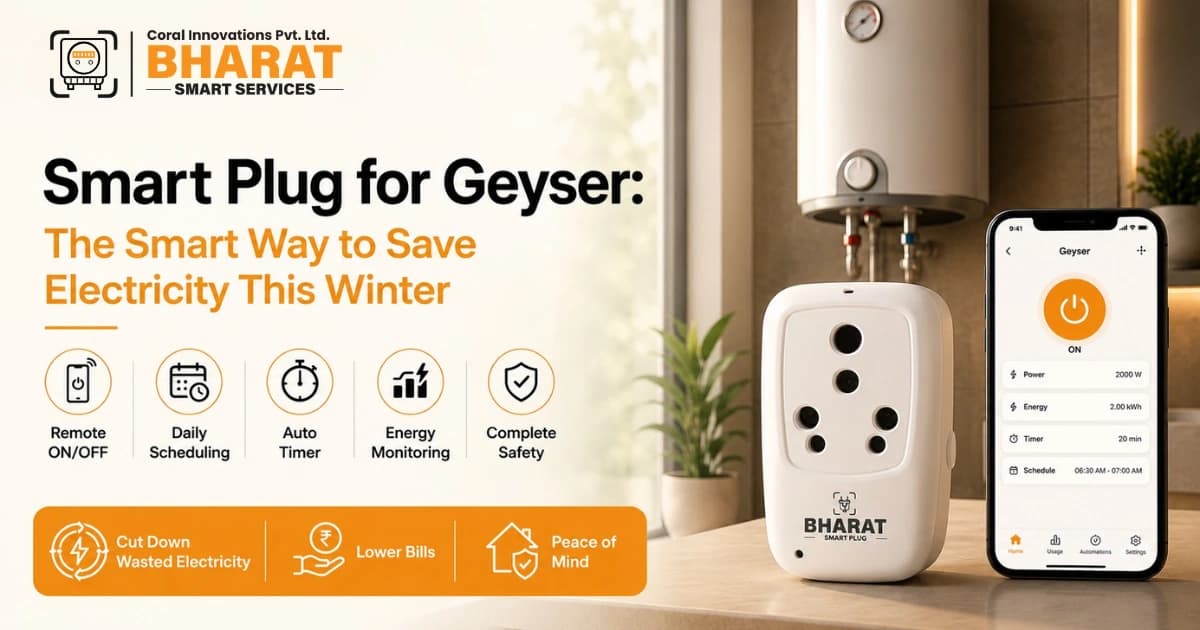
Smart plugs are becoming one of the most practical tools for managing household energy consumption. A smart plug allows homeowners to control connected appliances remotely through a smartphone. It also enables scheduling and automation, ensuring appliances operate only when required.
Practical Uses of Smart Plugs at Home
šæ
Geysers
Schedule operating hours so hot water is available only when needed — no more all-day heating.
āļø
Air Conditioners
Forgot to switch off the AC before leaving? Remotely turn it off and prevent unnecessary consumption.
š§
Water Pumps
Control pump operation remotely and prevent pumps from running longer than required.
š
Electric Irons & Kitchen appliances
Remotely switch off accidentally left-on irons and automate kitchen appliances for better energy management.
Moving from Guesswork to Real-Time Energy Monitoring
Traditionally, homeowners only become aware of their electricity consumption when they receive their monthly bill. By then, opportunities to reduce usage have already been missed. Today, smart energy management solutions make it possible to monitor consumption in real time and take action immediately.
Our Products
š
Bharat Smart Plug
Remotely control appliances, create schedules, set timers, and manage energy-intensive devices more efficiently. Eliminates unnecessary electricity consumption and promotes smarter energy usage.
š
Bharat Bijli Auditor
Provides real-time visibility into electricity consumption. Identifies which appliances consume the most power and enables informed decisions to reduce energy costs.
š±
Bharat Smart Services App
Brings energy monitoring and control into a single platform. Track usage, receive alerts, set energy-saving goals, and monitor patterns from anywhere.
š”
Bharat Smart Switches
Control lights, fans, and other electrical appliances through smartphones. Whether at home or away, ensure devices are not consuming electricity unnecessarily.
Smart Goal
Staying Within 200 Units: A Smart Goal for Every Household
For many households, keeping monthly electricity consumption below 200 units can significantly reduce electricity expenses. Achieving this goal requires awareness, regular monitoring, and timely control of high-energy-consuming appliances. Simple measures such as scheduling geysers, optimizing AC usage, controlling standby power, and monitoring consumption through smart energy solutions can make a substantial difference. These small changes can lead to meaningful savings month after month.
The simple way you can monitor your house consumption is by taking meter reading using bharat smart services app daily.
The Future of Electricity Savings Is Smart
Reducing electricity bills is no longer just about switching off a few lights. It is about understanding how electricity is used, identifying waste, and making smarter decisions every day.
At Bharat Smart Services, our mission is to help households take control of their electricity consumption through technology-driven solutions that make energy management simple, practical, and effective.
For anyone searching for how to save electricity at home, the first step is awareness, followed by action. After all, the first step to saving electricity is knowing where it is being used. Contact us to know where electricity is getting watsted in your home/businesses./industry.
BHARAT SMART SERVICES
Call : 7287030303
Read More ā
How to Check Smart Meter Reading Online
Electricity Tips | 5 min read
Have you recently got a smart meter installed and are wondering how to check smart meter reading online?
You are not alone. Many electricity consumers want to know how much electricity they are using, whether their daily consumption is increasing, and if there is a way to track it from their mobile phone.
The good news is that smart meters are designed for better energy management. But there is one thing every consumer should know.
You can check smart meter reading online only if your DISCOM provides access to that data.
Let's understand how it works and what you can do if online data is not available.
What is a Smart Meter?
A smart meter is a digital electricity meter that automatically records your electricity consumption. Unlike old meters that require manual readings, smart meters send data directly to the electricity department.
They help utilities with accurate billing and reduce the chances of manual reading errors. But for consumers, the biggest question is still the same.
How to check smart meter reading online?
How to Check Smart Meter Reading Online
If your electricity distribution company (DISCOM) has enabled consumer access, you can usually follow these steps.
Visit Your DISCOM Website or Mobile App
Most DISCOMs provide an online portal or mobile application where consumers can log in using their:
Consumer Number
Service Number
Registered Mobile Number
After logging in, you may be able to see:
Current meter reading
Electricity consumption history
Bill details
Prepaid balance (if applicable)
However, these features depend entirely on your local electricity utility.
Can Everyone Check Smart Meter Reading Online?
The simple answer is No.
Even if you have a smart meter installed, you can view your smart meter data only when your DISCOM gives access to consumers.
In many places, smart meters are already sending data to the electricity department — but that information may not yet be available for customers to view online.
Good to know:
If you cannot find your smart meter details online, it does not necessarily mean there is a problem with your meter. It may simply mean that your DISCOM has not enabled consumer access yet.
Is Seeing Total Electricity Consumption Enough?
For most families and businesses, the next question comes naturally.
"My electricity bill is high, but which appliance is actually consuming more power?"
A smart meter generally shows you the total electricity used. It may not tell you:
How much electricity your AC is consuming
Whether your geyser is increasing the bill
Which appliance is running unnecessarily
Where you can actually save electricity
That is where energy auditing becomes useful.
Bharat Smart Services App: A Practical Alternative
At Bharat Smart Services, we believe that people should not have to wait for utility data access to understand their electricity consumption.
Our goal is simple — help consumers know where their electricity is going and reduce unnecessary energy expenses.
Whether you are a homeowner, shop owner, office, or industry, having real-time energy information helps you make better decisions.Simply by installing bharat smart services app and taking meter reading
The app captures reading automatically and let's you know your expected usages for the month.
Bijli Auditor: Know Your Electricity Better
If you are searching for how to check smart meter reading online, chances are you also want to understand your electricity usage — not just see a number.
The Bijli Auditor from Bharat Smart Services is designed for exactly that purpose. Instead of showing only total consumption, it helps you:
ā Monitor electricity usage in real time
ā Track the power consumption of individual appliances
ā Identify energy wastage
ā Set energy targets and limits
ā Receive alerts for unusual electricity usage
ā Take action to reduce electricity bills
It gives you useful information to control your energy — instead of simply watching the bill every month.
Why Monitoring Electricity Consumption Matters
Most people only look at their electricity bill after it arrives. By then, the consumption has already happened.
Regular monitoring helps you:
Reduce unnecessary electricity usage
Find appliances that consume excess power
Improve energy efficiency
Avoid unexpected high electricity bills
Build better energy-saving habits over time
Small changes made with the right information can create big savings over time.
Frequently Asked Questions
How to check smart meter reading online?
You can check smart meter reading online through your DISCOM website or mobile app, but only if the utility has enabled consumer access for your area.
Why can't I see my smart meter data online?
Some DISCOMs use smart meter data for internal operations and billing but have not yet provided online viewing access to consumers. This is still being rolled out across many states.
Does a smart meter show appliance-wise electricity usage?
Generally, no. Most smart meters provide total electricity consumption only, not a breakdown by appliance.
What can I do if my DISCOM does not provide online smart meter data?
You can use energy monitoring solutions like the Bijli Auditor from Bharat Smart Services to understand your electricity usage in greater detail independently of DISCOM access
Final Thoughts
If you are searching for how to check smart meter reading online, the first step is to check whether your DISCOM offers that facility. If it does, you can access your electricity data through their official portal or app.
But if your DISCOM has not yet enabled consumer access, you do not have to stay in the dark about your electricity consumption.
With Bharat Smart Services App and the Bijli Auditor, you can move beyond just checking meter readings and start understanding your actual energy usage. Because saving electricity starts with knowing where it is being used.
Start monitoring your electricity the smart way.
Download the Bharat Smart Services app — free on Android.
Download the App →
Read More ā
Telangana HT Electricity Tariff 2024-25: What Industries Need to Know
Electricity is one of the largest operating expenses for industries. Yet, most businesses only look at their bill after it arrives — when it's already too late to act.
If you're an HT (High Tension) consumer in Telangana, understanding the latest tariff structure can help you identify opportunities to reduce costs, improve energy efficiency, and avoid hidden charges that silently increase your monthly bill.
Let's break down the latest Telangana HT tariff rates and the factors that often lead to unexpectedly high electricity bills.
Industrial Electricity Rates Telangana 2024-25 at a Glance
HT tariffs apply to consumers receiving electricity supply at 11 kV, 33 kV, or 132 kV and above. These categories typically include:
Manufacturing Industries Rice Mills Poultry Farms Commercial Establishments Hospitals Educational Institutions Airports & Railway Stations Residential Townships EV Charging Stations
Unlike LT consumers, HT consumers are billed across multiple parameters:
Demand Charges
Energy Charges
Maximum Demand
Power Factor
kVArh Lead Consumption
Customer Charges
Time-of-Day Consumption
HT Industrial Tariff — HT-I A (Industry General)
Industries form the largest segment of HT consumers in Telangana.
Voltage Level
Demand Charges (ā¹/kVA/month)
Energy Charges (ā¹/Unit)
11 kV
ā¹500
ā¹7.65
33 kV
ā¹500
ā¹7.15
132 kV & Above
ā¹500
ā¹6.65
Tariff for Poultry Farms
Voltage Level
Demand Charges (ā¹/kVA/month)
Energy Charges (ā¹/Unit)
11 kV
ā¹500
ā¹7.65
33 kV
ā¹500
ā¹7.15
Tariff for Industrial Colonies
Voltage Level
Energy Charges (ā¹/Unit)
11 kV
ā¹7.30
33 kV
ā¹7.30
132 kV & Above
ā¹7.30
Tariff for Seasonal Industries
Voltage Level
Demand Charges (ā¹/kVA/month)
Energy Charges (ā¹/Unit)
11 kV
ā¹500
ā¹8.60
33 kV
ā¹500
ā¹7.90
132 kV & Above
ā¹500
ā¹7.70
HT Commercial Tariff — HT-II
Commercial HT consumers include IT Parks, Shopping Malls, Corporate Offices, and Commercial Buildings.
Voltage Level
Demand Charges (ā¹/kVA/month)
Energy Charges (ā¹/Unit)
11 kV
ā¹500
ā¹8.80
33 kV
ā¹500
ā¹8.00
132 kV & Above
ā¹500
ā¹7.80
Note: Commercial consumers typically pay higher energy charges compared to industrial consumers.
Airports, Bus Stations & Railway Stations
Voltage Level
Demand Charges (ā¹/kVA/month)
Energy Charges (ā¹/Unit)
11 kV
ā¹500
ā¹8.50
33 kV
ā¹500
ā¹7.85
132 kV & Above
ā¹500
ā¹7.45
Railway Traction Tariff
Category
Demand Charges
Energy Charges
Railway Traction
ā¹500/kVA
ā¹5.05/unit
Hyderabad Metro Rail
ā¹500/kVA
ā¹4.95/unit
Residential Townships & Colonies — HT-VI
Voltage Level
Demand Charges
Energy Charges
11 kV
ā¹285/kVA
ā¹7.30/unit
33 kV
ā¹285/kVA
ā¹7.30/unit
132 kV & Above
ā¹285/kVA
ā¹7.30/unit
EV Charging Stations Tariff
As Telangana continues to promote electric mobility, dedicated tariffs are available for EV charging infrastructure.
Voltage Level
Demand Charges
Energy Charges
11 kV
ā¹100/kVA
ā¹6.00/unit
33 kV
ā¹100/kVA
ā¹6.00/unit
132 kV & Above
ā¹100/kVA
ā¹6.00/unit
The Real Question
Why Are Industries Still Receiving High Electricity Bills?
One of the most common questions we hear at Bharat Smart Services: "The tariff hasn't increased. Then why has my electricity bill gone up?"
The answer lies beyond the per-unit tariff. Many industries focus only on kWh consumed, while several other parameters significantly impact the final bill.
1. Contract Demand (CMD) Issues
Your Contracted Maximum Demand directly affects the fixed charges you pay every month. When CMD is not optimised:
You may pay for unused demand capacity.
Exceeding CMD triggers penalties.
Demand charges continue even during low production periods.
Many industries continue paying higher fixed charges simply because their CMD has not been reviewed for years.
2. Poor Power Factor Management
Power Factor plays a crucial role in electrical system efficiency. A poor power factor can lead to:
Increased system losses
Reduced equipment efficiency
Higher electricity costs and additional penalties
Maintaining an optimal power factor requires continuous monitoring and proper APFC panel management.
Watch Out For This
3. kVArh Lead Charges — A Charge Many HT Consumers Overlooked
After the recent implementation of kVArh Lead energy charges, many consumers started seeing unexpected additional amounts in their electricity bills. The challenge: most industries are still unaware of what kVArh Lead means, why it is being charged, and how to reduce it.
When capacitor banks are oversized or continue operating during low-load conditions, they generate excess leading reactive power, resulting in:
Increased kVArh Lead consumption
Additional charges on electricity bills
Higher overall energy costs with no increase in production
4. Equipment Operating Inefficiencies
Equipment such as air compressors, pumps, chillers, HVAC systems, and industrial motors can gradually lose efficiency over time — consuming significantly more electricity while appearing to function normally.
Result: Higher bills with no obvious warning signs.
5. Peak Demand Spikes
Many industries experience short-duration demand spikes during motor startups, shift changes, or simultaneous equipment operation. Even if these spikes last only a few minutes, they can register as Maximum Demand and substantially increase monthly demand charges.
6. Invisible Energy Waste
Most businesses track only total units consumed and the monthly bill. But they often miss:
Idle equipment consumption
After-hours energy usage
Load imbalances
Inefficient operating schedules
Energy wastage during non-production periods
"Two industries paying the same tariff can have drastically different electricity bills based on how efficiently they manage their energy. The industries that achieve the lowest costs are not those on the lowest tariff — they are the ones that continuously monitor and optimise."
How Bharat Smart Services Helps HT Consumers
Our AI-powered energy management and auditing solutions enable businesses to gain complete visibility into their electricity consumption:
ā
Monitor electricity usage in real time with BSS App
ā
Identify hidden energy losses
ā
Track equipment-wise consumption
ā
Detect excess demand charges
ā
Monitor power factor performance
ā
Identify kVArh Lead issues
ā
Analyse billing trends and improve overall energy efficiency
Conclusion
Most hidden electricity costs can be identified, monitored, and controlled with the right energy management approach. Instead of waiting for the bill to reveal a problem, leading industries are now using real-time energy insights to make smarter operational decisions.
The real question is: Am I using electricity as efficiently as possible?
Don't just pay your electricity bill. Understand it.
Get in touch with Bharat Smart Services today and discover how much you could be saving.
š Call: 7287030303
Get a Free Bill Review
Read More ā
Why Your HT Electricity Bill Spiked After Telangana's kVAh Billing Update ā A Real Case Study
Satyanarayana ran his factory for years paying around Rs.30,000 a month in electricity. One month the bill arrived at Rs.70,000 — a jump of over 130%. Nothing in his factory had changed. What changed was how Telangana’s regulator now calculates HT bills. Bharat Smart Services found the exact cause using live meter data — and fixed it.
Bill Optimisation · Case Study
Kinetics Organics & Plastics, Telangana — HT Consumer, kVAh Billing
The Bill That Nobody Saw Coming
Satyanarayana had been running Kinetics Organics and Plastics Private Limited for years on an HT connection. The electricity bill came every month. It was usually somewhere between ā¹30,000 and ā¹70,000. It was a cost of running the business — not something you worried about much.
“We just paid the bill and moved on,” he said.
Months before the crisis, there had been a notice. TGERC was changing how it calculated bills for HT consumers across Telangana — specifically, it was unlocking the lead power factor penalty. The notice had a lot of words. The effects seemed far away.
They knew about it. Then they moved on.
At the time, it seemed reasonable to assume that even if the bill went up, it would be 10 or 15 percent — something manageable. Nobody was ready for what actually happened.
The bill was not 10% higher. It was not 15% higher. It was double.
ā¹30,000 became close to ā¹70,000 in a single billing cycle. The reason was not that the factory used more power. The reason was that the way power use is measured and charged had fundamentally changed under the kVAh billing update.
The Worst Possible Moment
As Satyanarayana described it:
“At a time when business itself was not running properly, recession was going on, and everywhere outside we were hearing about wars and uncertainty… during this difficult situation, we got introduced to Bharat Smart Services.”
— Satyanarayana, Managing Director, Kinetics Organics & Plastics Pvt. Ltd.
Someone Who Actually Explained It — and Then Proved It With Data
The first thing that stood out was not a product or a quote for equipment. It was an explanation.
Bharat Smart Services sat down with the team and walked through what was actually happening — what lead power factor meant in practical terms, why their specific HT connection was now attracting penalties it had not before, and what kind of intervention would genuinely address the root cause rather than just patch the symptom.
“They explained to us what solution could be implemented for this type of billing issue.”
But the explanation alone was not what made the difference. What made the difference was how BSS found the cause in the first place.
Using the Bharat Smart Services meter reading app, our team monitored the facility’s live electricity data — hour by hour, day by day — without stepping onto the site. The app did not just show consumption numbers. It identified the exact nature of the power factor problem: whether penalties were being triggered by lagging power factor, leading power factor, or both.
Lagging Power Factor
Caused by motors, transformers, and inductive loads. The traditional penalty that most businesses already knew about and had tried to manage.
Leading Power Factor
Caused by overcorrection — typically from a fixed capacitor bank running even when load has dropped. Previously invisible to the bill. Now penalised just like lag.
Most businesses and even most electricians assume the problem is lagging. Many miss the lead entirely. Getting this wrong means installing the wrong solution and continuing to pay penalties indefinitely. The meter reading app removed all guesswork. The data told the story clearly.
The Right Fix — Not Just Any Fix
Once the cause was confirmed, the right solution became obvious. An APFC panel was recommended and installed — not a fixed capacitor bank. The difference matters enormously in practice.
APFC Panel (Smart System)
Monitors the load in real time and switches individual capacitor banks on and off based on actual demand at that moment. No overcorrection. No undercorrection. No unnecessary penalties.
Fixed Capacitor Bank (Old Type)
Always on at the same level regardless of what the load actually requires. During low-load periods it over-corrects — pushing the facility into lead factor and generating a penalty that never existed before.
“After installing it, things have now come somewhat under control.”
“The team at Bharat Smart Services also supported us very proactively in bringing this situation under control, and we are very happy about that.”
In His Own Words
“I would recommend everyone to take their service. It can help reduce this kind of tightrope walking situation to a great extent.”
— Satyanarayana, Managing Director, Kinetics Organics & Plastics Pvt. Ltd.
Listen the whole story from the owner words on Tightrope walking. That phrase stays with you. Because that is exactly what an unexpected electricity bill does to a business — especially during difficult times. It turns a manageable cost into a monthly anxiety. Getting off that tightrope is not just a financial decision. It is a relief.
Why This Is Happening to HT Consumers Across Telangana
A clarification that most HT consumers and many electricians still get wrong.
HT consumers in Telangana have always been billed on kVAh. That part is not new. What changed is something more specific — and far more impactful.
Until recently, TSERC’s penalty structure only penalised lagging power factor — the kind caused by motors, transformers, and inductive loads. Businesses had learned to manage this. Most had some form of capacitor correction in place.
What TGERC now penalises is both lagging and leading power factor.
Leading power factor — caused by overcorrection, typically from a fixed capacitor bank that keeps running even when load has dropped — was previously invisible to the bill. Now it shows up as a penalty charge just like lag does.
This is precisely why businesses that had their power factor “sorted” are suddenly finding their bills climbing. Their fixed capacitor bank, adequate under the old rules, is now working against them during low-load periods — pushing them into lead factor and generating a penalty they were never exposed to before.
The solution is not more equipment. It is smarter monitoring.
That is exactly what Satyanarayana’s facility was missing. And that is what BSS’s meter reading app identified before a single rupee was spent on hardware.
Why Businesses Trust Bharat Smart Services
01
We diagnose before we recommend
Using live meter data monitored remotely over 2–3 days, we identify the exact cause of your billing problem before suggesting a single rupee of equipment. No guesswork.
02
We distinguish between lag and lead
Most advisors assume the problem is lagging power factor. Under the new TGERC rules, the lead penalty is just as damaging — and far more commonly missed. We check both.
03
No conflict of interest
We are not equipment resellers. The only outcome we are paid to deliver is a lower electricity bill. If your existing setup only needs an adjustment, we will tell you that.
04
Deep familiarity with Telangana billing rules
We are Hyderabad-based and deeply familiar with TSERC and TGERC tariff structures — including the kVAh billing changes now affecting thousands of HT consumers across the state.
Is Your HT Bill Behaving Unexpectedly? Ask These Questions First.
Q1 · Data vs. Site Visit
Has anyone looked at your actual meter data, or just walked around your site?
A site inspection without meter data is like a doctor writing a prescription without running tests. Real diagnosis requires real numbers read by people who know what they mean.
Q2 · Lag vs. Lead
Has your advisor confirmed whether the problem is lagging, leading, or both?
Under the updated TGERC rules, the distinction is critical. Installing the wrong correction for the wrong type of power factor problem will not reduce your bill — it may make it worse.
Q3 · Existing Equipment
Is the equipment already installed in your panel actually working correctly?
Installed systems develop faults silently over years. A capacitor bank that appears to be functioning may be working against you during low-load periods without anyone realising.
Q4 · Proportionate Solution
Is the recommended solution proportionate to your facility type and load profile?
An APFC panel suited to a medium industrial facility is not the same specification as one for a small plastics unit or an office building. Knowing what is proportionate is part of genuine expertise.
Free Expert Review
Is Your HT Electricity Bill Higher Than It Should Be?
Our team monitors your meter data remotely and tells you exactly what is driving your bill — completely free, no site visit required to start.
Get Your Free Bill Review →
š +91 72870 30303 · š bharatsmartservices.com
Frequently Asked Questions
What is kVAh billing and why did my HT electricity bill suddenly go up?
HT consumers in Telangana have always been billed on kVAh, which accounts for both actual energy used and reactive power. What changed recently is that TGERC now penalises both lagging and leading power factor — whereas previously only lagging was penalised. If your bill has spiked without a change in consumption, leading power factor is a very common and very fixable cause.
I already have a capacitor bank installed. Why is my bill still high?
A fixed capacitor bank corrects at a constant level regardless of your actual load. During low-load periods — nights, weekends, idle production hours — it over-corrects and pushes your power factor into the leading range, which now attracts its own penalty under TGERC rules. A dynamic APFC panel adjusts in real time and prevents this.
Does BSS need to visit my site to diagnose the problem?
Not as a first step. Our team monitors your live meter data remotely for 2–3 days using the Bharat Smart Services app. In many cases, the data alone tells us exactly what is happening. When a site visit is needed, we arrive already knowing what to look for.
Is Bharat Smart Services relevant only for large factories?
No. The kVAh billing change and lead power factor penalties affect HT consumers of all sizes across Telangana — manufacturing units, commercial buildings, hospitals, and mid-size industrial facilities. The solution required will differ by load profile, but the diagnostic approach is the same.
Bharat Smart Services (Coral Innovations Pvt. Ltd.) is a Hyderabad-based smart energy company specialising in electricity bill reduction for homes, businesses, and utilities across India. Our Smart Business Solutions team works with HT and LT consumers across Telangana to identify and fix billing problems through data-first diagnosis.
Read More ā
Why Is My Commercial Building's Electricity Bill So High?
A corporate office installed an APFC panel specifically to reduce their electricity bill. Their bill didn't change. An expert quoted them ā¹2 lakh for new equipment. Then they called us and we found the real cause in 48 hours, for ā¹5,000.
Energy Audit · Case Study
We gave the permanent solution in 3 Days
The ā¹2 Lakh Mistake That Could Have Been Avoided for ā¹5,000
A corporate office 2nd floor of a commercial building in India. Every month, the electricity bill lands on the manager's desk. And every month, it's painful. Far higher than what an office that size should ever be paying.
They weren't ignoring the problem. They had already installed a piece of equipment specifically designed to bring electricity bills down. And still no change.
Finally, they called in an electrical expert. He walked around, inspected the panel, and gave his verdict: "You need to install an SVG unit." His quote? ā¹2 lakh. They trusted him. The order was placed.
Then, almost as an afterthought, they reached out to Bharat Smart Services. That one call changed everything.
We Didn't Give Advice on Day One. We Watched First.
When this building contacted our Smart Business Solutions team, our first response was: "Before we suggest anything let us monitor your electricity usage first."
For two full days, our energy experts tracked the building's live meter data through the Bharat Smart Services app hour by hour, without even visiting the site. By Day 3, the data had already told us the full story. Our team then visited the building not to guess, but to confirm what the numbers had revealed.
And there it was. Hidden in plain sight.
A small, old capacitor sitting quietly inside the electrical panel that nobody had noticed or thought to check. Not the building owner. Not the maintenance staff. Not the expert who had just quoted ā¹2 lakh for new equipment.
What Is a Capacitor and Why Would It Make My Bill Go Up?
Think of electricity like water flowing through a pipe. Ideally, all of it flows in one direction and does useful work running your ACs, lights, computers, and lifts.
But certain equipment in most offices especially motors, older lighting systems, and air conditioning units creates a kind of "backwash." Electricity that pushes back and forth without doing useful work. Your electricity provider still has to supply this extra flow, and under current billing rules in states like Telangana, you get charged for it. These charges appear on your bill as power factor penalties or higher kVAh consumption.
A capacitor cancels out the backwash, but there are two types:
Smart System (APFC Panel)
Constantly adjusts itself automatically based on real-time load. Like a tap that opens and closes exactly as needed - all day long.
Fixed Capacitor (Old Type)
Always on at the same level, regardless of what's happening in the building. Like a tap stuck fully open with no way to turn it down.
This building already had a smart APFC panel doing the correction automatically. But there was also an old fixed capacitor in the same premises - forgotten, never removed, always running.
At night and on weekends, when the office barely needed any correction, the stuck-open capacitor kept pushing anyway - in the wrong direction. Over-correction triggers its own penalty charges. So this building was being hit with charges every single month, not because something was missing, but because one forgotten component was working against everything else.
The recommended ā¹2 lakh SVG unit is designed for heavy-load environments like factories and data centres. For a corporate office, it was major surgery for a problem that needed a plaster. The root cause was never found because nobody had looked at the actual data.
— Our team found it in 48 hours
The Result Speaks for Itself
What Happened
Amount
New equipment purchased
ā¹0
Expert inspection charge
ā¹5,000
Money saved on unnecessary equipment
ā¹2,00,000
High electricity bill problem
Fully Resolved ā
Before You Spend Anything - Ask These 4 Questions
Q1 · Data vs. Site Visit
Has anyone actually looked at your usage data or just walked around your site?
A site inspection without meter data is like a doctor writing a prescription without running any tests. Real diagnosis requires real data read by people who know what the numbers mean.
Q2 · Existing Equipment
Is the equipment you already have actually working properly?
Installed systems develop faults silently over years. Just because something is physically sitting in your electrical panel does not mean it is functioning correctly.
Q3 · Old Components
Are there old or forgotten components in your panel that nobody has reviewed recently?
Old fixed capacitors, outdated settings, or equipment installed for a previous tenant can cause serious billing problems today. This is one of the most common causes of unexplained high electricity bills.
Q4 · Proportionate Solution
Is the solution being recommended appropriate for your building type?
Equipment designed for steel plants is not the right answer for a corporate office or retail space. Knowing what's proportionate is part of genuine expertise.
Why Businesses Trust Bharat Smart Services
01
No conflict of interest
We don't sell electrical equipment. The only outcome we're paid to deliver is a lower electricity bill.
02
Data + human expertise combined
Our app captures live meter data and our energy specialists interpret it far more powerful than a site visit or automated tool alone.
03
We catch DISCOM billing errors too
Our team cross-checks meter data against the actual bill. These errors happen more often than most businesses realise, and go unchallenged for years without an expert eye.
04
Deep familiarity with Telangana billing rules
We're Hyderabad-based and deeply familiar with TSERC tariff structures including the kVAh billing changes now affecting thousands of commercial consumers across the state.
Free Expert Review
Is Your Commercial Building Paying More Than It Should?
Upload your latest electricity bill and our team will tell you exactly where the charges are coming from — completely free, within 24 hours.
Upload Your Bill - Free Review →
š +91 7287030303 · š bharatsmartservices.com
Frequently Asked Questions
Why is my commercial electricity bill high even after installing an APFC panel?
An APFC panel manages power factor automatically, but it can't account for other components in the same panel. A forgotten fixed capacitor or faulty relay can cause over-correction - which triggers penalty charges just as surely as under-correction does. Expert real-time meter monitoring is the only reliable way to diagnose this.
What is a power factor penalty on an electricity bill?
When your power factor falls outside the acceptable range - either too low or too high - your DISCOM charges you extra. These penalties can silently add 5–15% to your monthly bill and often go unnoticed because they're buried in the bill breakdown.
What is kVAh billing and how does it affect businesses in Telangana?
Telangana's electricity regulator (TSERC) now bills commercial and industrial consumers based on kVAh which includes both actual energy used and reactive power. Poor power factor directly increases your bill every month, making expert monitoring and correction essential.
Is a site inspection necessary to find out why my electricity bill is high?
Not always and not as the first step. Our experts monitor meter data remotely for 2–3 days before visiting a site. In many cases, the data alone tells us exactly what the problem is. When a site visit is needed, we arrive already knowing what to look for.
Bharat Smart Services (Coral Innovations Pvt. Ltd.) is a Hyderabad-based smart energy company specialising in electricity bill reduction for homes, businesses, and utilities across India.
Read More ā
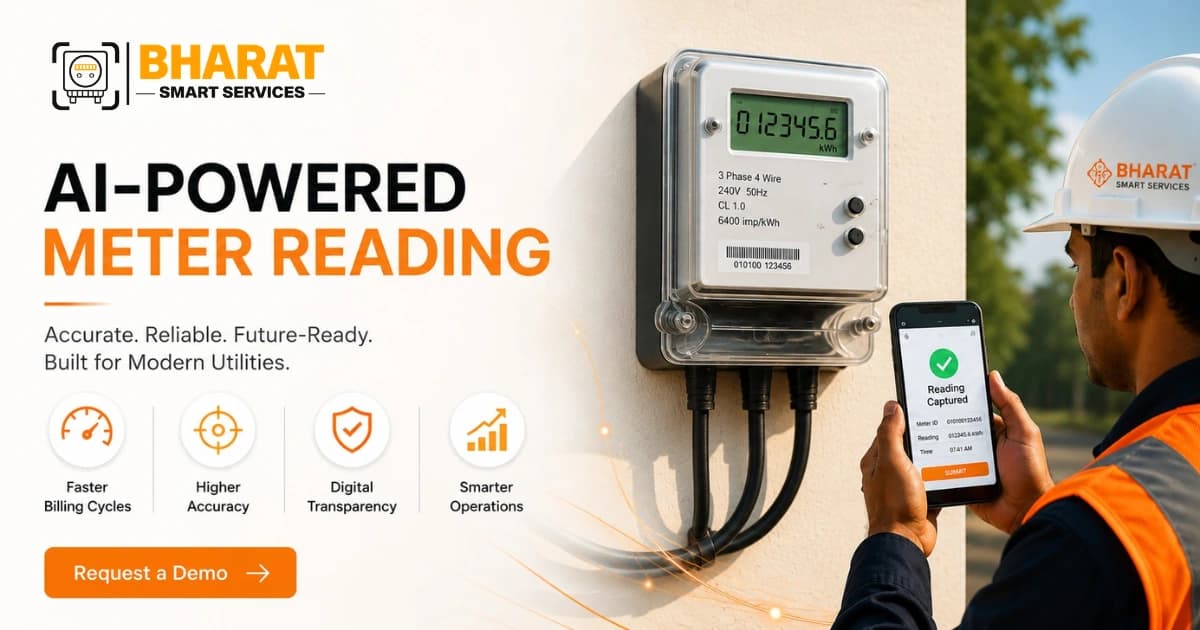
How Bharat Smart Services AI-Powered OCR Meter Reading Helps Field Workers
India's electricity distribution runs on field workers. Every day, meter readers cover hundreds of consumer points — across narrow lanes, high-rise buildings, and remote rural stretches — armed with nothing but a register and a pen.
The cost of that dependency shows up in every billing cycle. Misread digits, skipped meters, illegible entries, disputed bills. These are not rare failures. They are routine.
Field Operations
Bharat Smart Services ā Field Workforce & Operations ā 5 min read
Bharat Smart Services replaces this with AI-powered OCR meter reading technology giving field workers a faster, more accurate way to work, and giving DISCOMs the data quality they need to bill right the first time.
99.9%
Reading Accuracy
4.5 Cr+
Monthly Meter Reads
21+
Utilities Trust Us
Zero
Revenue Leakage
Why field operations stay broken
Billing errors start in the field. A misread digit triggers a dispute that takes weeks to resolve. Multiply that across thousands of consumer points per cycle and the scale is clear.
The problem goes beyond accuracy. Route planning, site verification, workforce tracking — most DISCOMs still manage these through spreadsheets and end-of-day phone calls. There is no real-time view. Errors surface late, when they are hardest to fix.
Our Ai-Powered OCR Meter Reading Technology was built to solve this at the source.
What happens when a field worker scans a meter
The OCR technology turns any smartphone into a smart meter reader. When a field worker points the camera at a meter, the AI engine:
ā Reads the meter value — mechanical or digital — without manual input
ā Identifies meter type, serial number, and reading validity instantly
ā Detects blurry images, spoofed photos, and parameter mismatches on the spot
ā Flags consumption anomalies against the consumer's historical profile
ā Captures a geotagged, timestamped photo as verifiable field evidence
ā Syncs the validated reading directly to the billing system
No typing. No register. The scan takes seconds. With 99.9% reading accuracy and 4.5 crore+ meter reads processed every month, the platform is proven at scale.
How it cuts complexity in the field
No more transcription errors
The biggest source of billing disputes is the gap between what the meter shows and what the register records. Our smart meter reading technology removes that gap entirely. The camera reads the meter. The system records the value. Nothing passes through a pen.
Faster rounds
Manual meter reading involves two steps at every consumer point: observe, then record. Bharat Smart Meter Reading Technology collapses these into one. Workers scan and move. Rounds finish faster. Overtime drops.
Every meter reader tracked
Supervisors get live GPS tracking of all field personnel. Missed or skipped meters trigger instant alerts. Route optimisation ensures workers cover assigned areas in the most efficient sequence — no guesswork, no backtracking.
Productivity analytics and performance reports give operations managers full visibility without constant follow-up calls.
Anomalies caught on-site
When a reading is outside the expected range, the platform flags it while the worker is still at the premises. The worker can re-scan, check the meter, or log an anomaly immediately — not weeks later during billing review.
The AI engine also detects tampering, suspicious consumption patterns, and energy losses turning meter readers into the first line of revenue protection.
A built-in audit trail
Every reading captured through BharatSMR carries:
ā A geotagged meter photograph
ā GPS coordinates confirming the correct premises
ā A timestamp of when the reading was taken
ā The AI-captured value alongside the original image
Billing disputes get resolved in minutes, not weeks. Supervisors see live completion rates, anomaly flags, and field coverage all from a single dashboard. No registers to locate. No handwriting to decipher.
Built for Indian meter infrastructure
Our AI engine reads all types of digital meters. It handles the real conditions field workers face every day:
ā Low light and glare on meter glass
ā Dirt, moisture, or weathering on display panels
ā Legacy meters with non-standard digit fonts
ā Damaged or faded displays
ā Attempts to submit a photo of a photo — spoof detection built in
This is not a generic OCR tool adapted for utility use. It was built for this.
What this means for operations
When field accuracy reaches 99.9%, the effects go beyond the reading itself:
Billing accuracy
Fewer disputes, fewer correction cycles, zero revenue leakage from faulty reads.
Consumer trust
Accurate bills, on time, reduce payment delays and complaints.
Revenue assurance
Tamper detection and anomaly alerts prevent losses before they compound.
Workforce accountability
Every reader tracked, every meter covered, every round verified.
Our application runs on existing smartphones and integrates with billing and MDMS systems. No hardware rollout. No infrastructure overhaul. 21+ utilities across India are already operating this way.
Field workers carry the first and most important step in the billing cycle.
Give them a tool that reads accurately, guides efficiently, and documents automatically — and everything that follows gets better. Bharat Smart Services AI-powered OCR meter reading does exactly that.
Request a Demo →
BharatSMR is an AI-powered utility metering platform from Bharat Smart Services, trusted by 21+ utilities across India.
Read More ā
How AI-Powered Meter Reading Is Quietly Fixing India's Biggest Utility Problem
Picture this: a meter reader walks to a house, tries to check a meter placed behind a gate or in a dark corner, notes down the reading - maybe correctly, maybe not - and moves to the next one. Later, that number becomes the electricity bill. If the reading is wrong, the bill becomes wrong. If this keeps happening across thousands of consumers, it slowly turns into a major revenue problem for utilities.
utility Insight · 8 min read
By Bharat Smart Services | Meter Reading, Billing & Analytics Platform for Electricity · Water · Gas Utilities
5 Yrs
Years of Excellence
4.5 Cr
Meter Reads / Month
99%+
Performance Excellence
21+
Utility Partners Across India
This is not just a random situation. This is still how meter reading works in many places across India today.
"After 5 years of working with electricity, water, and gas utilities, we've processed 4.5 crore meter reads every month - and we know exactly where the system breaks down."
— Bharat Smart Services
The discussion around DISCOM meter reading automation is no longer about "Should we move to AI?" Now the real question is: Which platform can actually work in Indian field conditions and at Indian scale?
The Real Cost of Getting Meter Reading Wrong
Ask any utility team about AT&C losses, and you will immediately understand how serious the issue is. While technical losses are difficult to avoid completely, commercial losses caused by billing mistakes, skipped readings, meter tampering, and manual errors can definitely be reduced.
Traditionally, meter reading in India depends heavily on manual processes. But inside this process, human errors can happen at many stages:
š¢
Misread Digits
One wrong digit changes the entire bill
š
Wrong Entry
Manual data entry errors compound daily
š«
Skipped Meters
Inaccessible meters are simply missed
The need to reduce AT&C losses in India's utility sector has become more important than ever. And this problem cannot be solved simply by increasing manpower or supervision. Utilities need intelligent technology.
What OCR Meter Reading Actually Does — and Why AI Makes the Difference
OCR meter reading is not something completely new. But AI has fundamentally changed how it works.
Basic OCR
Simply reads digits from a meter image. Useful, but provides no validation, no fraud detection, no quality checks. What comes in, goes to billing.
AI-Powered OCR Meter Reading - Bharat smart Services
Validates image genuineness, cross-checks against historical consumption, flags anomalies, detects spoofed photos, and integrates with billing — before any data is accepted.
In simple words, AI is not only reading the meter — it is also validating whether the reading can actually be trusted. This becomes extremely important in India because field conditions are variable and deliberate manipulation is always a real concern.
How Bharat Smart Services Is Solving This Problem
A complete platform built for Indian utility operations — not adapted, designed from scratch.
AI-Powered Meter Reading — 100% Accuracy at the Point of Capture
When a field agent captures a meter image, the AI system does not simply extract the digits. It validates the entire reading process instantly — before the reading enters the billing cycle.
ā
Image clarity check
ā
Meter genuineness
ā
Historical validation
ā
Spoof detection
ā
Exception flagging
ā
Instant validation
This is what makes our OCR meter reading SDK in India different — a complete validation system, not just image reading.
Check Meter Reading — Instant Verification, Anytime
Sometimes utility teams need immediate verification of a particular reading. Our Check Meter Reading feature allows utilities to instantly verify any meter reading whenever required — helping teams resolve consumer complaints faster, cross-check suspicious entries, and reduce billing disputes before they grow bigger. It may look like a simple feature, but operationally it saves a huge amount of time and effort.
Self Meter Reading for Consumers — Empowerment That Builds Trust
Our smart meter reading app for utilities allows consumers to submit their own meter readings through the app. Consumers simply capture the meter image, upload it, and view the expected bill instantly. The same AI validation applies — so utilities maintain accuracy while consumers gain transparency.
Result: Instead of consumers feeling disconnected from billing, they become active participants — reducing complaints before they even begin.
Bulk Photo Analysis — Scale Without the Chaos
Upload large batches of meter images and automatically receive structured outputs: meter values, serial numbers, and unit consumption data. The platform automatically identifies and flags problematic images:
ā Invalid images
ā Blurred image captures
ā Incorrect readings
ā Wrong parameters
ā Spoof attempts
ā Incorrect parameters
Supervisors only review flagged exceptions — making DISCOM meter reading automation practically scalable.
Consumer App & Portal — E-Billing with a Single Photo Upload
šø
Upload Photo
ā”
AI Validates
š
Bill Generated
No field visit. No paper bill. No delay between reading and billing. For utilities improving digital service delivery while reducing operational costs, this is a major advantage.
Real-Time Field Force Management — Every Meter Reader Tracked
Technology alone is not enough. Field operations also need visibility and accountability. Our platform provides real-time tracking and monitoring for the complete field force:
š GPS location of all meter readers in real time
š Automated route optimisation and scheduling
š Instant alerts for missed or skipped meters
š Individual and team productivity analytics
Real-Time Monitoring & Anomaly Alerts — Stay Ahead of Problems
Revenue leakage usually builds slowly through unnoticed irregularities — consumption anomalies, tampered meters, abnormal billing patterns. Our real-time monitoring system continuously analyses incoming data and triggers alerts whenever suspicious activity is detected.
The Shift This Creates
Instead of operating reactively — fixing problems after they've caused damage — utilities move towards proactive, alert-driven operations.
The Numbers That Matter
5 Years · 21+ Utilities · 4.5 Crore Reads a Month
21+
Utility Partners
4.5Cr
Reads / Month
99%+
Performance
Zero
Data Breaches
These are not just marketing figures. These are real operational numbers achieved through live deployments across Indian utility environments — electricity, water, and gas.
Utilities using our OCR meter reading SDK in India have moved from manual, complaint-driven billing systems towards intelligent, data-driven operations. This is what successful DISCOM meter reading automation looks like — a real platform that also helps utilities reduce AT&C losses in India in a measurable, demonstrable way.
A Closing Thought: Accurate Data Is the Foundation of Everything
Utilities invest heavily in infrastructure — transformers, substations, transmission systems, and network upgrades. But the data flowing through these systems — the meter readings that finally decide billing, revenue, and performance — is often still dependent on manual processes.
That gap creates
Billing disputes and consumer complaints
That gap creates
Revenue leakage quarter after quarter
That gap creates
Slow erosion of consumer trust
Improving meter reading is not just a small operational improvement anymore. Every improvement in billing efficiency, consumer service, compliance, and revenue recovery depends on one thing first: accurate field data.
At Bharat Smart Services, we have spent the last five years building a platform that helps utilities create that trust in data. Whether it is an electricity DISCOM trying to improve revenue recovery, a water utility modernising billing operations, or a gas utility improving field accountability — our smart meter reading app for utilities is designed specifically for Indian operational realities and Indian scale.
21+ utilities across India have already adopted this approach. And the shift towards intelligent utility operations has only just begun.
Get Started
Ready to Transform Your Utility Operations?
Join 21+ utilities already running on Bharat Smart Services · Electricity · Water · Gas
Talk to Our Team →
Bharat Smart Services | Empowering Utilities with Accuracy. Efficiency. Trust.
5 Years of Excellence · 4.5 Cr Meter Reads/Month · 21+ Utility Partners · Electricity · Water · Gas
Read More ā
Climate Yodha App - Helping Businesses Save on Electricity Bills, Helping You Earn Money
Earn real money by helping Telangana businesses reduce their electricity bills. No fees. No capital. Just your time, your network, and AI doing the heavy lifting.
Climate Yodha Team · 2025 · 5 min read · Earning App Zero Investment Telangana
Earn real money by helping Telangana businesses reduce their electricity bills. No fees. No capital. Just your time, your network, and AI doing the heavy lifting.
↓ Download on Google Play Store — Free
"What if you could earn money simply by helping someone else save money? That's not a riddle — that's exactly what Climate Yodha makes possible."
In a world flooded with promises of online earning without investment, most apps deliver nothing but disappointment. Climate Yodha by Bharat Smart Services is different — and here's why it matters.
Climate Yodha is a partner-focused mobile platform built for Telangana, connecting motivated individuals with Commercial and Industrial electricity consumers who are unknowingly overpaying on their power bills every single month.
How Does Climate Yodha Work?
The process is simple. Here's the full journey from sign-up to your first bank transfer.
1
Step 01 — Register
Download & Sign Up — Free
Download Climate Yodha from the Google Play Store and register. No fees. No hidden costs. Zero investment required from day one.
2
Step 02 — Learn
Get Trained & Certified
Built-in training modules teach you how electricity billing works in Telangana, what KVAH optimisation means, and how to spot excess units in a bill. Complete the training and earn your Climate Yodha Certification.
3
Step 03 — Field
Reach Out to Businesses
Visit shops, factories, commercial establishments — any business that pays electricity bills. Ask one simple question: "Are your electricity bills higher than they should be?" Most of the time, the answer is yes.
4
Step 04 — Analyse
Upload the Bill — AI Does the Rest
Use the app's AI/ML-powered tool. Upload the customer's bill and the app instantly identifies excess units, financial losses, and optimisation opportunities — no engineering knowledge needed.
5
Step 05 — Earn
Get Verified & Get Paid
Once the lead is verified, your earnings are transferred directly to your bank account. Transparent. Timely. Secure.
Why Climate Yodha Is Different
Most students searching for a no-investment earning app end up on platforms that pay peanuts for watching ads. Climate Yodha flips this model entirely.
ā¹
Zero Investment Required
You don't pay to join. You don't buy a kit. Your time, your network, and your willingness to learn are your only assets. This is a true earning app without investment.
š
Real, Skill-Based Earning
You're not clicking ads. You're learning energy efficiency, KVAH billing regulations, and AI-powered bill analysis — skills that actually matter in the real world.
ā±
Flexible Hours — Your Schedule, Your Rules
Whether you're a college student with 2 free hours a day or a professional looking for a side income, Climate Yodha adapts to you. Part-time or full-time — the choice is yours.
š¤
Backed by AI Technology
The app's AI/ML analysis does the heavy lifting. You don't need to be an energy engineer — the app tells you what's wrong with the bill. You just need to have the conversation.
š¦
Direct Bank Transfers
No wallets. No vouchers. No gift cards. Your earnings go straight to your bank account through secure, encrypted transfers.
Who Should Download Climate Yodha?
This app is built for anyone who wants online earning without investment and has the drive to make it happen.
š Students looking for part-time income between classes
ā” Electricians who already visit commercial establishments
š¤ Business networkers with existing industry contacts
š Field agents & service associates who love door-to-door work
š± Energy awareness volunteers passionate about climate impact
š¼ Channel partners & technicians seeking a new income stream
šØ‍š» Professionals wanting a side hustle without any financial risk
The Climate Angle — Why This Actually Matters
Most no-investment earning apps ask you to earn without contributing anything meaningful. Climate Yodha asks you to earn while making a difference. Excess electricity consumption isn't just expensive for businesses — it's damaging for the environment.
→Reducing energy waste in your community
→Helping local businesses become more financially sustainable
→Contributing to Telangana's energy efficiency goals
→Building climate awareness at the ground level, one bill at a time
Key Features at a Glance
Feature
What It Does
š¤ AI/ML Bill Analysis
Instant electricity bill extraction and analysis
š Smart Energy Insights
Identifies excess units and financial losses
ā” KVAH Optimisation
Compliant with Telangana electricity regulations
š Lead Management
Generate and track leads efficiently
š Training & Certification
Become a certified Climate Yodha partner
š Industry Outreach Support
Door-to-door earning framework
š¦ Secure Bank Transfers
Direct, transparent payouts to your account
š Multi-Language Support
Available in English and Telugu
š Your data is safe. Climate Yodha uses industry-standard encryption to protect all user information. KYC and personal data are used exclusively for verification and operational purposes. Your privacy is non-negotiable.
How to Get Started Today
You're six steps away from your first verified lead.
1
Visit the Google Play Store — search for "Climate Yodha" by Bharat Smart Services
2
Download and Register — completely free, no fees or hidden costs
3
Complete your training and earn your Climate Yodha Certification
4
Start reaching out to businesses in your area — shops, factories, commercial spaces
5
Upload bills using the AI analysis tool — identify excess units instantly
6
Generate verified leads and earn — direct bank transfer, every time
ā”
The Earning App Telangana Has Been Waiting For
It's not a get-rich-quick scheme. It's a structured, skill-building, impact-creating earning opportunity built on a real problem thousands of businesses face every month. The businesses are already losing money on their electricity bills. You could be the person who tells them — and gets paid for it.
Download Climate Yodha — Earn with Purpose
Available on Google Play · Telangana, India · Zero Investment Required
Read More ā
Climate Yodha DIY Kit: Best Educational Summer Activity for Kids in India
āļø
Summer 2026 — Limited kits available
Order now to receive your kit before summer holidays begin. Bulk orders for schools and housing societies welcome.
Climate Yodha Team · April 2026 · 6 min read · Ages 8–15 · STEM · Energy · Sustainability
Every summer, parents across India face the same question: What should my child do that's actually meaningful? Screen time is up. Outdoor play is shrinking. And most "educational summer activities for kids" feel like homework with a different cover. But what if your child could spend this summer learning a real skill — one that saves your family money, builds genuine scientific thinking, and turns into a habit that lasts well beyond the holidays?
That's exactly what the Climate Yodha DIY Kit is designed to do. It is one of the most purposeful educational summer activity kits for kids in India right now — not because it teaches children what to think, but because it gives them real tools to investigate, measure, and change something in their own home.
In this guide
What is the Climate Yodha DIY Kit?
What's inside the kit?
How does it work — 3 steps
The 6-month learning journey
Who is this kit for?
How it compares to other STEM kits
Frequently asked questions
How to get your kit
What Is the Climate Yodha DIY Kit?
The Little Climate Yodha DIY Kit is a hands-on, home-based STEM learning kit for children aged 8 to 15, created by Bharat Smart Services. It is not a toy. It is not a workbook. It is a real smart home device bundled with a structured 6-month activity programme — combining technology, environmental awareness, and practical science in a single package that any family in India can use together.
The idea behind the kit is simple but genuinely powerful: instead of telling children to switch off the lights, this kit lets them see exactly what a watt looks like, measure the electricity your family actually uses, and track whether their habits are making a real difference — all reflected on your next electricity bill. This is STEM education for kids that delivers a result the whole family can see.
What's Inside the Climate Yodha DIY Kit?
Here is everything your child receives when the kit arrives:
01 — Bharat Smart Plug
The star of the kit — a real Wi-Fi smart home device that connects to any standard household appliance (TV, fan, phone charger, table lamp, router) and displays live electricity usage on a phone app. Your child can also switch appliances on and off remotely. It is not a simulation. It is the same technology used in smart homes across India — and your child sets it up themselves.
02 — Climate Yodha Activity Book (6-Month Programme)
A structured activity book with monthly missions that run for a full six months. Each month, children read the electricity bill, log appliance usage, identify energy-wasting habits, set a family goal, and measure improvement. The same six missions deepen every month — building genuine awareness that outlasts any school holiday.
03 — Climate Yodha Branded Kit Bag
A kit bag that makes your child feel like a real energy detective from day one. Children are far more invested when they have a sense of identity around what they're doing — and carrying their kit matters.
04 — Plantable Pencil
Used to complete missions in the activity book, then planted in soil after use to grow into a plant. Sustainability made tangible — a memorable, concrete way to connect the dots between energy, environment, and daily choices.
05 — Kid-Friendly Explainer Videos
Short, engaging videos that explain what a watt is, how electricity bills are calculated, and why saving energy matters for the planet. Watched before the child even opens the box — setting up the learning context so the first mission feels exciting, not confusing. Parents often find themselves learning something new too.
How to Use the Kit — 3 Simple Steps
1
Watch and Learn
Your child starts with the explainer videos included with the kit. These cover foundational questions: What is a unit of electricity? How does your monthly bill get calculated? Why does a fan left on all day actually matter? These are designed for children — clear, visual, and under 10 minutes total.
2
Connect and Explore
A parent does the initial Wi-Fi setup — plugging the Bharat Smart Plug into a socket, connecting it to your home Wi-Fi via the Bharat Smart Services app, and pairing an appliance. This takes under five minutes and requires no technical knowledge. After the one-time setup, the child takes over completely — controlling appliances and tracking usage from the app, safely, with no wiring involved.
3
Track, Compare, Improve — for 6 Months
Every month for six months, your child works through the activity book: reading the electricity bill, logging which appliances used the most power, spotting wasteful habits using the smart plug data, and setting a family goal. Over time these check-ins become second nature — less like an assignment and more like a routine your child looks forward to.
The 6-Month Learning Journey
Most holiday activity kits for children in India are designed for a weekend — the excitement fades fast. The Climate Yodha kit is intentionally built to run for six months, because that is how long it actually takes for a new behaviour to become a permanent habit. Here is how the journey unfolds, month by month.
Month
What your child does
What changes at home
Month 1
Awareness
Meets the smart plug. Measures their first appliances. Sees watts for the first time.
Family becomes curious. Conversations begin about electricity at home.
Month 2
Understanding
Reads the electricity bill with a parent. Decodes units. Connects numbers to daily life.
The bill stops being a piece of paper. It becomes data.
Month 3
First changes
Identifies one wasteful habit. Sets a family challenge. Switches things off from the app.
Real changes start. Appliances get checked. First savings appear.
Month 4
Habits form
Daily routines — check usage, compare, switch off — become second nature.
The family follows the child's lead. Energy awareness spreads naturally.
Month 5
Consistency
Weekly comparisons stay steady. Savings turn from a hope into a visible pattern.
Lower electricity bill confirmed. Family celebrates the difference together.
Month 6
Results
Completes the 6-month programme. Reviews the full journey. Becomes a certified Climate Yodha.
A measurably smaller electricity bill. A proud child. A family that thinks about energy every single day.
Why 6 months? Research on habit formation consistently shows that behaviours need 60–90 days of consistent repetition before they become automatic. Most kids' summer activity kits are designed for a week. The Climate Yodha kit is designed to last — because the goal is not a summer project. It's a permanent shift in how your family uses energy.
Who Is the Climate Yodha DIY Kit For?
For children aged 8–15
This is a hands-on summer science activity for kids that builds real-world skills — analytical thinking, data reading, smart home technology, and the connection between daily actions and measurable outcomes. Children who use this kit don't just learn about electricity. They become the person in the household who does something about it.
If your child loves science experiments, gadgets, or anything hands-on, this kit was made for them. And even children who aren't particularly "into" science find it engaging once they realise they are controlling real appliances from a phone and watching live numbers change in real time.
For parents
Here is what makes this kit genuinely different from most summer holiday learning activities for children: it delivers value to the whole family. As your child works through the monthly missions, your household naturally becomes more energy-aware — appliances get switched off, usage patterns get examined, bills get read. Many families see a measurable reduction in their monthly electricity bills over the 6-month activity — not because anyone lectured them, but because a child took ownership of it.
For schools, housing societies, and summer camps
The Climate Yodha kit is available for bulk group orders — perfect for summer camps, apartment complex children's programmes, school holiday projects, and corporate CSR initiatives focused on sustainability education. Contact the team directly for bulk pricing.
How It Compares to Other STEM Kits for Kids
There are many good STEM kits available in India. Here is what makes the Climate Yodha kit different from the rest.
Climate Yodha Kit
Typical STEM kit
Duration
6 months
1–3 days
Uses real technology
ā Yes — actual smart plug
Mostly simulations
Delivers home savings
ā Reflected on electricity bill
No real-world impact
Continues after school restarts
ā 6-month programme
Ends with holidays
Parent-child activity
ā Designed for both
Typically solo child activity
Climate / sustainability link
ā Every mission connects
Rarely addressed
Frequently Asked Questions
Is the smart plug safe for children to use?
Yes. The Bharat Smart Plug is a standard household smart device — the same type used across Indian homes. Your child interacts with it entirely through the phone app, not by touching any electrical connections. A parent handles the one-time physical setup, which takes under five minutes. After that, all interactions are through the app — safe, remote, and with no wiring involved.
Does it need a Wi-Fi connection at home?
Yes — the Bharat Smart Plug connects to your home Wi-Fi to send data to the app. A standard 2.4 GHz Wi-Fi connection is all that's needed. If you are unsure of your connection type, most home routers in India support 2.4 GHz by default.
Which appliances can the smart plug monitor?
Any standard appliance that plugs into a wall socket — fans, table lamps, phone chargers, TVs, routers, small air coolers, and more. Note that the smart plug is not designed for very high-load appliances like geysers, air conditioners, or washing machines when used by children as part of this kit. For the activity book missions, lower-wattage appliances work best and produce the clearest data for learning.
What if my child loses interest after the first month?
The activity book is designed to keep each monthly mission short — typically 20–30 minutes — so it never feels overwhelming alongside school or other activities. The missions build on each other, and most children find that by Month 3, when they start seeing real changes on the electricity bill, motivation increases naturally. The smart plug stays connected to the app, so even a 5-minute daily check becomes the habit that holds it together.
Can this kit be used by multiple children in the same household?
Absolutely. Siblings can work through the activity book together or take turns as the "lead Climate Yodha" for each month. The smart plug and app support the whole household — and having two children engaged in the missions typically makes the family impact even stronger.
How to Get the Climate Yodha DIY Kit
The kit is available directly at summercamp.climateyodha.com with secure Razorpay checkout. Schools, housing societies, summer camps, and corporate CSR teams can submit a bulk order request on the same page.
Contact options
WhatsApp (queries)
+91 72870 30303 — for questions before purchasing. Response within 24 hours.
Bulk orders
Schools, societies, and camps — WhatsApp or submit the bulk request form on the website.
Delivery
Pan-India shipping. Order at least 5–7 days before summer holidays begin to ensure timely delivery.
Give Your Child a Summer That Actually Means Something
Summer 2026 is an opportunity. Your child has weeks of unstructured time, a curious mind, and the capacity to learn far more than any textbook allows — if given the right environment and the right tools. The Climate Yodha DIY Kit doesn't teach children what to think about electricity. It gives them the tools to investigate it themselves, measure it, change it, and feel the pride of results they created.
By the time the six months are up, the smart plug is still in your home, the habits are embedded, and your child has completed a structured programme they can genuinely be proud of — one that shows up every month as a lower number on your electricity bill. That shift in identity, from passive observer to active problem-solver, is the most valuable thing any summer activity can create.
ā”
Your child's first watt is waiting.
Order the Climate Yodha DIY Kit before summer begins. Limited kits available for Summer 2026.
Get Your Kit at climateyodha.com
Bulk orders for schools & housing societies available · WhatsApp: +91 72870 30303
Read More ā
Power Factor Correction Services in Telangana
BSS Energy Team · April 2026 · 8 min read · Power Factor
Across factories, manufacturing units, and commercial buildings in Hyderabad, one charge quietly inflates electricity bills month after month — not the units consumed, not the tariff rate, but a penalty for poor power factor. Most businesses paying this penalty have no idea it is there, or that power factor monitoring & correction services in Telangana can eliminate it entirely.
At Bharat Smart Services, we have worked with industries across Telangana who were paying 15-30% more on their electricity bill purely because of power factor issues - problems that had a clear technical solution they simply were not aware of. This guide explains what power factor is, why a poor PF costs you money, and exactly how power factor correction services in Telangana work, from root cause analysis through to APFC panel installation and long-term monitoring.
20–30%
Average bill reduction after PF correction
Near to Unity PF
Target power factor we deliver
7 Steps
Structured correction process
In this guide
What is power factor and why does it matter?
Identifying the root cause of your high electricity bill
Electricity bill optimisation services
PF monitoring services — staying optimised 24/7
The role of APFC panel installation
Our 7-step power factor correction process
Benefits and why choose BSS
What Is Power Factor — and Why Does It Matter for Your Bill?
Power factor (PF) measures how efficiently your electrical system converts incoming power into actual useful work. It is expressed as a number between 0 and 1, a value of 1.0 means every unit of electricity drawn is doing productive work. A value of 0.75 means 25% of the current drawn is wasted as reactive power, producing heat and losses without delivering any useful output.
For industries and commercial establishments in Telangana, a low power factor has two direct financial consequences. First, TGSPDCL and TGNPDCL levy a power factor penalty in Telangana when PF falls below 0.85 this penalty alone accounts for 15–30% of total electricity bills for many industrial consumers. Second, because your electrical infrastructure is carrying more current than needed, cables, transformers, and switchgear wear faster and fail sooner than they should.
Industry insight: A power factor below 0.85 typically triggers financial penalties from Telangana's electricity distribution companies. Many businesses are unaware that these penalties can account for 15–30% of their total electricity bill - a charge that disappears entirely after professional reactive power correction.
What causes poor power factor?
Poor power factor is almost always caused by inductive loads — the motors, transformers, welding machines, air compressors, and UPS systems that are standard equipment in any industrial or commercial facility. These loads draw reactive current from the grid in addition to the active current that does actual work. Over time, as equipment ages or new loads are added without reassessing the electrical system, power factor drifts downward and the penalty charges begin to accumulate. This is why reactive power correction is not a one-time fix — it requires ongoing monitoring to stay effective.
Identifying the Root Cause of Your High Electricity Bill
Before recommending any solution, the BSS team performs a structured Energy audit - root cause analysis of your electricity bill. This is one of the most overlooked - and most valuable - steps in any energy efficiency programme. Installing capacitors without first understanding why your power factor is poor often leads to overcorrection, harmonic problems, or a partial fix that doesn't fully eliminate the penalty.
Our engineers combine power quality measurement, harmonic analysis, and load profiling to identify what is actually driving your bill upward. The common causes we find include:
ā
Poor power factor from inductive loads - motors, transformers, welding machines, UPS systems
ā
Unbalanced loads causing neutral current and additional distribution losses
ā
Harmonic distortion from VFDs, drives, and non-linear loads distorting waveforms
ā
Malfunctioning APFC panels failing to switch capacitor banks correctly — a common finding in Telangana industries
ā
Time-of-day consumption patterns triggering peak demand charges on top of PF penalties
ā
Oversized or undersized capacitor banks not matched to actual operational load
ā
Leakage currents and cable losses from ageing or undersized wiring
The output of this Energy Audit is a precise, documented diagnosis — not a guess. Every recommendation we make is backed by measured data, which means the solution addresses the actual problem rather than applying a generic fix and hoping for results.
Electricity Bill Optimisation Services — Beyond Just Capacitors
True electricity bill optimisation is not about installing one component and walking away. It requires understanding your entire electrical ecosystem — how loads interact across shifts, how demand peaks form, and where penalty charges are actually generated. The BSS bill optimisation programme is built around this complete picture.
Our structured programme includes:
ā
Detailed energy audit and bill analysis across 6–12 billing cycles
ā
Identification of every penalty component — PF penalty, TOD penalty, MD penalty, and reactive energy charges
ā
Load scheduling recommendations to reduce maximum demand charges
ā
Reactive power compensation through custom APFC panel design and installation
ā
Harmonic filtering where distortion is found to be contributing to losses
ā
Month-on-month reporting so you can track and verify savings directly against your TGSPDCL bills
Client result — Hyderabad industry
After implementing our electricity bill optimisation service, an industrial client in Hyderabad reduced their monthly electricity expenditure by ā¹1.2 lakhs within the first billing cycle — purely through power factor correction and load rebalancing. No new equipment, no production changes. Just a corrected electrical system. know more ..
PF Monitoring Services — Staying Optimised 24/7
Installing a power factor correction system is only the first step. Power factor drifts as loads change - when new equipment is added, when seasonal HVAC patterns shift, or when a capacitor bank fails silently. Without continuous PF monitoring services, your power factor can drop below the penalty threshold within weeks of installation and you won't know until the next bill arrives.
BSS deploys advanced monitoring infrastructure that provides real-time visibility into your system's health - keeping your power factor correction in Telangana effective long after the initial installation is complete.
What our PF monitoring covers
ā
Real-time PF meters with digital display and continuous data logging
ā
RS485 communication-enabled controllers for remote monitoring and SCADA integration
ā
Automated alerts the moment PF drops below your target threshold — via the BSS app
ā
Monthly performance reports with trend analysis — track PF health and predicted penalty risk
ā
Preventive maintenance scheduling based on live monitoring data — before failures cause penalty charges
Why monitoring matters: One of the most common failure scenarios we encounter is an APFC panel that appears functional but has one or two capacitor banks silently out of service. The panel stays switched on. The display shows it is running. But power factor has dropped to 0.78 and the power factor penalty in Telangana is building up month after month, invisible until the bill arrives. Continuous PF monitoring services catch this within minutes, at the moment - not waiting for the next bill.
The Role of APFC Panel Installation in Long-Term Power Factor Correction
An Automatic Power Factor Correction (APFC) Panel is the core technology that makes sustained power factor improvement possible. Unlike fixed capacitor banks, an APFC panel continuously monitors your electrical load and automatically switches capacitor banks in or out to maintain the target power factor — without human intervention, across every shift, every hour of the day.
BSS carries out APFC panel installation in Hyderabad and across Telangana, sizing every panel specifically to the load profile of your facility. Our panels are built to standards and fully tested before installation to ensure reliable, long-term operation.
Key components of the APFC panel
ā
Power Factor Controller: The intelligent brain that measures PF in real time and sends switching commands to capacitor banks
ā
Capacitor Banks: Fixed or variable banks that inject reactive power as needed to maintain the target PF
ā
Thyristor/Contactor Switches: Fast-switching elements for precise connection and disconnection of capacitor stages
ā
Power Factor Meter: Displays live PF readings and records historical data for trend analysis
ā
Protection Devices: MCBs, fuses, and surge arrestors safeguarding panel components from voltage spikes and overloads
Unlike generic off-the-shelf panels, every APFC panel installation in Hyderabad completed by BSS is custom-sized to the specific reactive power demand of your facility. This ensures the panel neither overcorrects (which creates its own problems) nor undercorrects (which leaves the penalty in place).
Our 7-Step Power Factor Correction Process
Every power factor correction project in Telangana that BSS undertakes follows a structured seven-step methodology — ensuring the solution is accurate, durable, and delivers the savings we project.
01
System Analysis & Root Cause Identification
Our engineers evaluate your electrical system, review historical TGSPDCL/TGNPDCL bills, identify all inductive loads, and diagnose the root causes of poor power factor and excess charges. This analysis is the foundation everything else is built on.
02
Power Factor & Power Quality Monitoring Setup
We install monitoring devices (or it can be done through capturing meter readings daily) to capture real-time data on PF levels, harmonic content, voltage, current, and demand patterns across your facility.
03
Custom Solution Design
Based on the analysis, we design a tailored reactive power correction solution — selecting the right APFC panel size, capacitor bank configuration, and harmonic filtering (where needed) for your specific load profile. No off-the-shelf panels. No guesswork.
04
APFC Panel Installation
Our certified technicians complete the APFC panel installation in Hyderabad and across Telangana with precise cabling, proper earthing, and full protection as per IS 13925 guidelines. Every installation is documented with a commissioning report.
05
Power Factor Controller Integration
We programme the PF controller with your target setpoint and configure RS485 communication for remote monitoring - laying the groundwork for continuous PF visibility through the BSS app.
06
Testing, Commissioning & Optimisation
The system is fully tested under live load conditions. Fine-tuning ensures smooth capacitor switching, prevents overcorrection, and confirms that the power factor penalty in Telangana is fully eliminated before we hand over.
07
Ongoing Monitoring, Maintenance & Support
Scheduled maintenance visits, remote monitoring via RS485 and the BSS app, and quarterly performance reports ensure you stay optimised year-round. This is where reduce electricity bill Telangana becomes a permanent outcome, not a one-time result.
What Power Factor Correction Delivers for Your Business
The benefits of professional power factor correction in Telangana extend well beyond eliminating the penalty line on your bill. Here is what changes across your facility after a complete correction and monitoring system is in place.
Benefit
What it means for your business
Reduced electricity bills
Eliminate PF penalty charges. Cut reactive energy costs by 20–30%. Results visible from the first billing cycle.
No more utility penalties
Stay fully compliant with TGSPDCL/TGNPDCL PF norms. No surprise excess charges on your next bill.
Extended equipment life
Stable voltage and lower current reduces thermal stress on motors, transformers, and switchgear.
Improved voltage stability
Better voltage profile across the facility, protecting sensitive CNC, control, and instrumentation equipment.
Lower maintenance costs
Fewer breakdowns and reduced thermal degradation of cables — directly lowering your maintenance expenditure.
Higher system capacity
Releasing reactive current frees up transformer and feeder capacity — delay costly infrastructure upgrades by years.
Why industries across Telangana choose Bharat Smart Services
ā
Telangana-focused expertise: Deep knowledge of TGSPDCL/TGNPDCL tariff structures, penalty regulations, and kVAh billing implications
ā
End-to-end service: From audit and root cause analysis to APFC installation, PF monitoring, and ongoing support
ā
Custom-engineered solutions: Every APFC panel sized and configured for your specific load profile
ā
BSS app integration: Live PF tracking, demand alerts, and bill projection on your phone — every day, not once a month
ā
Transparent ROI reporting: We quantify your savings every month so you can see the impact directly against your TGSPDCL/TGNPDCL bill
Is Your Electricity Bill Higher Than It Should Be?
Get a free technical consultation and root cause analysis from Bharat Smart Services.
We will identify every excess charge, explain what is causing it, and tell you exactly how much you can save — free, within 48 hours. No commitment required.
Get Your Free Energy Audit
www.bharatsmartservices.com | contact@bharatsmartservices.com | Hyderabad, Telangana
Read More ā
How to Reduce MD Penalty in Electricity Bill
Would you believe you're paying for electricity you're not even using?
A printing press in Jeedimetla, Hyderabad, had been running well for years. Machines were operating regularly. Orders were coming in. Business was stable. But every month, the electricity bill was higher than expected and nobody in the business could explain why. The owner had asked his electrician. He had called the billing office. He had compared this month's bill to last month's. The units consumed looked roughly the same. Yet the bill kept swelling.
When the Bharat Smart Services team analysed their electricity bill, they found not one problem but two — sitting quietly on the same bill, draining money every single month.
Real case — Printing press, Jeedimetla, Hyderabad
ā
Problem 1 — Power factor penalty: Due to reactive energy (kVArh) charges going unmonitored, the press was paying ā¹85,000 excess per month.
ā
Problem 2 — MD penalty: Their sanctioned load was 200 kVA but actual usage was only 50–60 kVA. The gap between sanctioned and actual load was triggering demand charges every month — another ā¹80,000 excess per month.
Total excess per month: ā¹1,60,000
In one year: nearly ā¹19 lakhs — paid for electricity problems, not electricity.
Bharat Smart Services resolved this in two steps - corrected the power factor and helped revise the sanctioned load to match actual usage. The electricity bill was almost cut in half. The problem was never the electricity. The problem was the lack of monitoring.
If you are reading this as a factory owner, a plant manager, or a business running on a commercial electricity connection in Telangana, this guide will show you exactly what MD penalty is, why it keeps appearing even when your usage hasn't changed, and how to make it stop.
In this guide
What is MD penalty in an electricity bill?
Why MD penalty keeps coming even when usage is the same
How to identify when your demand is crossing, before the bill arrives
How to reduce and avoid MD penalty in Telangana
Frequently asked questions
What Is MD Penalty in an Electricity Bill?
MD stands for Maximum Demand. Not your total monthly consumption, that is the kWh or kVAh figure on your bill. Maximum Demand is specifically the highest instantaneous power load your facility pulls from the grid, measured as an average over any 15-minute window during the billing month. It is measured in kVA (kilovolt-amperes).
When you got your electricity connection, you declared a Sanctioned Load — also called Contracted Demand. This is the maximum power your premises is authorised to draw at any point. Think of it as the lane you booked on a highway. The penalty kicks in the moment you drive outside that lane, even for 15 minutes, even once. Even if every other hour of the month was perfectly within limits.
But - and this is what the printing press in Jeedimetla discovered the hard way ,the penalty can also come from the opposite direction. If your sanctioned load is far higher than what you actually use, you are still billed for a minimum percentage of that sanctioned load every month. That gap between what you contracted and what you actually consume quietly inflates your bill regardless of how efficiently you operate.
"Their sanctioned load was 200 kVA. Their actual usage was 50–60 kVA. Nobody had ever reviewed the mismatch. The bill was quietly reflecting that gap every single month."
Who is affected by MD penalty?
MD penalty applies to commercial and industrial consumers, anyone on a three-phase connection, LT-III industrial category, or any HT (High Tension) connection under TGSPDCL or TGNPDCL. Factories, printing presses, warehouses, hospitals, hotels, IT parks, cold storage units, and large commercial complexes are all in scope. If your electricity bill exceeds ā¹50,000 per month, there is a good chance MD charges are contributing to it and an equally good chance you have never fully scrutinised that line item.
Why MD Penalty Keeps Coming Even When Usage Is the Same
This is the most common frustration: consumption is the same, production is the same, and the MD penalty keeps reappearing. That is because MD penalty has almost nothing to do with how much electricity you use and everything to do with how you use it and in some cases, how much you contracted for years ago. There are four specific patterns behind this.
Sanctioned load set too high for actual operations
This was the second problem the Jeedimetla press faced. Their sanctioned load of 200 kVA was set when the business first got its connection, possibly with future expansion in mind, or simply without careful calculation of actual requirements. Years later, actual usage was 50–60 kVA. Under TGSPDCL/TGNPDCL billing rules, you are charged for a minimum percentage of your contracted demand every month regardless of what you actually consume. That means the press was paying demand charges on 140–150 kVA of capacity it never used. Every month. For years.
Poor power factor inflating your kVA demand
Maximum demand is measured in kVA, not kW. Power factor is the ratio between the two. When your power factor drops due to ageing motors, failing capacitors, or heavy inductive loads, your kVA demand rises even though your actual productive consumption in kW stays the same. A facility running at 0.75 power factor is drawing 33% more kVA than the same facility at 1.0 power factor. That invisible 33% can push your recorded demand above your contracted limit every month. The press in Jeedimetla was paying ā¹85,000 per month on reactive energy charges alone before this was identified and corrected.
The morning startup surge
When the shift begins and multiple motors, compressors, and HVAC units start simultaneously, each machine draws 3 to 6 times its normal running current during startup. If this happens within the same 15-minute window, the meter records it as your peak demand for the entire month. By 9 AM everything is running normally but the spike has already been captured and your MD is set for the full billing cycle.
No visibility until the bill arrives
Most facilities have no real-time view of their demand curve. Nobody knows in the moment that demand has crossed the contracted limit. By the time the bill arrives and someone investigates, the event is three weeks old. There is no log of which machines were running, no timestamp of the spike, and no way to prevent the same thing from happening next month. The penalty repeats. The frustration continues. Nothing changes,because there is no data to act on.
How MD Penalty Is Calculated
The calculation has three moving parts: your Sanctioned Load (Contracted Demand), your Recorded Maximum Demand (RMD), and the penal rate that applies to the excess. Here is how it works.
How to Identify When Your Demand Is Crossing — Before the Bill Arrives
The core problem with MD penalty is not that it is unavoidable. It is that most businesses find out about it weeks after it happened. The bill arrives on the 5th of the month. The spike that triggered it happened on the 14th of the previous month. By then, there is no recourse — only payment and the hope it doesn't happen again. Without real-time visibility, that hope is all you have.
This is exactly the gap the Bharat Smart Services app and the Bharat Bijli Auditor are built to close.
Live demand monitoring — know the moment you're about to cross
The Bharat Bijli Auditor monitors your facility's demand continuously — every 15 minutes, exactly as TGSPDCL's/TGNPDCL's meter does. The difference is that you see it in real time, not at the end of the month. You can set a demand alert threshold just below your contracted limit — say, 180 kVA if your sanctioned load is 200 kVA. The moment your live demand approaches that threshold, you and your team receive an immediate alert on the Bharat Smart Services app.
That alert gives you a window typically 10 to 12 minutes of the current 15-minute interval to take action. Switch off a secondary compressor. Defer a pump startup. Pause a non-critical batch process. Any load-shedding that brings demand back below the threshold within that window means the spike is never recorded, and the penalty is never charged. You intervened before the meter captured it.
How BSS demand monitoring prevents MD penalty — step by step
1
Bharat Bijli Auditor is installed at your facility and connected to your main incomer. It begins tracking your demand curve in real time, logging every 15-minute interval exactly as the TGSPDCL meter does.
2
You set your demand alert threshold on the BSS app typically 85–90% of your sanctioned load. The app monitors this threshold continuously throughout the day, across every shift.
3
When demand approaches the threshold, you receive an instant push notification on your phone and your plant supervisor's phone. You have a live view of exactly which loads are running and how much each is drawing.
4
Your team sheds a non-critical load — pauses a secondary compressor, defers a pump, reschedules a batch process before the 15-minute window closes. Demand drops below the threshold.
ā
The spike is never recorded. The penalty is never charged. The next month's bill reflects a clean demand figure — within your sanctioned load, no excess charges.
Daily bill tracking — one minute a day keeps the bill shock away
Beyond demand alerts, the BSS app gives you a daily consumption view of your facility — breaking down energy usage by appliance and load category, showing your projected monthly bill based on current usage, and flagging anomalies before they accumulate. This is the "one minute daily" habit behind the BSS Zero Excess Bill movement: spending 60 seconds each morning reviewing your consumption dashboard tells you immediately if something is running that shouldn't be, or if a load pattern has changed overnight.
For the printing press in Jeedimetla, this kind of daily visibility simply didn't exist. The problem was building month after month without anyone knowing. With the BSS app, the same scenario would have surfaced within days — the power factor anomaly visible in the reactive energy trend, the demand pattern showing consistent proximity to the contracted limit — and both problems could have been addressed long before they compounded into ā¹1,60,000 of monthly excess.
How to Reduce and Avoid MD Penalty in Telangana
Reducing MD penalty is not about consuming less electricity. It is about consuming it more intelligently — and starting from an accurate picture of what your sanctioned load should actually be. Here are the five steps that work, in the order you should address them.
Step 1 — Get a free bill analysis first
Before changing anything, understand exactly where your excess charges are coming from. This is where BSS starts with every client. Upload your last 3–6 months of TGSPDCL/TGNPDCL bills to the BSS app or share them through our free consultation. Our team reviews the bill line by line — identifying whether the excess is from MD penalty, power factor charges, incorrect tariff category, or a mismatch between sanctioned and actual load (as was the case with the Jeedimetla press). The analysis is free, takes 24–48 hours, and gives you a clear breakdown of what you are overpaying and why.
Step 2 — Fix power factor — it is almost always the biggest lever
If your power factor is below 0.90, correcting it reduces your kVA demand without touching production. This means checking whether your APFC (Automatic Power Factor Correction) panel is functioning properly — not just switched on, but actively switching capacitor banks as load changes. In Telangana's kVAh billing environment, poor power factor hits you twice: in energy charges and in demand charges simultaneously. The Jeedimetla press was paying ā¹85,000 per month on reactive energy alone. Fixing the capacitor bank eliminated that charge in the very next billing cycle.
Step 3 — Right-size your sanctioned load
If your actual maximum demand is consistently 50–60 kVA but your sanctioned load is 200 kVA, you are paying demand charges on 140 kVA of unused capacity every month. Apply to TGSPDCL to revise your contracted demand to match actual usage — with a reasonable buffer of 15–20% for occasional peaks. BSS can prepare the load schedule documentation required for this application and calculate the exact sanctioned load figure that minimises your total bill, accounting for the 75% minimum billing clause. The press in Jeedimetla applied this fix and saw their demand charges drop dramatically in the very next cycle.
Step 4 — Stagger your equipment startup times
Create a written startup sequence for each shift. Never start more than one large motor, compressor, or HVAC unit within the same 5-minute window. This single zero-cost change eliminates the startup surge that sets monthly MD peaks. Post the sequence next to the main switchboard and train every shift supervisor on it. Combined with real-time demand alerts from the BSS app, your team will know exactly when to hold a startup and when it is safe to proceed.
Step 5 — Move non-critical heavy loads to off-peak windows
Identify processes that must happen but do not need to run during your production peak hours — water heating, pumping cycles, refrigeration defrost, certain grinding or mixing operations. Reschedule them to early morning before the main shift or late night. This flattens your demand curve and reduces the probability of hitting your contracted limit during the hours when your core machines are already drawing heavily.
Telangana-specific rule: Under TGSPDCL's/TGNPDCL kVAh billing system for HT consumers, poor power factor increases both your energy charges and your kVA demand simultaneously. This means industries in Telangana face high electricity bills. Fixing power factor is not optional here — it is essential. If you are unsure whether your connection is billed on kVAh, the free BSS bill analysis will confirm this within 24 hours.
Frequently Asked Questions
How do I know if my business is paying MD penalty right now?
Look at your TGSPDCLTGNPDCL bill for a line item labelled "Excess Demand Charges," "MD Penalty," or "Excess kVA Charges." If you see any of these — or if your demand charges seem disproportionately high relative to your consumption — share your bill with BSS through the free analysis. Our team will identify within 24 hours whether you are paying a penalty, by how much, and what is causing it.
Can I get an MD penalty reversed?
In most cases, no — if the meter has legitimately recorded excess demand. However, if the spike was caused by a grid-side voltage surge or a meter fault rather than your own equipment, you can raise a billing dispute with TGSPDCL/TGNPDCL and request a technical investigation. Having your own monitoring data from inside the facility the kind the BSS Bijli Auditor provides is the strongest evidence in this situation.
How quickly will the bill reduce after taking action?
Power factor correction shows results in the very next billing cycle. Sanctioned load revision takes a few weeks to process with TGSPDCL/TGNPDCL but takes effect from the month it is approved. Load scheduling changes stabilise within one to two cycles. Most clients who address all three see a measurable reduction in their electricity bill within 60 days — similar to the Jeedimetla press whose bill was nearly cut in half.
Is MD penalty the same as power factor penalty?
They are separate charges but closely connected. Power factor penalty is levied when your average power factor falls below the required threshold. MD penalty is levied when your peak demand exceeds your contracted limit. However, poor power factor directly inflates kVA demand — so fixing power factor frequently reduces or eliminates both penalties at the same time, as it did for the printing press in Jeedimetla.
Could Your Business Also Be Leaking Money Silently?
The printing press in Jeedimetla was a well-run business. Good orders, regular operations, a careful owner. And yet ā¹1,60,000 was leaving the account every month through two lines on a bill that nobody had ever fully read. Nearly ā¹19 lakhs in a year — not on operations, not on growth, not on staff. On electricity problems that had a solution.
The problem was not the electricity. The problem was the lack of monitoring. With real-time demand visibility on the BSS app and a free bill analysis that took 24 hours, both problems were identified, both were fixed, and the bill was almost halved. That same process is available to any industry or business in Telangana starting with a free review of your last three months of TGSPDCL/TGNPDCL bills.
If your factory, warehouse, press, or commercial facility is paying more than ā¹50,000 per month on electricity — there is almost certainly something in that bill worth finding. The first step costs nothing.
Get Your Free Electricity Bill Analysis
Share your last 3 TGSPDCL/TGNPDCL bills. We'll identify every excess charge, explain what's causing it, and tell you exactly how much you can save — free, within 48 hours.
Start Your Free Bill Analysis
Read More ā
Is Your Electricity Bill Higher Than It Should Be? Here's What an Energy Audit Can Do for You
You open your electricity bill. The number stares back at you - higher than last month, higher than the month before. You haven't changed anything. No new appliances. No extra usage. And yet, somehow, the bill keeps climbing.
If this sounds familiar, you're not alone. Across homes, offices, and factories in Hyderabad and Telangana, consumers are paying hundreds - sometimes thousands - of rupees more than they need to every month. Not because they're using more electricity, but because they don't know where it's quietly leaking away.
That's exactly what an electricity audit is designed to fix.
What Is an Electricity Audit, and Why Does It Matter?
An electricity audit (also called an energy audit) is a structured examination of how your home, office, or facility consumes power. Think of it the way you'd think of a health check-up. You don't wait until you're seriously ill to see a doctor. You get a check-up to catch small problems before they become big ones. An energy audit does the same thing for your electricity consumption.
During an audit, a trained technician reviews your electricity bills over the past 6 months, inspects your appliances and equipment, measures live energy consumption, identifies inefficiencies, and gives you a clear, actionable report on exactly where your money is going and how to stop wasting it.
Did you know? Studies show that homes and businesses implementing audit recommendations typically reduce their electricity bills by 10–30%. For an industrial unit in Telangana paying ā¹2–3 lakh per month, a 20% reduction means ā¹40,000–ā¹60,000 saved every month.
What Happens During an Electricity Audit in Hyderabad?
If you've been searching for electricity audit services in Hyderabad, you may be wondering what the process actually involves. Here's what a proper audit covers.
Step 1 — Bill analysis
Your auditor reviews 5–6 months of electricity bills. They look for unusual spikes, check whether your consumer category (domestic, commercial, or industrial) is correctly assigned under TGSPDCL, and identify months where your consumption jumped without an obvious reason.
Step 2 — On-site inspection
A trained energy consultant visits your premises and inspects every major load — air conditioners, motors, geysers, lighting, pumps, and standby equipment. They measure actual running consumption against rated capacity to identify appliances that are consuming far more than they should.
Step 3 — Power quality check
For commercial and industrial consumers, this is critical. Issues like low power factor, voltage fluctuations, and harmonic disturbances silently inflate your bill every month. A poor power factor alone can trigger penalties, as we covered in our detailed case study of an industrial unit that lost ā¹25,000 in just five days from an undetected power factor drop.
Step 4 — Audit report and recommendations
You receive a written report with prioritised recommendations - sorted by the ones that save the most money with the least investment first. Most quick-win changes (schedules, standby power, equipment settings) cost nothing to implement and can show results within the first billing cycle.
How Bharat Smart Services Delivers Expert Energy Audit Services Across Telangana
Bharat Smart Services offers professional energy audit services in Telangana for homes, businesses, and industries — combining on-ground inspections with AI-powered monitoring tools so the savings don't stop after the audit.
Here's what makes our approach different.
Continuous monitoring, not a one-time report
Most traditional audit firms hand you a PDF and leave. We equip your premises with the Bharat Bijli Auditor, which tracks appliance-level energy consumption in real time and alerts you the moment something unusual happens - a motor running inefficiently, an AC drawing excess power, or a geyser that was left on overnight.
App-based bill tracking
Using the Bharat Smart Services app, our consultants and your in-house team can monitor consumption daily instead of waiting for a monthly bill shock. This is the "one minute daily" habit that our Zero Excess Bill Telangana campaign is built on — check daily, catch problems early, and keep your bill predictable.
Local expertise
Our team understands the specific tariff structure in Telangana — domestic slabs, commercial rates, kVAh billing for industries, and the Gruha Jyothi subsidy implications. When you work with a reduce electricity bill service near me, local knowledge matters. What works in another state doesn't always apply to TGSPDCL/TGNPDCL - served consumers.
Industrial Energy Audits: Where the Biggest Savings Are Hidden
For factories, manufacturing units, IT parks, hospitals, and commercial complexes across Hyderabad, the scale of waste is often far larger than owners realise.
Industrial energy audit services go beyond inspecting a few AC units. A thorough industrial audit covers:
ā
Motor systems: Motors account for approximately 64–70% of industrial electricity consumption in India, according to the Bureau of Energy Efficiency (BEE). Worn bearings, oversized motors, and motors running at partial load are among the most common and expensive inefficiencies found.
ā
Power factor and reactive power: Industrial units in Telangana are required to maintain a power factor close to 1.0. When it drops, reactive power charges and TGSPDCL penalties stack up fast. Our real-time monitoring catches power factor drops before they reach your bill.
ā
HVAC and compressed air systems: These are typically the second-largest energy consumers in commercial and industrial buildings, and often the most inefficient.
ā
Lighting: Lighting accounts for 10–25% of electricity consumption in Indian manufacturing facilities. Switching to LED and installing motion sensors or daylight-linked controls is frequently the fastest-payback investment identified in any audit.
ā
Standby and ghost loads: Equipment left in standby consumes between 5–10% of a facility's total bill, according to industry estimates. Identifying and eliminating these loads is a zero-cost intervention that delivers immediate savings.
The BEE estimates that motor system optimisation alone offers national savings potential of 23–30 billion kWh annually. At your facility level, that translates to real rupees — often lakhs per year.
Why More Homes and Businesses in Hyderabad Are Seeking an Electricity Bill Consultant
The demand for an electricity bill consultant in India has grown sharply in the past two years, and for good reason. Electricity tariffs in Telangana have been rising steadily. The new kVAh billing regulations introduced for industrial consumers have added another layer of complexity. And the Gruha Jyothi subsidy, while valuable for eligible domestic consumers, has created confusion about how bills are actually calculated.
Most consumers — residential and industrial alike — are in a reactive mode. They see the bill, feel the shock, and pay. They don't have the tools or the expertise to understand why it's high, or what to do about it.
A good electricity bill consultant doesn't just identify problems. They help you build systems that prevent those problems from returning — whether that's setting up automatic power factor correction, scheduling heavy loads to off-peak hours, or upgrading to BEE 5-star appliances where the return on investment justifies it.
The Right Time for an Energy Audit Is Before the Problem Gets Worse
If you've noticed your electricity bill rising over the past 3–6 months without a clear reason, that's your signal. If you're an industrial consumer seeing unexpected reactive power charges or power factor penalties on your bill, that's your signal. If you manage a commercial building or office in Hyderabad and energy costs are eating into your margins, that's your signal too.
Waiting doesn't make the problem smaller. It just makes the next bill higher.
Get a Free Technical Consultation from Bharat Smart Services
Whether you're a homeowner in Hyderabad, a business owner in Secunderabad, or running an industrial facility in Medchal or Patancheru, Bharat Smart Services is offering a free technical consultation to help you understand your electricity bill and identify your savings potential.
In this consultation, we will:
ā
Review your recent electricity bills and identify irregularities
ā
Explain how your tariff category affects what you pay
ā
Recommend the right level of audit for your premises
ā
Walk you through how continuous monitoring can prevent bill surprises in future
Download the Bharat Smart Services app and start tracking your consumption daily — because understanding your electricity is the first step to controlling it.
Book Your Free Consultation
Read More ā
Ugadi 2026 Sankalp: From Ugadi Panchangam to Power Panchangam & Zero Excess Bill Telangana
“We follow the Ugadi Panchangam to plan our year… but why don’t we plan our electricity bill?”
This question stayed with us during Ugadi 2026. Across Telangana, people were not just discussing predictions. They were worried about their electricity bill, rising current bill, and unpredictable power bill month after month.
The Reality Behind Rising Electricity Bills
Everywhere we went, we heard the same concerns.
People told us their electricity bill was increasing without any major change in usage. Their current bill felt confusing. Their power bill felt unfair.
They were trying everything, yet nothing worked. The real issue was not consumption. The real issue was lack of clarity.
Why We Started Zero Excess Bill Telangana Movement?
At Bharat Smart Services, we saw a clear gap.
People were paying high electricity bills, not because they used more power, but because they couldn’t track it.
That’s why during Ugadi 2026, we launched Zero Excess Bill Telangana—a movement to help people stop paying extra and take control of their current bill.
Introducing Power Panchangam — Your Daily Electricity Guide
We already trust the Ugadi Panchangam to guide our year.
So we created something similar for electricity.
What is Power Panchangam?
Power Panchangam is a simple way to understand your electricity bill daily, instead of waiting for monthly surprises. It helps you stay aware, take action, and avoid unnecessary increases in your power bill and current bill.
What Power Panchangam Helps You Do?
Know your expected Electricity bill for the year
Identify sudden increases in your current bill
Take quick action before your electricity bill increases
Because when you check daily, your electricity bill becomes predictable.
One Minute Daily. Zero Excess Bill
Most people check their electricity bill once a month. By then, it’s too late. That’s why we introduced a simple habit.
One Minute Daily. Zero Excess Bill Telangana
Just one minute every day helps you:
Stay aware of your current bill
Avoid unnecessary increases in your power bill
Keep your electricity bill under control
Taking the Movement to the Ground!
This movement didn’t stay online during Ugadi 2026. We went on ground across Telangana to understand real problems behind rising electricity bills. One of the key initiatives was conducted at Cherlapally. At this location, our team actively engaged with industries and consumers to understand their current bill challenges and explain how they can reduce unnecessary electricity costs.Reaching Every Industry, Every Consumer
From Jayashankar Public Park, Cherlapally, our team visited nearby industries and interacted directly with business owners.
We observed one common issue:
Most industries had rising power bills
But they didn’t know the exact reason
This lack of awareness was increasing their electricity bill every month.
Why 60 Members Were on Ground?
This was not a small activity.
A 60-member team from Bharat Smart Services went on ground across Telangana.
This included HR team, Accounts team, IT team, Technical experts. Because this is not just a technical problem.
This is a real financial pain people are facing through high electricity bills.
Our Mission : Help Every kVAh Consumer
We are here with one clear purpose:
To help every kVAh consumer understand their electricity usage
To reduce unnecessary electricity bill burden
To bring clarity in every current bill
To make every power bill predictable
Because people are not wasting electricity intentionally. They are simply unaware.
Free Technical Consultation — Turning Awareness into Action
Understanding your electricity bill is the first step. Fixing it is the next. That’s why we are offering. Free Technical Consultation.
In this, we help you:
Identify why your electricity bill is high
Detect hidden inefficiencies affecting your current bill
Understand your power bill structure
Suggest clear, practical solutions
What Changed After Ugadi 2026?
After launching Zero Excess Bill Telangana, we saw a shift.
People started realizing their electricity bill is not random. Their current bill has reasons. Their power bill can be controlled.
This awareness is the first step towards reducing unnecessary electricity costs.
How We Are Continuing the Movement?
This is not just a Ugadi campaign.
We are continuing this across Telangana through:
Daily Awareness
Encouraging people to track their electricity usage daily using BSS APP.
On-Ground Campaigns
Reaching industries and households directly.
Free Consultations
Helping people fix their current bill issues, Smart Monitoring, Giving tools to control electricity usage and power bill.
Why This Matters Today?
Electricity costs are increasing. If you don’t monitor your electricity bill, your current bill keeps rising silently. Your power bill becomes unpredictable. Without clarity, people continue paying extra every month. That is exactly what Zero Excess Bill Telangana aims to stop.
This Ugadi, Take a Smarter Sankalp
Along with following the Ugadi Panchangam, start following your Power Panchangam.
Because real financial control begins with:
Understanding your electricity bill
Monitoring your current bill
Managing your power bill daily
If your electricity bill feels confusing, this is your moment.
Book your FREE Technical Consultation. Take control of your current bill and power bill
Ugadi 2026 was not just about new beginnings. It was about awareness.
From Ugadi Panchangam to Power Panchangam…
From confusion to clarity…
From high electricity bill to Zero Excess Bill Telangana
Read More ā
Featured in Eenadu: Our Journey Towards Zero Excess Electricity Bills in Telangana
From “Why is my bill so high?” to "Clarity & Control"
“ą°ą°ą°¦ą±ą°ą± ą°ą°ą°¤ ą°ą°°ą±ą°ą°ą± ą°¬ą°æą°²ą±ą°²ą± ą°µą°ą±ą°ą°æą°ą°¦ą°æ? Usage ą°®ą°¾ą°°ą°²ą±ą°¦ą±… ą°
ą°Æą°æą°Øą°¾ bill ą°ą°ą°¦ą±ą°ą± ą°Ŗą±ą°°ą°æą°ą°æą°ą°¦ą°æ?”
This is a question we hear every day.
It is also the exact concern highlighted by Eenadu in their recent feature.
We are proud that Bharat Smart Services has been featured in Eenadu, recognizing the work we are doing to solve this growing issue.
Why This Feature Matters
The article reflects a real situation:
People are shocked after seeing their electricity bill
They check with electricians
They try to find the reason
But still, there is no clarity
This repeated confusion leads to continuous electricity bill increase and today, this has become a serious electricity bill problem India is facing.
What We See for the Future?
At Bharat Smart Services, we are working towards a clear vision: Zero Excess Electricity Bill – Telangana
A future where:
No one feels shocked after seeing their bill
No one is confused about their usage
Every consumer has full clarity and control
The Impact We Have Created
What started as solving one problem has now scaled to impact Hundreds of users.
We have helped consumers who:
Checked multiple times but found no issue
Still faced repeated bill increases
Had no visibility into their consumption
By introducing real-time electricity monitoring, We gave them what they were missing - clarity. This is how we are addressing the growing electricity bill problem in India.
Our Core Concern
From day one, one thing stood out clearly: The problem is not just usage it is lack of understanding
People are trying to fix the issue but without the right data.
This leads to:
Repeated checking
Continued confusion
Ongoing electricity bill increase
Our focus has always been to bridge this gap
How It All Started
Bharat Smart Services began with a simple question:
“Why do people only understand electricity after the bill arrives?” We wanted to change that. So we built solutions that enable:
Continuous tracking
Clear insights
Better electricity bill optimization
A Team That Works On-Ground
One of our biggest strengths is our on-ground approach.
Our team:
Visits consumers
Understands real problems
Works directly with users
This is why we don’t just assume problems - we solve what people are actually facing.
Consistency That Builds Trust
The issue highlighted in the article is not one-time.
It happens every month.
That’s why our approach is also continuous:
Daily monitoring
Continuous improvement
Ongoing support
This helps users achieve better energy consumption control and reduce unexpected bill shocks.
Our Bill Optimisation Solutions
Real-Time Electricity Monitoring
No more waiting for the bill to understand usage
Electricity Bill Optimization
Identify where and why your bill is increasing
Power Factor & Efficiency Checks
Solve hidden issues like power factor issue
Smart Devices
Get appliance-level clarity and control With real-time electricity monitoring, users no longer depend on guesswork. They gain complete energy consumption control.
Why Eenadu Featured This Story
Because this is happening everywhere and people are trying but struggling. As the need for clarity is urgent. Where solutions like us are already making a difference.
More Than a Feature - A Responsibility
For us, this feature is not just recognition.
It is a responsibility to continue working towards:
Zero Excess Electricity Bills
Complete transparency
Stronger energy consumption control
Take the First Step
If you’ve ever felt confused after seeing your bill… you’re not alone. But now, you have a solution. Don’t just pay your bill. Understand it. Control it. Reduce it.
Get Free Technical Consultation
Read More ā
ā¹25,000 Lost in 5 Days Due to Low Power Factor: A Telangana Industry Case Study
For many industries in Telangana, rising electricity bills are often blamed on increased production or tariff changes. But in reality, low Power Factor (PF) and power factor penalties by TSSPDCL are major hidden cost drivers. This real industrial case from Telangana shows how a Power Factor drop from 0.99 to 0.6 resulted in ā¹25,000 loss in just 5 days.
Understanding Power Factor Penalty in Telangana (TSSPDCL)
Under Telangana electricity regulations, industries are expected to maintain a healthy Power Factor (generally close to 1.0).
When Power Factor drops:
Reactive power increases
Lag condition dominates
Excess units are billed
Power factor penalty is applied
Overall electricity bill increases
Many industries under TSSPDCL (Telangana State Southern Power Distribution Company Limited) face additional charges due to poor power factor maintenance.
Maintaining PF above 0.95–0.99 is critical to avoid penalties.
The Industry’s Preventive Approach
The industry owner understood how to reduce electricity bill in Telangana industry operations.
They implemented:
Daily meter reading monitoring using Bharat Smart Services App
Power factor tracking
APFC panel observation
Capacitor bank performance checks
Using the BSS app by Bharat Smart Services, Power Factor was consistently maintained at 0.99.
No reactive power charges, No PF penalty, No excess billing.
What Happens When Power Factor Monitoring Stops
For five days, the person responsible for capturing readings was unavailable.
Monitoring stopped.
Production continued.
On the 6th day:
Power Factor dropped from 0.99 to 0.6
2,800 excess electricity units were billed
ā¹25,000 additional cost incurred
This is a classic case of low power factor in industry leading to penalty charges.
Root Cause: APFC Panel and Capacitor Bank Failure
With support from Bharat Smart Services, the APFC panel was inspected.
The issue:
A rat had bitten the capacitor sensing wire.
Due to this APFC panel failure:
Capacitor bank did not switch ON
System operated in lag
Reactive power increased
TSSPDCL power factor penalty was triggered
The panel was assumed to be functioning.
But without industrial power factor monitoring, the fault went unnoticed.
Common Causes of Low Power Factor in Telangana Industries
Industries frequently experience PF issues due to:
Capacitor bank failure
APFC relay malfunction
Improper power factor correction settings
Loose wiring or sensing faults
Rodent damage inside panels
Poor APFC panel maintenance
Without real-time alerts, these issues directly increase Telangana electricity bills.
How to Improve Power Factor and Avoid TSSPDCL Penalty
To improve power factor in industry and reduce reactive power charges:
Monitor Power Factor daily
Track APFC panel health
Inspect capacitor bank switching
Set automatic PF drop alerts
Conduct periodic electrical audits
If the PF drop had been detected on Day 1, the ā¹25,000 loss could have been prevented.
Real-Time Power Factor Monitoring with Bharat Smart Services
Bharat Smart Services provides:
ā Industrial Power Factor Monitoring
Track PF trends in real time.
ā Instant PF Drop Alerts
Receive mobile notifications when PF falls below safe levels.
ā APFC Panel Monitoring Support
Identify capacitor bank problems early.
ā Energy Audit & Correction Guidance
Structured support to reduce electricity bill in Telangana industries.
Power Factor is not just a technical number.
It directly impacts your profitability.
If your industry is facing:
Low Power Factor issues
TSSPDCL penalty charges
Sudden increase in electricity bills
Reactive power billing problems
It’s time to act before the next billing cycle.
Contact Bharat Smart Services for expert Power Factor monitoring and correction support.
Read More ā
Why Has Power Factor Become a Buzzword in Telangana Industries?
If you speak to any industrial electrical engineer, industry owner or plant manager in Telangana today, one term keeps coming up again and again: “Power Factor”.
For years, it quietly sat in electricity bills as a small number few people paid attention to. Capacitor panels were installed once, settings were rarely checked, and operations continued.
That’s when the power factor moved from a technical parameter to a business concern.
The Turning Point: When PF Became Financially Visible
Industries mainly worried about low power factor because utilities penalized lagging reactive power. The common response was simple:
Install capacitor banks.
Add more capacitors if PF dropped.
Problem solved.
But Telangana DISCOMs introduced stricter enforcement of reactive energy accounting, including kVArh lead.
This meant over-correction using excessive capacitors also began affecting bills.
Suddenly industries faced two simultaneous questions:
how to improve power factor in industry without overcompensation
how to improve leading power factor when capacitors overshoot
The power factor was no longer just about correction. It became about balance.
Why Are Telangana Industries Concerned About PF Recently?
There are three main reasons power factor has become a buzzword across Telangana’s industrial sector.
Only capacitor installation- no longer works
For many years, industries managed power factor using fixed or manually set capacitor banks. This worked when plant loads were mostly steady.
But today, industrial loads keep changing due to VFD-driven motors, automation cycles, and varying production levels. So the reactive power requirement also keeps changing.
When capacitors remain connected during low-load periods, they inject excess reactive power, pushing PF into the leading region and causing kVArh lead billing.
This is why industries now require properly tuned automatic APFC panels that switch capacitor steps according to real-time load and are adopting more reliable Power factor improvement methods instead of fixed capacitor correction.
A recent update in the Electricity billing in Telangana
A key reason power factor has become a buzzword in Telangana industries is the change in how reactive energy is measured and billed.
With stricter metering and billing analytics, utilities now account separately for kVArh lag and kVArh lead.
Earlier, many industries did not notice these components in detail. But now they directly impact monthly electricity costs.
Because of this visibility, plant teams are actively discussing how to improve power factor in industry, reviewing practical Power factor improvement methods, and correcting over-compensation by learning how to improve leading power factor.
Power factor has therefore moved from an electrical parameter on the bill to a controllable cost factor in Telangana industries.
“How to improve PF?”
“How to correct PF without creating leading PF?”
This is why searches around how to improve power factor using capacitors now include questions on tuning and control not just installation.
Why Capacitors Alone Are Not Enough Anymore
Capacitors remain essential but unmanaged capacitors create risk.
Many plants still rely only on APFC panels configured years ago.
But without monitoring:
steps may remain ON unnecessarily
PF may overshoot
leading PF persists unnoticed
billing impact accumulates
This is why industries are revisiting how to improve power factor using capacitors with better control logic and measurement.
Effective Power factor improvement methods now include:
PF monitoring
step optimization
load-linked capacitor switching
harmonic evaluation
Not just capacitor installation.
How Smart Monitoring Changes PF Management
Modern PF optimization requires continuous visibility.
This is where Bharat Smart Services energy analytics and auditing systems help industries move from reactive correction to proactive control.
Instead of guessing capacitor sizing, plants can:
track PF trends in real time
detect leading PF events
correlate PF with load behavior
optimize capacitor operation
This enables industries to implement how to improve power factor using capacitors with precision rather than trial-and-error.
It also supports accurate decisions on how to improve leading power factor by identifying when and why over-correction occurs.
The BSS Approach to Power Factor Improvement in Industries
Maintaining power factor is not just about installing capacitors. It requires correct assessment, proper correction, and continuous monitoring.
Bharat Smart Services supports industries through a structured three-step approach that ensures sustainable PF improvement and penalty avoidance.
Step 1: Complete Energy Audit
The first step is understanding the plant’s actual reactive power behavior.
Through certified electrical audits, BSS evaluates:
existing PF maintenance
lag and lead patterns
capacitor bank condition
APFC panel performance
load variation across shifts
Machine health
This helps industries clearly see whether PF issues are due to under-correction, over-correction, or improper capacitor control.
So instead of guessing how to improve power factor in industry, plants receive measured PF diagnostics and correction guidance.
Book audit now
Step 2: Correct APFC Panel Sizing and Optimization
Based on audit findings, BSS recommends the required capacitor capacity and APFC configuration and installation.
If existing panels are oversized, undersized, or poorly tuned, industries receive guidance on:
required capacitor kVAr rating
optimal APFC step size
step sequence correction
panel upgrade if needed
This ensures capacitors match real plant load behavior.
As a result, how to improve power factor using capacitors becomes technically accurate avoiding both lag and lead conditions.
It also directly addresses over-compensation by defining how to improve leading power factor through proper capacitor sizing and switching logic.
Step 3: Year-Long PF Monitoring Through BSS App
After correction, sustained PF performance requires monitoring through the billing cycle.
Industries capture periodic meter readings in the BSS App, which records:
kWh
kVAh
kVArh Lag
kVArh Lead
and get PF, lag/lead units, and excess billed unit insights.
MR insights
The dashboard then shows:
monthly PF trend
lag/lead accumulation
excess reactive energy
billed vs consumed units
This allows industries to detect PF drift early and adjust capacitor steps before penalties accumulate.
Continuous visibility ensures practical Power factor improvement methods are sustained throughout the year not just after installation.
Industries that adopt data-driven Power factor improvement methods will avoid both lagging and leading penalties while optimizing electricity costs.
And those that understand how to improve power factor in industry in a dynamic load environment will gain measurable tariff advantage.
Because in today’s Telangana industrial power ecosystem, power factor is no longer just electrical efficiency, it is financial efficiency.
Read More ā
Bharat Smart Services at India AI Impact Summit 2026: Applying AI Where Energy Meets Reality
The India AI Impact Summit 2026, hosted by the Government of India under the IndiaAI Mission, brings together global leaders, innovators, and enterprises to advance responsible, inclusive, and real-world AI deployment. Held from 16–20 February at Bharat Mandapam, New Delhi, the summit highlights AI solutions driving measurable impact across the pillars of People, Planet, and Progress.
Within this global platform, Bharat Smart Services (BSS) showcases how artificial intelligence is transforming one of the most fundamental infrastructures of modern life: Electricity.
From Electricity Data to Energy Intelligence
Across homes, industries, and utilities, electricity data has traditionally remained fragmented, manual, and under-utilised. Bharat Smart Services applies AI across the entire electricity data lifecycle converting raw consumption data into actionable energy intelligence.
At the India AI Impact Summit, BSS demonstrates how AI enables:
Automated meter reading at scale
Smart-meter data analytics and interpretation using NILM
Real-time energy monitoring and control
Energy efficiency intelligence
Electricity bill optimisation
These capabilities transform electricity from a passive utility into a measurable, optimisable system.
AI-Powered Meter Reading: Digitising the Foundation of Energy Data
Electricity optimization begins with accurate data. Bharat Smart Services deploys AI-based capture and recognition technologies to digitise meter readings across large consumer bases and utility networks. This eliminates manual entry errors, accelerates billing cycles, and creates reliable consumption datasets, the essential foundation for downstream AI analytics and optimisation.
By turning millions of meter images into structured energy data, BSS enables utilities and consumers to move from estimation to intelligence.
Smart-Meter Analytics: Making Sense of Energy Behaviour
As smart-meter deployments expand across India, vast streams of high-frequency electricity data are generated. Bharat Smart Services applies AI analytics to interpret this data in meaningful ways:
Load patterns and usage behaviour
Inefficiencies and abnormal consumption
Demand peaks and wastage zones
Device-level energy insights
This transforms smart-meter data from raw meter data into decision-ready intelligence, aligning directly with the summit’s focus on deploying AI for infrastructure transformation and sustainable development.
AI for Energy Efficiency and Bill Optimisation
Energy inefficiency often hides within billing structures, tariff slabs, demand penalties, power factor behaviour, and consumption patterns using Bharat Smart Services App. Bharat Smart Services applies AI models and rule-based energy intelligence to identify optimisation opportunities such as:
Avoidable demand penalties
Power factor inefficiencies
Lead and lag kVArh imbalance conditions
Excess reactive power compensation
Load imbalance and wastage
Tariff optimisation potential
Operational energy losses
Through continuous analysis of meter and billing data, BSS App detects adverse power factor trends, capacitor over- or under-compensation, and lead/lag reactive energy conditions that directly impact electricity costs.
For industries and large consumers, this enables corrective actions in capacitor bank configuration, load distribution, and operational practices translating into measurable cost reduction and improved electrical efficiency.
For households and small consumers, it builds awareness and control over electricity usage, bringing AI-driven energy efficiency into everyday life.
Real-Time Energy Intelligence: From Monitoring to Control
Beyond analytics, BSS Smart Devices enable real-time monitoring of device-level consumption through intelligent Ai- Powered Smart Devices called Bijli Auditor and Bharat Smart Plug Consumers and enterprises can:
Track appliance-level energy use
Set limits and targets
Receive optimisation alerts
Control consumption and appliance
This shifts energy management from reactive billing to proactive optimisation, a core theme across global AI sustainability discussions at the summit.
One Coral: Accelerating AI-Driven Energy Operations
At the India AI Impact Summit, Bharat Smart Services is also showcasing One Coral, its digital AI execution platform designed to rapidly build and deploy operational applications for utilities and energy ecosystems.
One Coral enables organisations to:
Digitise field and utility workflows quickly
Automate data capture and validation processes
Deploy analytics-ready operational systems
Integrate AI models into real operations
Scale energy and infrastructure applications faster
By converting operational requirements into working digital systems, One Coral reduces the time between AI insight and real-world deployment, a critical challenge in infrastructure sectors.
AI Impact Where It Matters: Energy for People, Planet, Progress
Energy sits at the intersection of economic growth, environmental sustainability, and daily life. By applying AI to electricity measurement, optimisation, and intelligence, Bharat Smart Services contributes directly to the summit’s foundational pillars:
People: enabling consumers to understand and control energy
Planet: improving efficiency and reducing wastage
Progress: digitising infrastructure through AI
This reflects the summit’s broader mission to move AI beyond research into scalable societal impact.
Driving AI-Powered Energy Optimisation in India
Participation in the India AI Impact Summit 2026 represents a significant milestone for Bharat Smart Services aligning its work with India’s national AI vision and the Global South’s development-focused technology agenda.
From automated meter reading to smart-meter intelligence, energy analytics, and digital execution platforms, BSS demonstrates how AI can transform electricity systems into intelligent, efficient, and optimised infrastructures.
As India advances toward an AI-enabled future, Bharat Smart Services continues its mission:
Driving AI-powered energy optimisation in India.
Read More ā
Page 1 of 5