
Every day, electricity distribution companies (DISCOMs) coordinate thousands of activities — from meter reading and billing to new service connections, consumer complaints, inspections, asset maintenance and revenue collection. While enterprise systems manage business data, the real challenge lies in coordinating people, approvals and field execution.
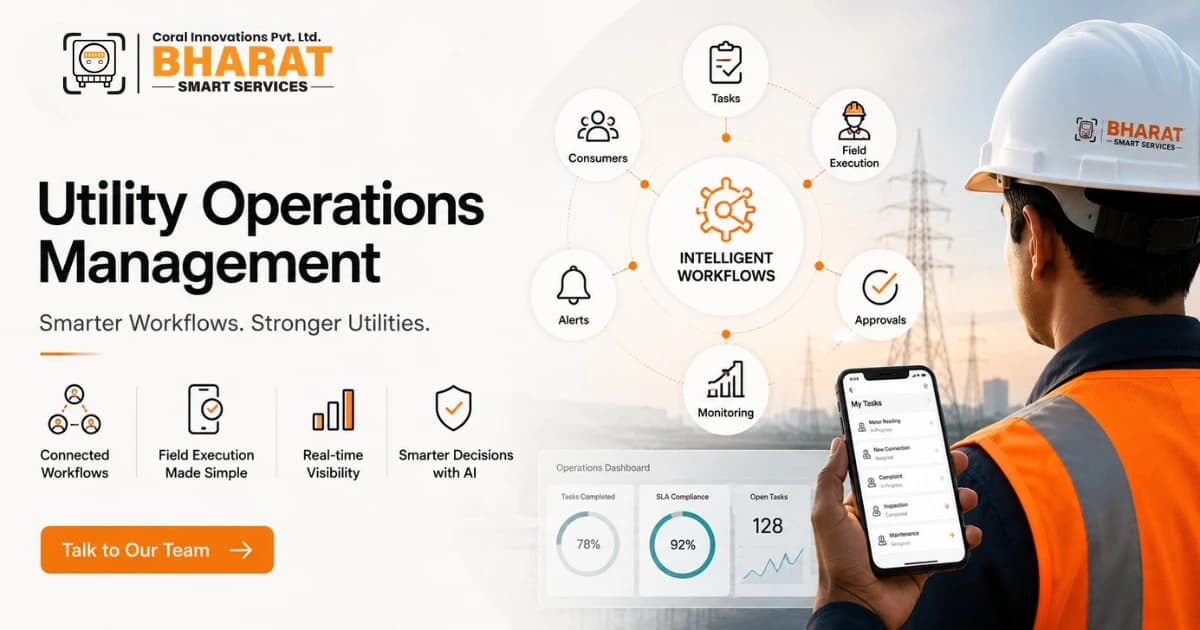
As utilities expand, disconnected workflows lead to delays, duplicate work and limited visibility. This is why modern DISCOMs are investing in Utility Operations Management — connecting people, processes and technology through intelligent workflows.
Why Utility Operations Have Become More Complex
Growing consumer expectations, distributed field teams, regulatory compliance, smart metering and multiple enterprise applications have increased operational complexity. Utilities need faster approvals, better collaboration and complete operational visibility without replacing their existing IT investments.
What Is Utility Operations Management?
Utility Operations Management is the structured coordination of day-to-day utility activities. It ensures every task is assigned, executed, verified, approved and monitored through standardised workflows. It connects departments instead of allowing them to operate in silos, improving accountability and execution.
Traditional Operations vs Intelligent Workflows
| Aspect | Traditional Operations | Intelligent Workflows |
|---|---|---|
| Task tracking | Paper forms and spreadsheets | Digitised field execution |
| Approvals | Manual, email-driven | Automated notifications and routing |
| SLA monitoring | Limited or none | Continuous SLA tracking |
| Visibility | Fragmented, after the fact | Real-time dashboards and audit trails |
A Real Utility Workflow
Imagine a consumer reports a faulty meter. Instead of multiple calls and paperwork, the complaint is automatically assigned, the field engineer receives the task on a mobile device, captures GPS-tagged photos and submits observations. The supervisor approves digitally, the consumer receives updates, and management tracks progress through live dashboards — all without a single manual handoff.
See what connected operations look like for your utility.
Talk to Our TeamCommon Challenges
Utilities commonly face several recurring issues that affect billing, consumer service and governance:
- Delayed approvals
- Inconsistent field reporting
- Disconnected systems
- Duplicate entries
- Manual follow-up
- Poor SLA tracking
- Limited operational visibility
How AI Improves Utility Operations
AI enhances operational workflows by validating field data, identifying anomalies, improving image quality checks, prioritising exceptions and supporting faster decision-making. Rather than replacing people, AI helps teams focus on the exceptions that genuinely need human expertise.
ERP vs Workflow Intelligence
ERP, Billing, GIS, CRM and AMI systems remain the systems of record. Workflow intelligence platforms complement them by managing operational execution — task allocation, approvals, inspections, evidence collection and field coordination — before synchronising verified information back to enterprise systems.
Where One Coral Fits
One Coral acts as an AI-powered Utility Workflow Intelligence Layer. It digitises inspections, meter-to-revenue processes, consumer service workflows, field verification, revenue protection and operational approvals. By integrating with existing enterprise systems, One Coral helps utilities modernise execution while protecting previous technology investments.
Benefits Across Every Level
| Leadership Real-time dashboards and stronger governance across operations. | Operations Teams Standardised workflows and faster, more consistent approvals. |
| Field Teams Mobile-first task execution and simple evidence capture on site. | Consumers Quicker service delivery and greater transparency throughout. |
Future of Utility Operations
The future belongs to connected utilities where AI, mobile workflows, enterprise systems and real-time dashboards work together. Utilities that modernise operational execution today will be better prepared for smart meters, predictive analytics and digital consumer services tomorrow.
Frequently Asked Questions
Yes. ERP systems manage business data and records, while Utility Operations Management focuses on coordinating field execution, approvals and day-to-day task workflows on top of that data.
Yes. One Coral is built to integrate with existing enterprise systems and synchronises verified field data back to them.
No. One Coral complements ERP, Billing, GIS, CRM and AMI systems by managing operational execution, not by replacing them as the system of record.
Yes. The same workflow intelligence approach applies across electricity, water and gas utilities, since the underlying challenges of field coordination and approvals are similar.
AI validates field data, flags anomalies, checks image quality and prioritises exceptions, so teams spend their time only where human judgement is genuinely needed.
Transform Utility Operations with Intelligent Workflows
Utility Operations Management is no longer just about managing activities — it is about creating connected, intelligent operations. By combining digital workflows, AI-assisted validation, mobile field execution and seamless enterprise integration, DISCOMs can improve efficiency, strengthen governance and deliver better consumer experiences. One Coral enables this transformation by acting as the operational intelligence layer that connects field execution with enterprise systems.
Request a One Coral Demo