Every summer, the same message lands in a thousand Hyderabad WhatsApp family groups: "ee sari current bill entha vachindi?" Between fans, ACs and the fridge running overtime, the number on the TSSPDCL or TGNPDCL bill always feels bigger than expected. But the bill isn't random — it's calculated using a fixed formula set by TSERC (Telangana State Electricity Regulatory Commission), and once you see the formula, the number stops feeling mysterious. Here's exactly how it works, slab by slab, with a real worked example.
The 5 Components of a Telangana Electricity Bill
Whether you're on TSSPDCL (Southern Telangana — Hyderabad, Rangareddy, Nalgonda, Mahabubnagar, Medak) or TGNPDCL (Northern Telangana — Warangal, Karimnagar, Nizamabad, Khammam, Adilabad), the tariff structure is identical because both DISCOMs follow the same TSERC-approved order. Your bill is built from five parts:
| Component | What it means |
| 1. Energy Charges | The core cost — units (kWh) consumed, charged on a rising "telescopic" slab system. |
| 2. Fixed Charges | A flat monthly charge per kW of your sanctioned load, regardless of how much you use. |
| 3. Customer Charges | A small fixed service/metering fee, roughly ₹40–₹160 depending on your consumption slab. |
| 4. FSA / FCA | Fuel Surcharge / Fuel Cost Adjustment — a small variable amount per unit that changes based on the DISCOM's monthly power-purchase cost. |
| 5. Electricity Duty | A statutory tax under the Telangana State Electricity Duty Act, 1939 — about 6% of your energy charges. |
Good to know: Under the Gruha Jyothi scheme, eligible domestic consumers get free electricity up to 200 units/month, credited directly as a subsidy on the bill. If your household qualifies, your energy charges for that portion show up as zero.
Domestic (LT-I) Slab Rates — FY 2025-26
This is the "telescopic" part everyone gets confused about: you are not charged your highest slab rate for all your units. Only the units that fall inside each slab are charged at that slab's rate — so climbing into a higher slab never makes your earlier, cheaper units more expensive.
| Slab | Rate per unit |
| 0 – 50 units | ₹1.95 |
| 51 – 100 units | ₹3.10 |
| 101 – 200 units | ₹4.80 |
| 201 – 300 units | ₹7.70 |
| 301 – 400 units | ₹9.00 |
| 401 – 800 units | ₹9.50 |
| Above 800 units | ₹10.00 |
Fixed charge: ₹10/kW of sanctioned load (₹50/kW if monthly consumption crosses 800 units). Rates effective 01.05.2025–31.03.2026 per the TGSPDCL/TGNPDCL retail supply tariff order. Slab rates are revised annually — always cross-check the current rate on your latest bill.
Worked Example: A 350-Unit Hyderabad Household
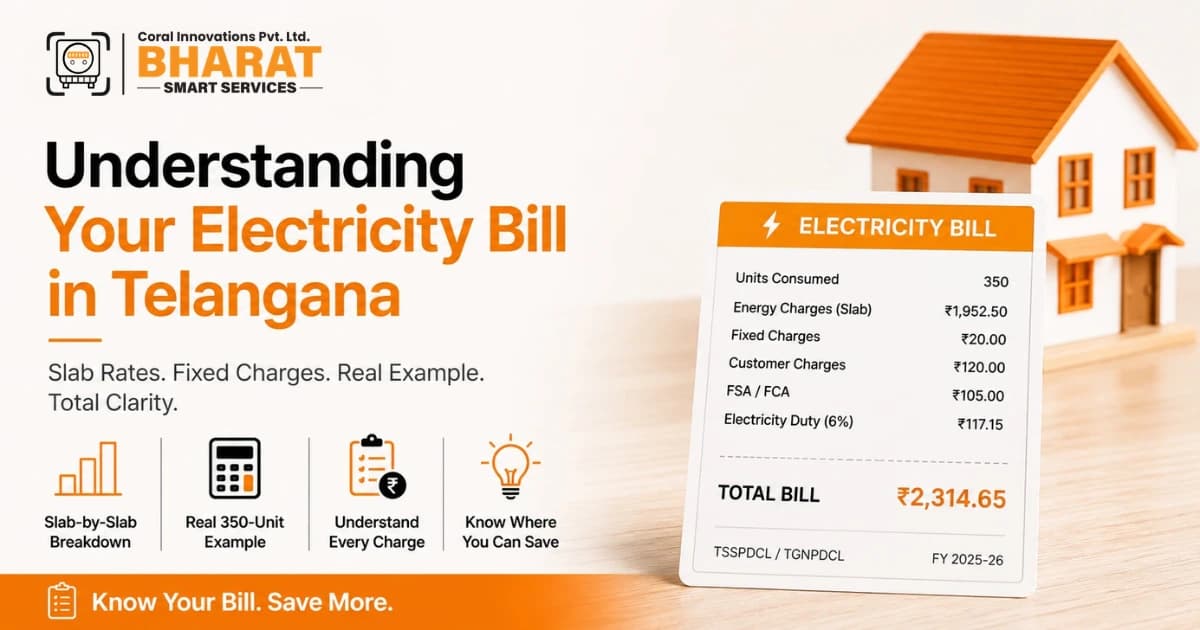
Let's take a real 2BHK in Hyderabad running two ACs through a hot month, with a sanctioned load of 2 kW and a total consumption of 350 units.
| Step | Calculation | Amount |
| First 50 units | 50 × ₹1.95 | ₹97.50 |
| Next 50 units (51–100) | 50 × ₹3.10 | ₹155.00 |
| Next 100 units (101–200) | 100 × ₹4.80 | ₹480.00 |
| Next 100 units (201–300) | 100 × ₹7.70 | ₹770.00 |
| Last 50 units (301–350) | 50 × ₹9.00 | ₹450.00 |
| Total Energy Charges | ₹1,952.50 | |
| Fixed Charges | 2 kW × ₹10 | ₹20.00 |
| Customer Charges | Slab-based | ≈ ₹120.00 |
| FSA (illustrative) | 350 × ₹0.30 | ≈ ₹105.00 |
| Electricity Duty | 6% of energy charges | ₹117.15 |
| Approx. Total Bill | ₹2,314.65 |
FSA and customer charges vary month to month and by division — the exact figures always appear on your bill slip. This worked example shows the method, not a guaranteed number.
Why Bills Spike So Fast After 200 Units
Look at the slab table again: the rate nearly doubles between the 101–200 slab (₹4.80) and the 201–300 slab (₹7.70). This is by design — the first ~100–200 units are subsidised to keep basic power affordable, while higher consumption is priced to reflect real cost and cross-subsidise lower-income households. Practically, it means the units you use during peak AC season are the most expensive ones on your bill, and shaving even 30-40 units off a 350-unit month can move you into a cheaper slab for a meaningful chunk of your usage.
Where to Actually Save
Once you can see which slab is driving your bill, the fix becomes obvious: find out which appliances are pushing you into the ₹7.70–₹9.50 slabs, and cut their contribution. This is exactly where a Bharat Smart Plug earns its keep — it shows you, appliance by appliance, which one is quietly running up your bill, so you're not guessing between the AC, the geyser, and the fridge. For businesses and larger HT connections, BSS's bill optimisation audit does the same thing at industrial scale, identifying the exact load and power-factor issues adding to the bill.
Not sure which appliance is running up your bill?
Bharat Smart Services helps Telangana homes and businesses find exactly where their units are going — and how to cut them.
Get an Energy Audit from BSS