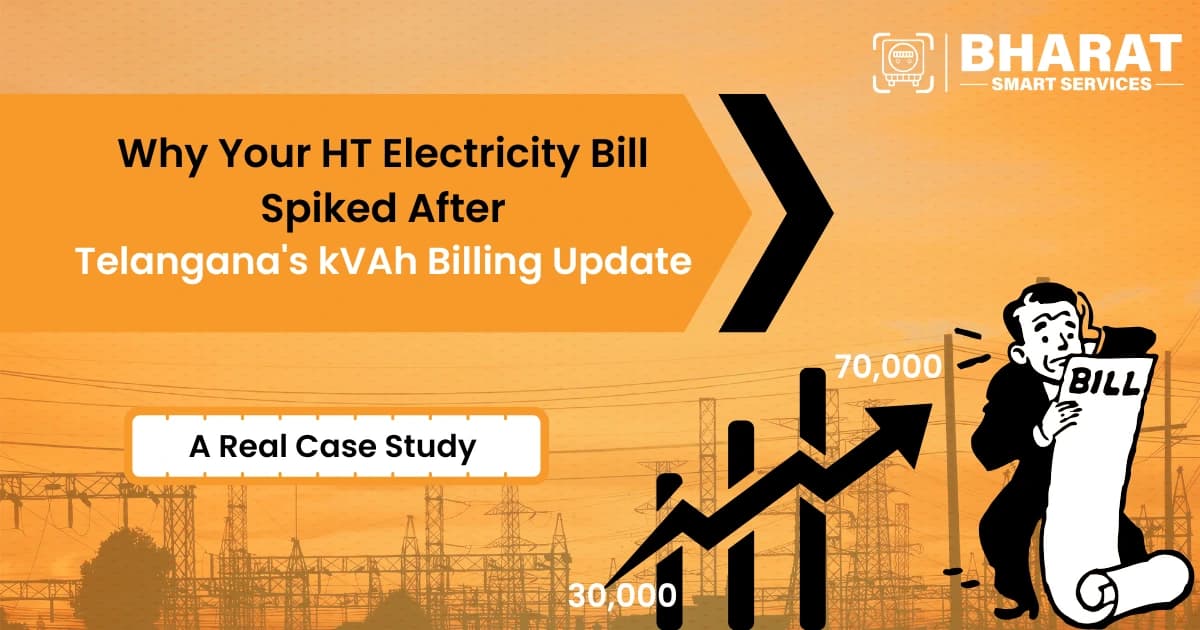
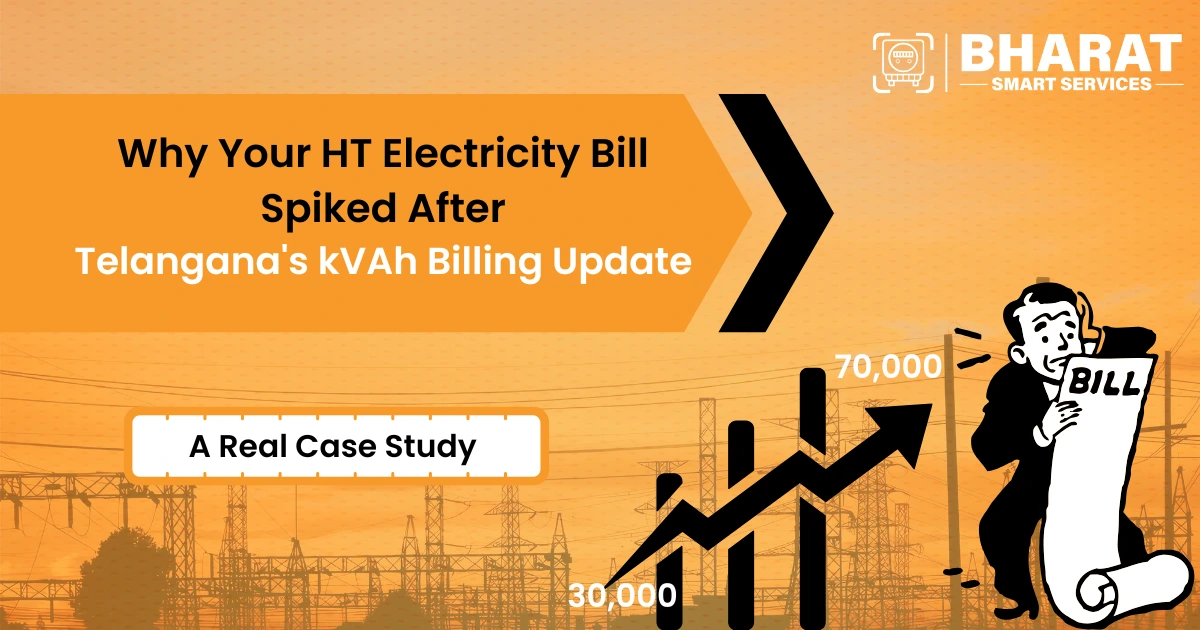
Satyanarayana ran his factory for years paying around Rs.30,000 a month in electricity. One month the bill arrived at Rs.70,000 — a jump of over 130%. Nothing in his factory had changed. What changed was how Telangana’s regulator now calculates HT bills. Bharat Smart Services found the exact cause using live meter data — and fixed it.
Bill Optimisation · Case Study
Kinetics Organics & Plastics, Telangana — HT Consumer, kVAh Billing
The Bill That Nobody Saw Coming
Satyanarayana had been running Kinetics Organics and Plastics Private Limited for years on an HT connection. The electricity bill came every month. It was usually somewhere between ₹30,000 and ₹70,000. It was a cost of running the business — not something you worried about much.
“We just paid the bill and moved on,” he said.
Months before the crisis, there had been a notice. TGERC was changing how it calculated bills for HT consumers across Telangana — specifically, it was unlocking the lead power factor penalty. The notice had a lot of words. The effects seemed far away.
They knew about it. Then they moved on.
At the time, it seemed reasonable to assume that even if the bill went up, it would be 10 or 15 percent — something manageable. Nobody was ready for what actually happened.
The bill was not 10% higher. It was not 15% higher. It was double.
₹30,000 became close to ₹70,000 in a single billing cycle. The reason was not that the factory used more power. The reason was that the way power use is measured and charged had fundamentally changed under the kVAh billing update.
The Worst Possible Moment
As Satyanarayana described it:
“At a time when business itself was not running properly, recession was going on, and everywhere outside we were hearing about wars and uncertainty… during this difficult situation, we got introduced to Bharat Smart Services.”
— Satyanarayana, Managing Director, Kinetics Organics & Plastics Pvt. Ltd.
Someone Who Actually Explained It — and Then Proved It With Data
The first thing that stood out was not a product or a quote for equipment. It was an explanation.
Bharat Smart Services sat down with the team and walked through what was actually happening — what lead power factor meant in practical terms, why their specific HT connection was now attracting penalties it had not before, and what kind of intervention would genuinely address the root cause rather than just patch the symptom.
“They explained to us what solution could be implemented for this type of billing issue.”
But the explanation alone was not what made the difference. What made the difference was how BSS found the cause in the first place.
Using the Bharat Smart Services meter reading app, our team monitored the facility’s live electricity data — hour by hour, day by day — without stepping onto the site. The app did not just show consumption numbers. It identified the exact nature of the power factor problem: whether penalties were being triggered by lagging power factor, leading power factor, or both.
|
Lagging Power Factor Caused by motors, transformers, and inductive loads. The traditional penalty that most businesses already knew about and had tried to manage. |
Leading Power Factor Caused by overcorrection — typically from a fixed capacitor bank running even when load has dropped. Previously invisible to the bill. Now penalised just like lag. |
Most businesses and even most electricians assume the problem is lagging. Many miss the lead entirely. Getting this wrong means installing the wrong solution and continuing to pay penalties indefinitely. The meter reading app removed all guesswork. The data told the story clearly.
The Right Fix — Not Just Any Fix
Once the cause was confirmed, the right solution became obvious. An APFC panel was recommended and installed — not a fixed capacitor bank. The difference matters enormously in practice.
|
APFC Panel (Smart System) Monitors the load in real time and switches individual capacitor banks on and off based on actual demand at that moment. No overcorrection. No undercorrection. No unnecessary penalties. |
Fixed Capacitor Bank (Old Type) Always on at the same level regardless of what the load actually requires. During low-load periods it over-corrects — pushing the facility into lead factor and generating a penalty that never existed before. |
“After installing it, things have now come somewhat under control.”
“The team at Bharat Smart Services also supported us very proactively in bringing this situation under control, and we are very happy about that.”
In His Own Words
“I would recommend everyone to take their service. It can help reduce this kind of tightrope walking situation to a great extent.”
— Satyanarayana, Managing Director, Kinetics Organics & Plastics Pvt. Ltd.
Listen the whole story from the owner words on Tightrope walking. That phrase stays with you. Because that is exactly what an unexpected electricity bill does to a business — especially during difficult times. It turns a manageable cost into a monthly anxiety. Getting off that tightrope is not just a financial decision. It is a relief.
Why This Is Happening to HT Consumers Across Telangana
A clarification that most HT consumers and many electricians still get wrong.
HT consumers in Telangana have always been billed on kVAh. That part is not new. What changed is something more specific — and far more impactful.
Until recently, TSERC’s penalty structure only penalised lagging power factor — the kind caused by motors, transformers, and inductive loads. Businesses had learned to manage this. Most had some form of capacitor correction in place.
What TGERC now penalises is both lagging and leading power factor.
Leading power factor — caused by overcorrection, typically from a fixed capacitor bank that keeps running even when load has dropped — was previously invisible to the bill. Now it shows up as a penalty charge just like lag does.
This is precisely why businesses that had their power factor “sorted” are suddenly finding their bills climbing. Their fixed capacitor bank, adequate under the old rules, is now working against them during low-load periods — pushing them into lead factor and generating a penalty they were never exposed to before.
The solution is not more equipment. It is smarter monitoring.
That is exactly what Satyanarayana’s facility was missing. And that is what BSS’s meter reading app identified before a single rupee was spent on hardware.
Why Businesses Trust Bharat Smart Services
We diagnose before we recommend
Using live meter data monitored remotely over 2–3 days, we identify the exact cause of your billing problem before suggesting a single rupee of equipment. No guesswork.
We distinguish between lag and lead
Most advisors assume the problem is lagging power factor. Under the new TGERC rules, the lead penalty is just as damaging — and far more commonly missed. We check both.
No conflict of interest
We are not equipment resellers. The only outcome we are paid to deliver is a lower electricity bill. If your existing setup only needs an adjustment, we will tell you that.
Deep familiarity with Telangana billing rules
We are Hyderabad-based and deeply familiar with TSERC and TGERC tariff structures — including the kVAh billing changes now affecting thousands of HT consumers across the state.
Is Your HT Bill Behaving Unexpectedly? Ask These Questions First.
Free Expert Review
Is Your HT Electricity Bill Higher Than It Should Be?
Our team monitors your meter data remotely and tells you exactly what is driving your bill — completely free, no site visit required to start.
Get Your Free Bill Review →📞 +91 72870 30303 · 🌎 bharatsmartservices.com
Frequently Asked Questions
What is kVAh billing and why did my HT electricity bill suddenly go up?
HT consumers in Telangana have always been billed on kVAh, which accounts for both actual energy used and reactive power. What changed recently is that TGERC now penalises both lagging and leading power factor — whereas previously only lagging was penalised. If your bill has spiked without a change in consumption, leading power factor is a very common and very fixable cause.
I already have a capacitor bank installed. Why is my bill still high?
A fixed capacitor bank corrects at a constant level regardless of your actual load. During low-load periods — nights, weekends, idle production hours — it over-corrects and pushes your power factor into the leading range, which now attracts its own penalty under TGERC rules. A dynamic APFC panel adjusts in real time and prevents this.
Does BSS need to visit my site to diagnose the problem?
Not as a first step. Our team monitors your live meter data remotely for 2–3 days using the Bharat Smart Services app. In many cases, the data alone tells us exactly what is happening. When a site visit is needed, we arrive already knowing what to look for.
Is Bharat Smart Services relevant only for large factories?
No. The kVAh billing change and lead power factor penalties affect HT consumers of all sizes across Telangana — manufacturing units, commercial buildings, hospitals, and mid-size industrial facilities. The solution required will differ by load profile, but the diagnostic approach is the same.
Bharat Smart Services (Coral Innovations Pvt. Ltd.) is a Hyderabad-based smart energy company specialising in electricity bill reduction for homes, businesses, and utilities across India. Our Smart Business Solutions team works with HT and LT consumers across Telangana to identify and fix billing problems through data-first diagnosis.