For most petrol pump owners, fuel sales are easy to track. Daily litres sold remain stable. Customer flow looks normal. Yet suddenly, the electricity bill shoots up.
This leads to a common question many fuel station operators ask:
“If fuel sales are the same, why is my petrol bunk electricity bill increasing?”
This blog explains a real petrol bunk case from Saroornagar, and breaks down why high electricity bills can occur despite steady sales, how power factor mistakes impact costs, and what petrol pump owners should do to avoid excess billing and how to reduce petrol bunk electricity bill.
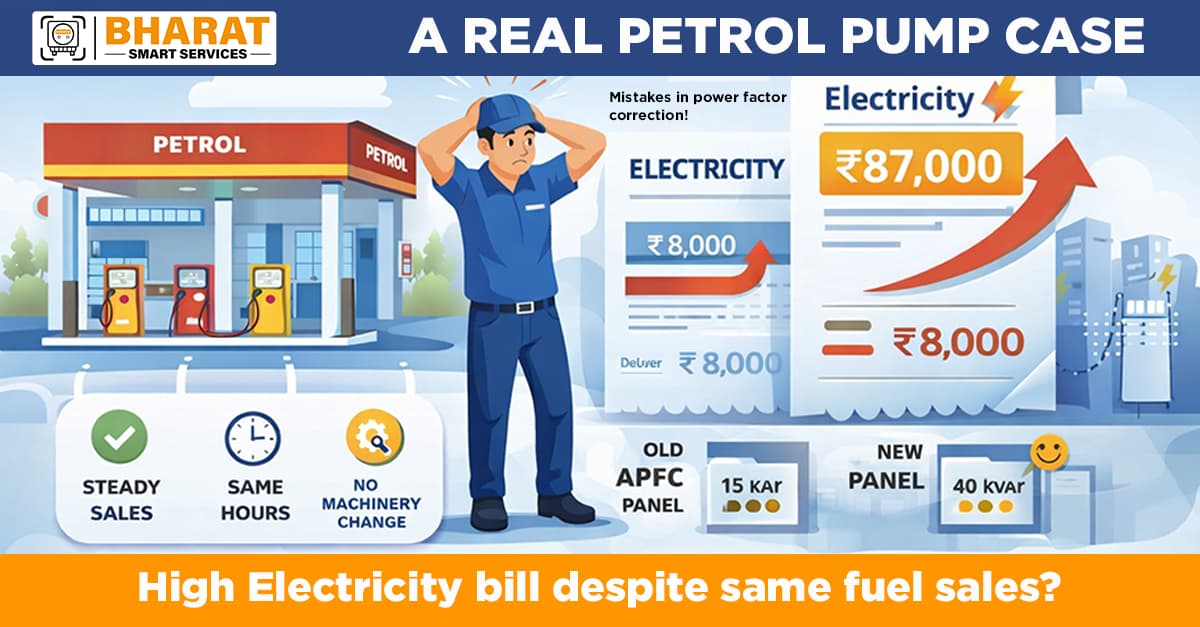
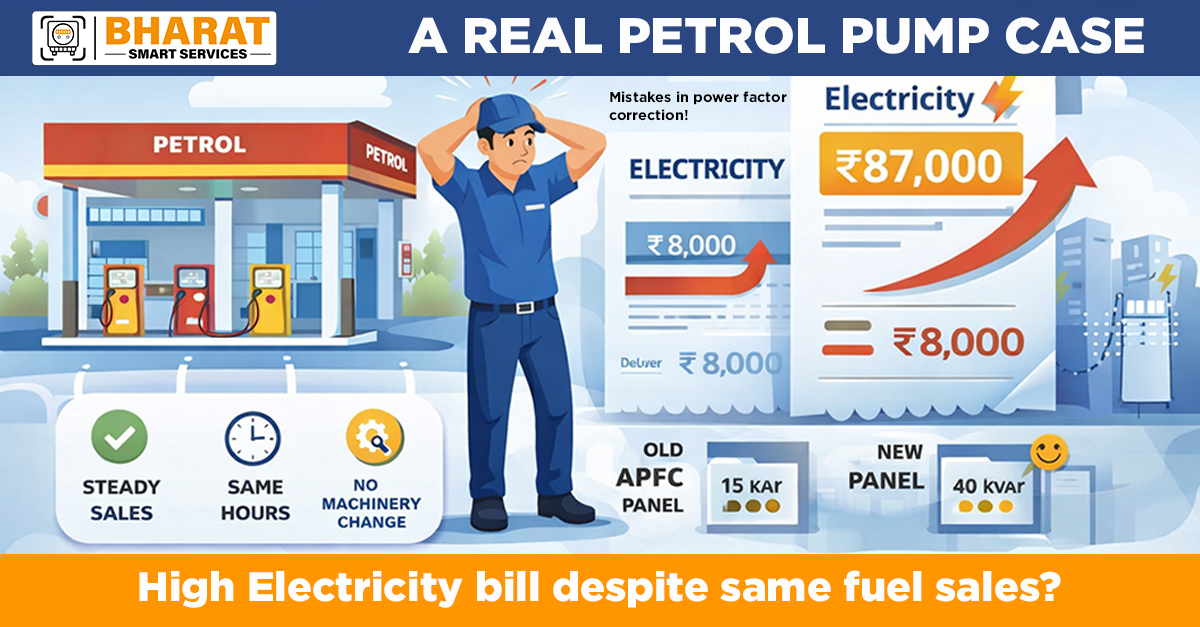
High Electricity Bill Despite Same Sales: A Real Petrol Pump Case
A petrol bunk in Saroornagar had been operating normally for months.
Fuel sales were consistent. No new machinery was added. Operating hours remained the same.
Yet, one month their electricity bill jumped drastically.
- Earlier monthly bill: ₹8,000
- New electricity bill: ₹87,000
- Fuel sales: No major change
This is a classic example of high electricity bills despite the same sales, something many fuel station owners experience but struggle to understand.
What Changed? kVArh Lead Unblock Notice
The key trigger was a kVArh Lead unblock notice from the electricity utility. Earlier, the petrol bunk’s reactive energy charges were not actively impacting the bill.
After unblocking, power factor behaviour directly affected billing. Instead of analysing the requirement, the bunk owner made a quick decision.
- Existing APFC panel: 15 kVAr
- Upgraded to: 40 kVAr
- Reason: “More capacitor means better bill control”
Unfortunately, this assumption turned out to be costly.
Petrol Pump Profit vs Power Cost: Where Things Went Wrong
After upgrading to a higher capacitor capacity:
- Actual energy consumption: 1000 units
- Units charged in bill: 9000 units
- Excess units billed: 8000 units
This had nothing to do with fuel sales or pump operations. The issue was purely electrical. Installing capacitors more than required pushed the system into PF Lead mode, which attracts penalties after kVArh Lead unblocking.
This is where petrol pump profit vs power cost becomes critical. Even if margins on fuel sales remain the same, incorrect power factor correction can wipe out profits through excess electricity charges.
Why Fuel Station Bills Increase Suddenly
Many petrol bunk owners assume electricity bills increase only when:
- Sales increase
- Equipment usage increases
- Tariff rates change
But in reality, fuel station bills can increase suddenly due to electrical configuration issues, especially:
- Incorrect capacitor sizing
- PF shifting from Lag to Lead
- kVArh penalties becoming active
No post-notice analysis after utility changes
In this case, the correct kVAr requirement would have cost only ₹60,000 as a one-time investment. Instead, a wrong decision led to recurring monthly losses.
The Right Approach: Analysis Before Installation
After a kVArh Lead unblock, the right approach is:
- Analyse load pattern
- Check PF levels over time
- Study kVArh Lag–Lead behaviour
- Decide capacitor size based on data, not assumption
More capacity is not better capacity. The right capacity is what saves money.
How Bharat Smart Services Helps kVArh Consumers
This is exactly where expert support becomes essential.
Bharat Smart Services (BSS) helps petrol bunks and other kVArh consumers by:
- Analysing real load behaviour
- Identifying PF and kVArh issues
- Recommending correct capacitor sizing
- Preventing excess and avoidable electricity bills
The goal is simple:
Ensure petrol pump owners do not pay more than what they actually consume.
If your petrol bunk is facing:
- High electricity bill despite same sales
- Sudden increase in power cost
- Confusion after kVArh Lead unblocking
Do not rely on guesswork on how to reduce petrol bunk electricity bill. Electricity decisions taken without expert analysis often turn into recurring losses. With the right data and guidance, electricity bills can be controlled and profits protected.