Our Latest Blogs
Stay updated with the latest news, trends, and insights from our experts.
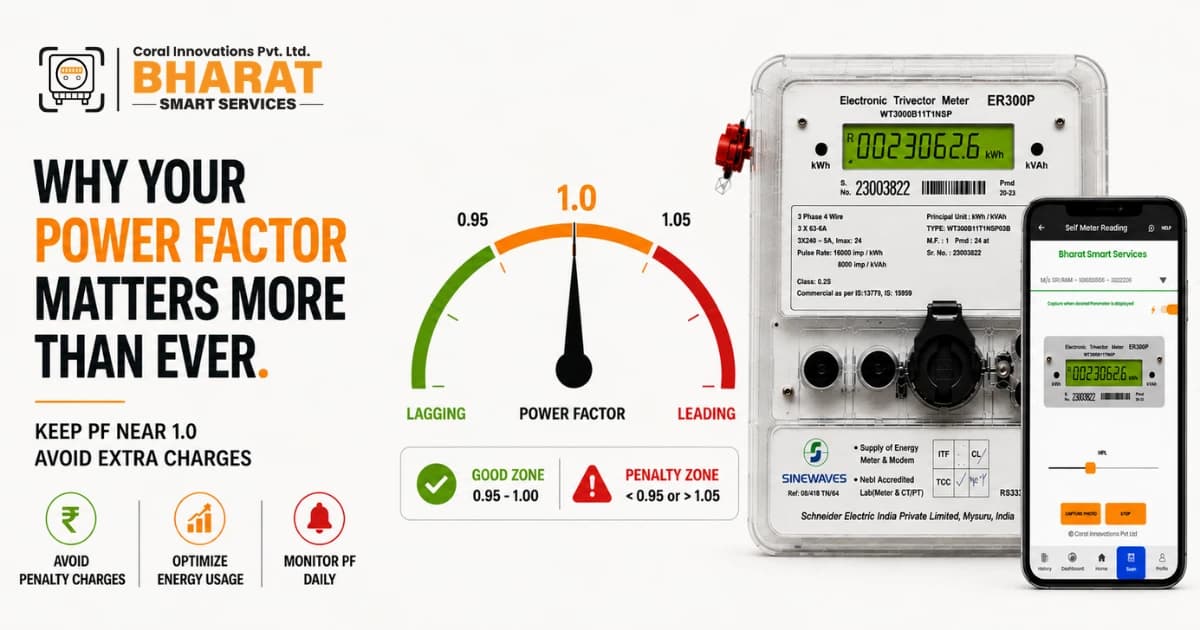
Why Has Power Factor Become a Buzzword in Telangana Industries?
If you speak to any industrial electrical engineer, industry owner or plant manager in Telangana today, one term keeps coming up again and again: “Power Factor”.
For years, it quietly sat in electricity bills as a small number few people paid attention to. Capacitor panels were installed once, settings were rarely checked, and operations continued.
That’s when the power factor moved from a technical parameter to a business concern.
The Turning Point: When PF Became Financially Visible
Industries mainly worried about low power factor because utilities penalized lagging reactive power. The common response was simple:
Install capacitor banks.
Add more capacitors if PF dropped.
Problem solved.
But Telangana DISCOMs introduced stricter enforcement of reactive energy accounting, including kVArh lead.
This meant over-correction using excessive capacitors also began affecting bills.
Suddenly industries faced two simultaneous questions:
how to improve power factor in industry without overcompensation
how to improve leading power factor when capacitors overshoot
The power factor was no longer just about correction. It became about balance.
Why Are Telangana Industries Concerned About PF Recently?
There are three main reasons power factor has become a buzzword across Telangana’s industrial sector.
Only capacitor installation- no longer works
For many years, industries managed power factor using fixed or manually set capacitor banks. This worked when plant loads were mostly steady.
But today, industrial loads keep changing due to VFD-driven motors, automation cycles, and varying production levels. So the reactive power requirement also keeps changing.
When capacitors remain connected during low-load periods, they inject excess reactive power, pushing PF into the leading region and causing kVArh lead billing.
This is why industries now require properly tuned automatic APFC panels that switch capacitor steps according to real-time load and are adopting more reliable Power factor improvement methods instead of fixed capacitor correction.
A recent update in the Electricity billing in Telangana
A key reason power factor has become a buzzword in Telangana industries is the change in how reactive energy is measured and billed.
With stricter metering and billing analytics, utilities now account separately for kVArh lag and kVArh lead.
Earlier, many industries did not notice these components in detail. But now they directly impact monthly electricity costs.
Because of this visibility, plant teams are actively discussing how to improve power factor in industry, reviewing practical Power factor improvement methods, and correcting over-compensation by learning how to improve leading power factor.
Power factor has therefore moved from an electrical parameter on the bill to a controllable cost factor in Telangana industries.
“How to improve PF?”
“How to correct PF without creating leading PF?”
This is why searches around how to improve power factor using capacitors now include questions on tuning and control not just installation.
Why Capacitors Alone Are Not Enough Anymore
Capacitors remain essential but unmanaged capacitors create risk.
Many plants still rely only on APFC panels configured years ago.
But without monitoring:
steps may remain ON unnecessarily
PF may overshoot
leading PF persists unnoticed
billing impact accumulates
This is why industries are revisiting how to improve power factor using capacitors with better control logic and measurement.
Effective Power factor improvement methods now include:
PF monitoring
step optimization
load-linked capacitor switching
harmonic evaluation
Not just capacitor installation.
How Smart Monitoring Changes PF Management
Modern PF optimization requires continuous visibility.
This is where Bharat Smart Services energy analytics and auditing systems help industries move from reactive correction to proactive control.
Instead of guessing capacitor sizing, plants can:
track PF trends in real time
detect leading PF events
correlate PF with load behavior
optimize capacitor operation
This enables industries to implement how to improve power factor using capacitors with precision rather than trial-and-error.
It also supports accurate decisions on how to improve leading power factor by identifying when and why over-correction occurs.
The BSS Approach to Power Factor Improvement in Industries
Maintaining power factor is not just about installing capacitors. It requires correct assessment, proper correction, and continuous monitoring.
Bharat Smart Services supports industries through a structured three-step approach that ensures sustainable PF improvement and penalty avoidance.
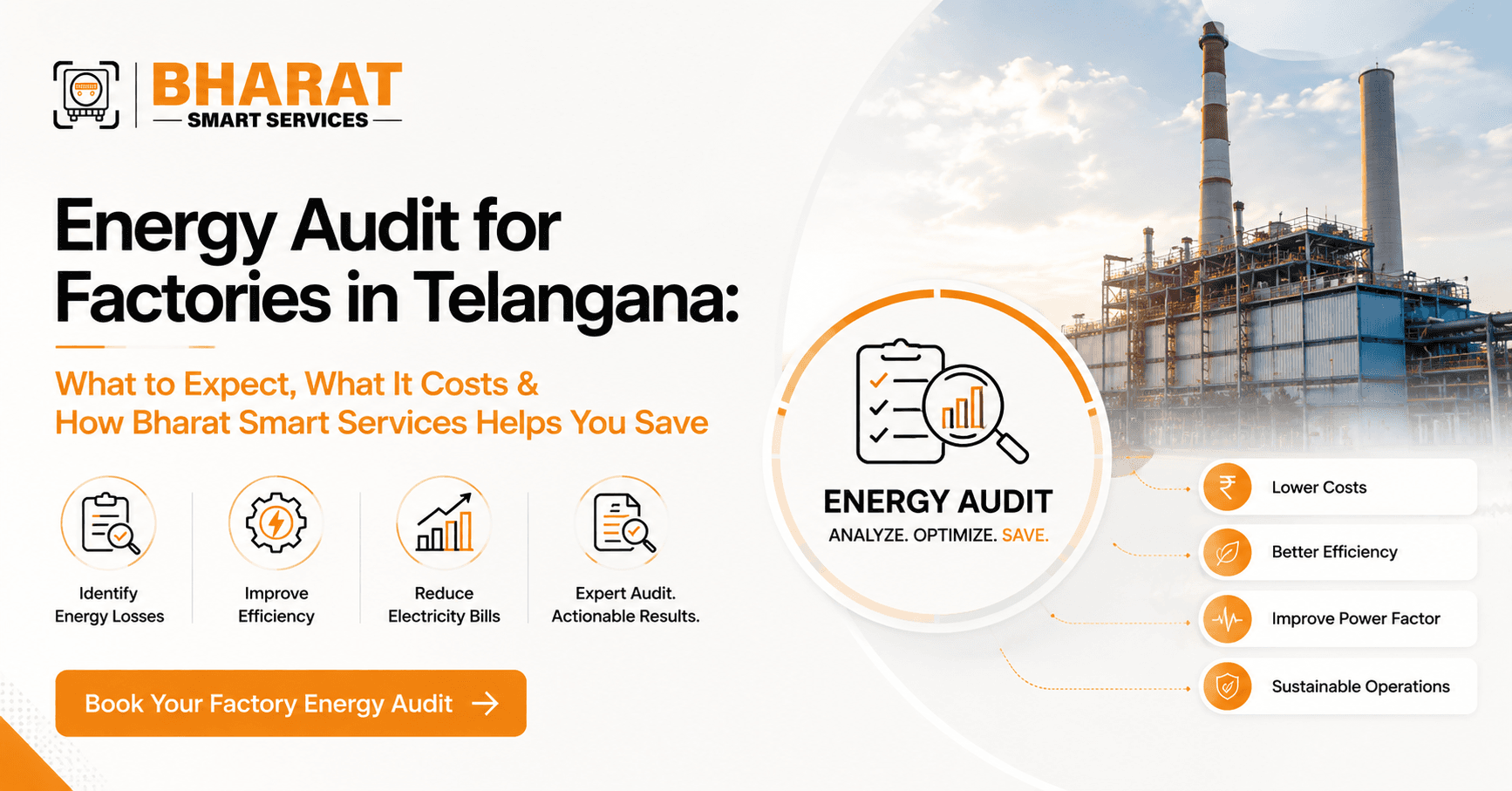
Step 1: Complete Energy Audit
The first step is understanding the plant’s actual reactive power behavior.
Through certified electrical audits, BSS evaluates:
existing PF maintenance
lag and lead patterns
capacitor bank condition
APFC panel performance
load variation across shifts
Machine health
This helps industries clearly see whether PF issues are due to under-correction, over-correction, or improper capacitor control.
So instead of guessing how to improve power factor in industry, plants receive measured PF diagnostics and correction guidance.
Book audit now
Step 2: Correct APFC Panel Sizing and Optimization
Based on audit findings, BSS recommends the required capacitor capacity and APFC configuration and installation.
If existing panels are oversized, undersized, or poorly tuned, industries receive guidance on:
required capacitor kVAr rating
optimal APFC step size
step sequence correction
panel upgrade if needed
This ensures capacitors match real plant load behavior.
As a result, how to improve power factor using capacitors becomes technically accurate avoiding both lag and lead conditions.
It also directly addresses over-compensation by defining how to improve leading power factor through proper capacitor sizing and switching logic.
Step 3: Year-Long PF Monitoring Through BSS App
After correction, sustained PF performance requires monitoring through the billing cycle.
Industries capture periodic meter readings in the BSS App, which records:
kWh
kVAh
kVArh Lag
kVArh Lead
and get PF, lag/lead units, and excess billed unit insights.
MR insights
The dashboard then shows:
monthly PF trend
lag/lead accumulation
excess reactive energy
billed vs consumed units
This allows industries to detect PF drift early and adjust capacitor steps before penalties accumulate.
Continuous visibility ensures practical Power factor improvement methods are sustained throughout the year not just after installation.
Industries that adopt data-driven Power factor improvement methods will avoid both lagging and leading penalties while optimizing electricity costs.
And those that understand how to improve power factor in industry in a dynamic load environment will gain measurable tariff advantage.
Because in today’s Telangana industrial power ecosystem, power factor is no longer just electrical efficiency, it is financial efficiency.
Read More →
Bharat Smart Services at India AI Impact Summit 2026: Applying AI Where Energy Meets Reality
The India AI Impact Summit 2026, hosted by the Government of India under the IndiaAI Mission, brings together global leaders, innovators, and enterprises to advance responsible, inclusive, and real-world AI deployment. Held from 16–20 February at Bharat Mandapam, New Delhi, the summit highlights AI solutions driving measurable impact across the pillars of People, Planet, and Progress.
Within this global platform, Bharat Smart Services (BSS) showcases how artificial intelligence is transforming one of the most fundamental infrastructures of modern life: Electricity.
From Electricity Data to Energy Intelligence
Across homes, industries, and utilities, electricity data has traditionally remained fragmented, manual, and under-utilised. Bharat Smart Services applies AI across the entire electricity data lifecycle converting raw consumption data into actionable energy intelligence.
At the India AI Impact Summit, BSS demonstrates how AI enables:
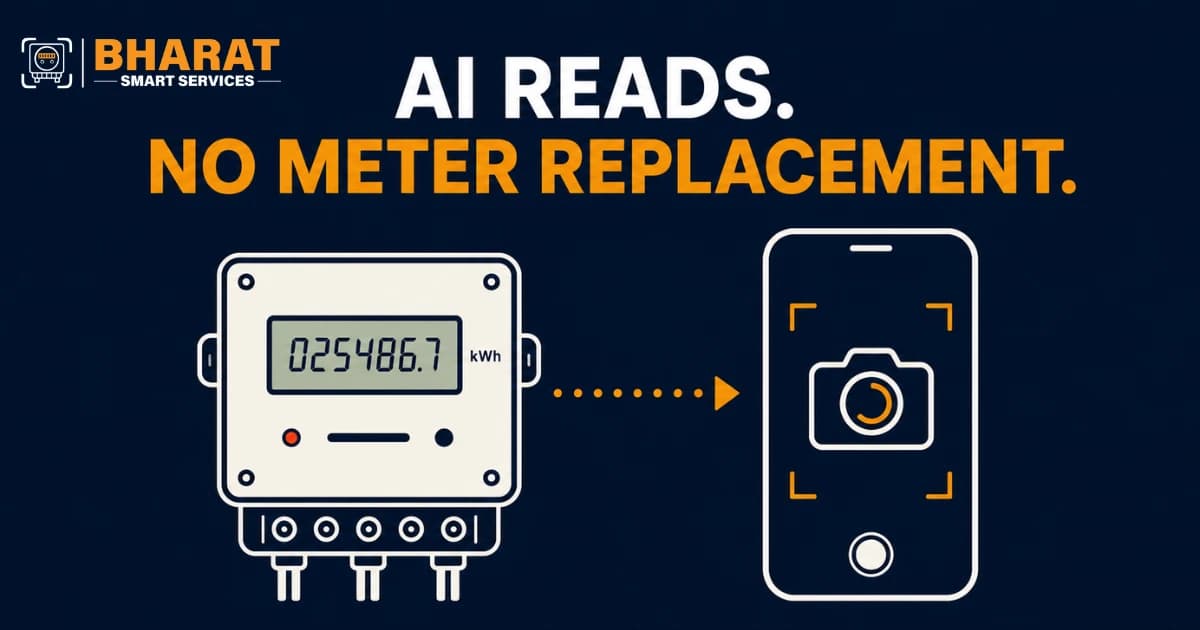
Automated meter reading at scale
Smart-meter data analytics and interpretation using NILM
Real-time energy monitoring and control
Energy efficiency intelligence
Electricity bill optimisation
These capabilities transform electricity from a passive utility into a measurable, optimisable system.
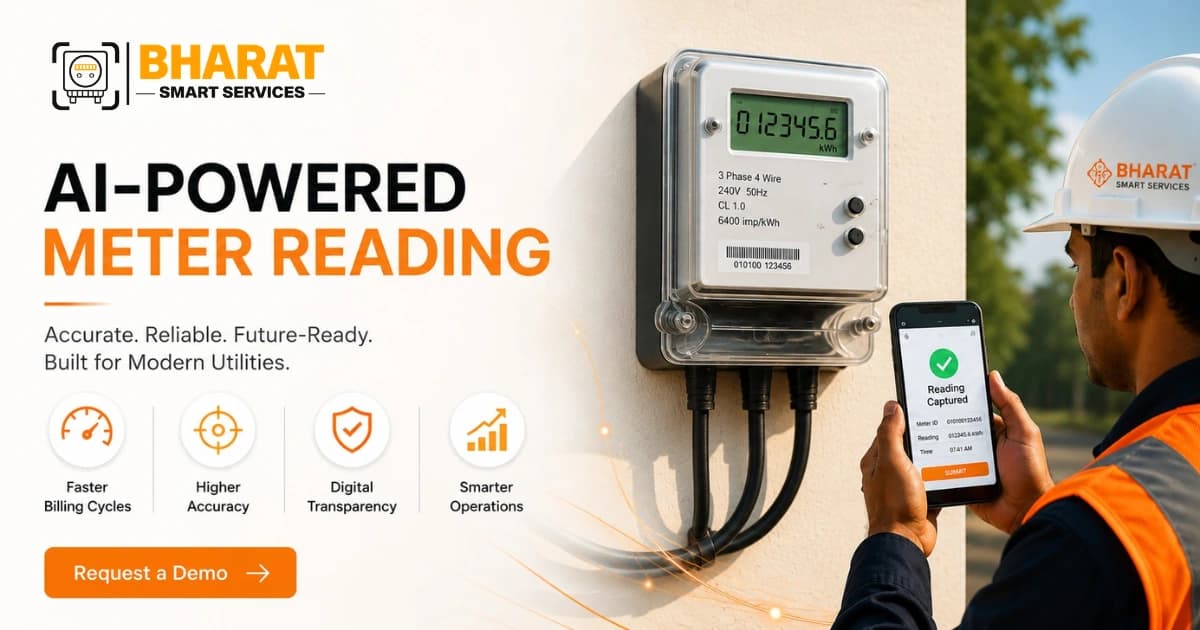
AI-Powered Meter Reading: Digitising the Foundation of Energy Data
Electricity optimization begins with accurate data. Bharat Smart Services deploys AI-based capture and recognition technologies to digitise meter readings across large consumer bases and utility networks. This eliminates manual entry errors, accelerates billing cycles, and creates reliable consumption datasets, the essential foundation for downstream AI analytics and optimisation.
By turning millions of meter images into structured energy data, BSS enables utilities and consumers to move from estimation to intelligence.
Smart-Meter Analytics: Making Sense of Energy Behaviour
As smart-meter deployments expand across India, vast streams of high-frequency electricity data are generated. Bharat Smart Services applies AI analytics to interpret this data in meaningful ways:
Load patterns and usage behaviour
Inefficiencies and abnormal consumption
Demand peaks and wastage zones
Device-level energy insights
This transforms smart-meter data from raw meter data into decision-ready intelligence, aligning directly with the summit’s focus on deploying AI for infrastructure transformation and sustainable development.
AI for Energy Efficiency and Bill Optimisation
Energy inefficiency often hides within billing structures, tariff slabs, demand penalties, power factor behaviour, and consumption patterns using Bharat Smart Services App. Bharat Smart Services applies AI models and rule-based energy intelligence to identify optimisation opportunities such as:
Avoidable demand penalties
Power factor inefficiencies
Lead and lag kVArh imbalance conditions
Excess reactive power compensation
Load imbalance and wastage
Tariff optimisation potential
Operational energy losses
Through continuous analysis of meter and billing data, BSS App detects adverse power factor trends, capacitor over- or under-compensation, and lead/lag reactive energy conditions that directly impact electricity costs.
For industries and large consumers, this enables corrective actions in capacitor bank configuration, load distribution, and operational practices translating into measurable cost reduction and improved electrical efficiency.
For households and small consumers, it builds awareness and control over electricity usage, bringing AI-driven energy efficiency into everyday life.
Real-Time Energy Intelligence: From Monitoring to Control
Beyond analytics, BSS Smart Devices enable real-time monitoring of device-level consumption through intelligent Ai- Powered Smart Devices called Bijli Auditor and Bharat Smart Plug Consumers and enterprises can:
Track appliance-level energy use
Set limits and targets
Receive optimisation alerts
Control consumption and appliance
This shifts energy management from reactive billing to proactive optimisation, a core theme across global AI sustainability discussions at the summit.
One Coral: Accelerating AI-Driven Energy Operations
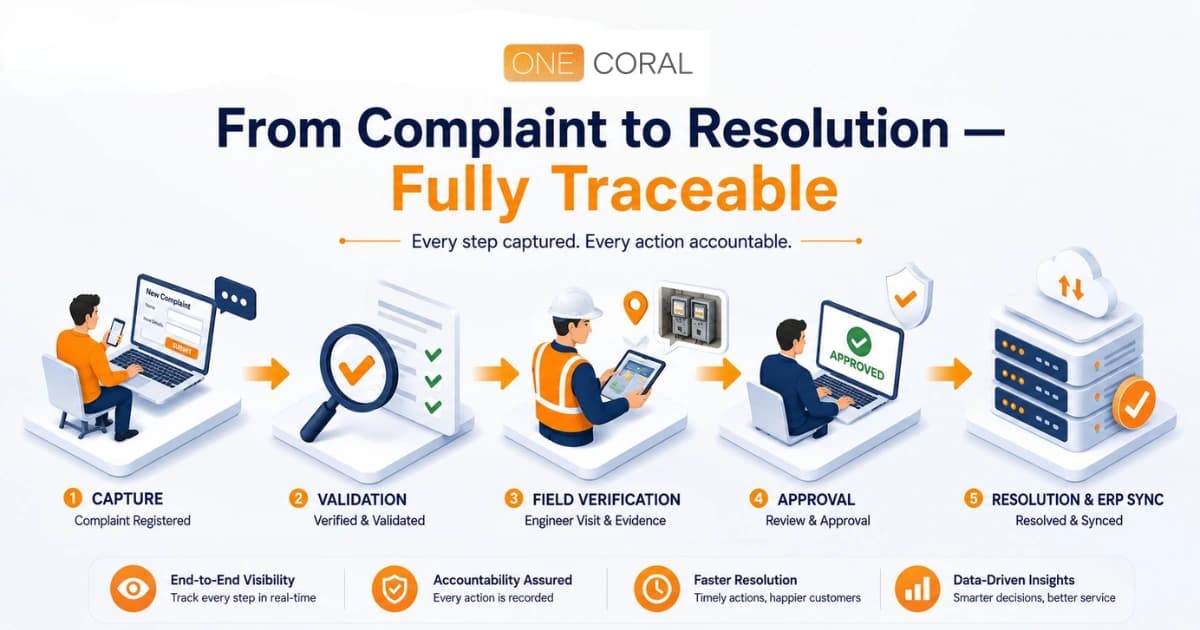
At the India AI Impact Summit, Bharat Smart Services is also showcasing One Coral, its digital AI execution platform designed to rapidly build and deploy operational applications for utilities and energy ecosystems.
One Coral enables organisations to:
Digitise field and utility workflows quickly
Automate data capture and validation processes
Deploy analytics-ready operational systems
Integrate AI models into real operations
Scale energy and infrastructure applications faster
By converting operational requirements into working digital systems, One Coral reduces the time between AI insight and real-world deployment, a critical challenge in infrastructure sectors.
AI Impact Where It Matters: Energy for People, Planet, Progress
Energy sits at the intersection of economic growth, environmental sustainability, and daily life. By applying AI to electricity measurement, optimisation, and intelligence, Bharat Smart Services contributes directly to the summit’s foundational pillars:
People: enabling consumers to understand and control energy
Planet: improving efficiency and reducing wastage
Progress: digitising infrastructure through AI
This reflects the summit’s broader mission to move AI beyond research into scalable societal impact.
Driving AI-Powered Energy Optimisation in India
Participation in the India AI Impact Summit 2026 represents a significant milestone for Bharat Smart Services aligning its work with India’s national AI vision and the Global South’s development-focused technology agenda.
From automated meter reading to smart-meter intelligence, energy analytics, and digital execution platforms, BSS demonstrates how AI can transform electricity systems into intelligent, efficient, and optimised infrastructures.
As India advances toward an AI-enabled future, Bharat Smart Services continues its mission:
Driving AI-powered energy optimisation in India.
Read More →
Bharat Smart Services: AI-Powered Energy Management & Electricity Bill Reduction Company in India
Who We Are
Bharat Smart Services is an AI-powered energy management and electricity bill optimization company in India helping people and businesses understand, control, optimize energy usage and reduce their electricity bills.
We work at the point where electricity bills, meters, penalties, and human confusion intersect. Instead of generic advice, we give clear, meter-level answers and continuous support so users don’t repeat the same costly mistakes every month.
Our work industries, commercial buildings, utilities, and residential users, all with one common goal electricity bill reduction through core-level problem identification, detailed machine-level audits, and continuous monitoring.
Founded Year
Bharat Smart Services was founded in 2020 to address long-standing challenges in electricity bill accuracy and reduction. The company was established to combine AI-powered meter reading, electricity bill analysis, and early-stage energy management solutions, enabling accurate billing for utilities and reduced Electricity bills for consumers.
What We Believe In
Collective Action
We believe electricity savings cannot happen in isolation.
When utilities, industries, households, and technology work together, the impact multiplies. Every unit saved is shared progress.
Lowest Cost – Highest Impact
Our philosophy is simple:
Don’t push expensive upgrades first.
Fix what’s leaking money already.
Most electricity bill problems can be solved by understanding consumption, equipment behaviour, consumption trends not by replacing equipment blindly.
The Problem We Solve
High Electricity Bills
Many users approach us with one question:
“Why is my electricity bill suddenly high?”
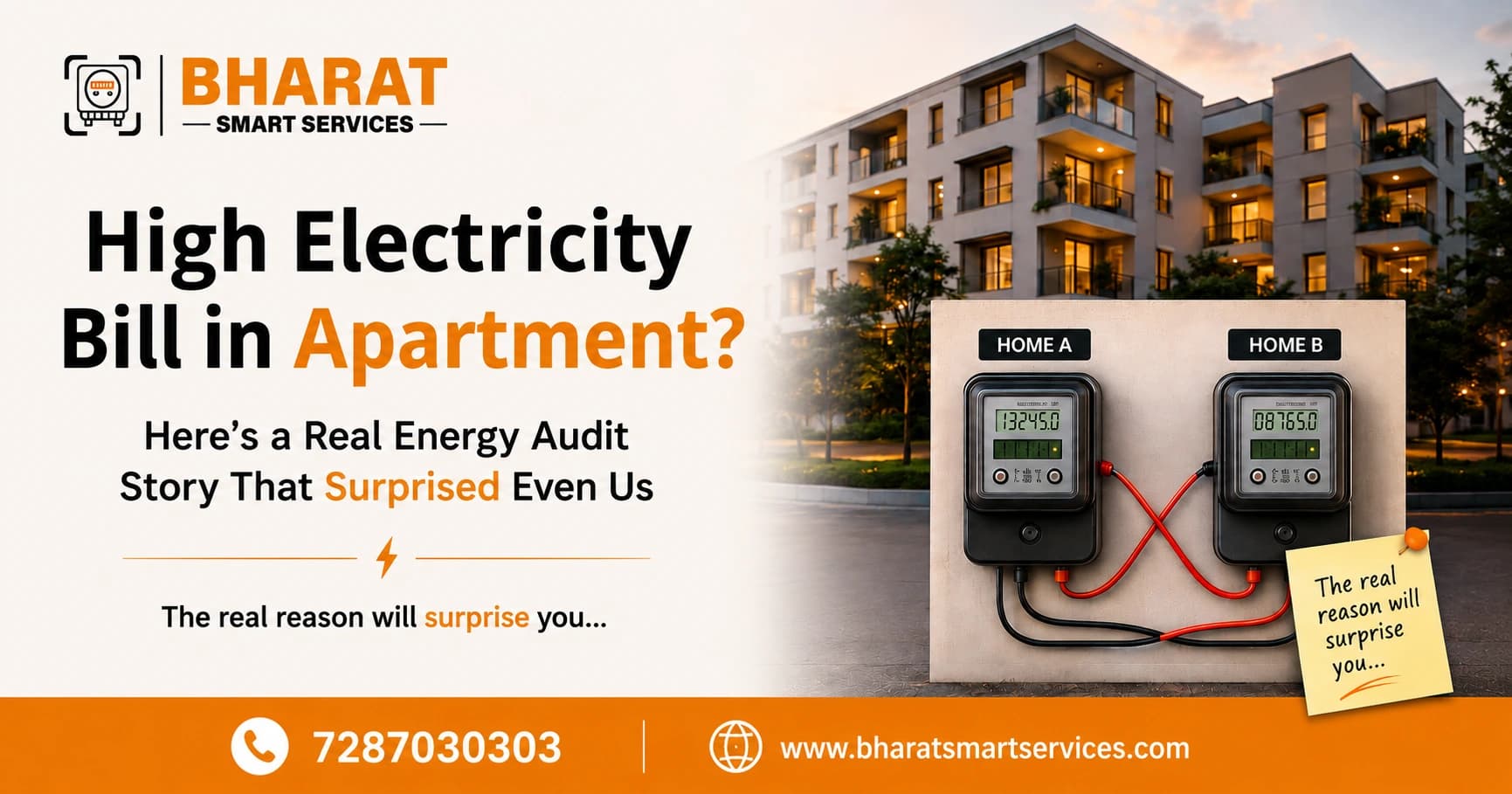
In most cases, consumption hasn’t changed but the electricity bill was higher than the previous month . What has changed is how electricity is being billed, penalized, or misinterpreted.
Penalties
Electricity bills often include hidden penalties that users don’t understand until it’s too late. These penalties quietly increase bills month after month without any visible warning. Like penalties added when recorder MD crosses more than the allocated one.
kVArh Lead Unblocking Impact
kVArh lead charges are one of the most misunderstood reasons for bill spikes, especially in commercial and industrial connections mainly in Telangana.
Without proper monitoring, kVArh lead impact can inflate bills even when the whole industry operations fall under lead.
APFC Inefficiencies
Having an APFC panel does not guarantee savings.
Many users have APFC inefficiencies, incorrect capacitor sizing, operating APFC in manual mode leading to penalties despite the system being installed.
Continuous monitoring
Our objective extends beyond solving existing issues. We ensure that consumers do not experience recurring high electricity bills by providing year-long monitoring services that continuously track performance, identify risks early, and prevent repeat billing problems.
Who We Serve
Industries
We help industries reduce high electricity bills caused by penalties, kVArh lead impact, APFC inefficiencies, and operational blind spots — through continuous monitoring and bill optimisation.
Commercial Buildings
From malls to hospitals to hostels, commercial buildings benefit from meter-level visibility, alert systems, and year-long monitoring to prevent sudden bill shocks.
Utilities
We work closely with utilities to improve meter reading accuracy, billing confidence, and consumer trust using AI-powered systems.
Residential Users
Homes face rising electricity bills due to unmanaged appliances, seasonal usage, and lack of awareness. Our solutions help residential users see, control, and reduce electricity consumption in real time.
Products & Services
Energy Auditing & Root Cause Analysis
We conduct detailed energy audits to identify the core reasons behind high electricity bills. This includes analyzing consumption patterns, penalty triggers, equipment behavior, and billing parameters to ensure corrective actions are based on data, not assumptions.
Free Electricity Bill Analysis
As a starting point, we offer free electricity bill analysis to help consumers understand:
Why their bill has increased
Whether penalties are being applied
What corrective steps are required
This initial analysis helps determine the need for audits, monitoring, or system upgrades.
Bijli Auditor
The Bijli Auditor is an AI-powered energy auditing device that shows real-time electricity consumption at the meter level.
It helps users identify wastage, track patterns, and take corrective action before bills rise.
Smart Plug
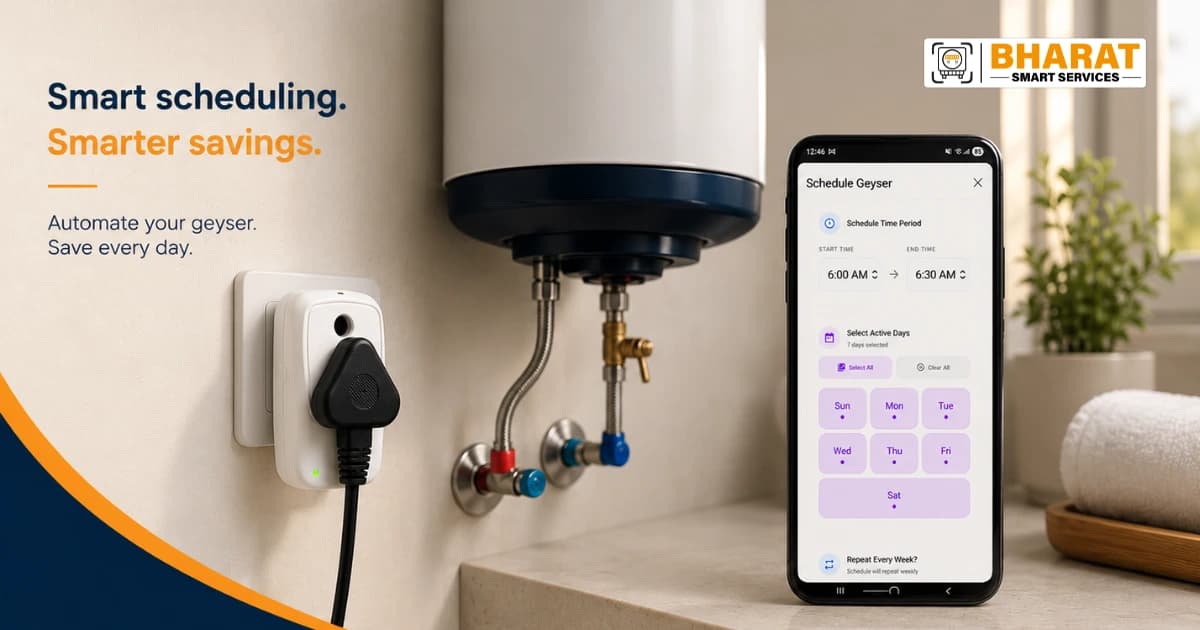
The Smart Plug allows users to control individual appliances, monitor energy usage, and set limits.
It is especially effective for high-consumption devices like geysers, air conditioners, and industrial equipment.
Smart Switches
Our Smart Switches combine elegant design with intelligent control, enabling users to operate lights and appliances remotely while tracking usage data.
APFC Panels & Reactive Power Management
We provide and support APFC panels designed to address power factor penalties and kVArh lead impact. Our approach focuses on proper system design, correct capacitor sizing, and performance validation through monitoring.
Maximum Demand (MD) Monitoring
We offer MD monitoring solutions to help consumers track demand peaks, avoid MD penalties, and manage load behavior effectively across billing cycles.
Power Factor (PF) Correction
Through a combination of system design, APFC optimization, and monitoring, we help maintain optimal power factor levels, ensuring penalty-free billing and stable electrical performance.
AI Meter Reading & Bill Optimisation Services
We use AI-powered meter reading and bill analysis to identify discrepancies, inefficiencies, and penalty triggers ensuring accurate billing and actionable insights.
Year-Long Monitoring (Key Differentiator)
This is where Bharat Smart Services stands apart.
We not only offer Energy Audits but ensure no Electricity bills are recurring, so monitoring must be continuous.
Our year-long monitoring service ensures:
Issues are identified early
Penalties don’t repeat
Savings are sustained month after month
This continuous approach is what delivers real electricity bill reduction, not temporary relief.
Why Bharat Smart Services
Years of Experience
With over 5+ years of experience, we understand electricity billing systems deeply across utilities, industries, and consumer categories.
Scale
We process millions of meter readings every month and actively support 500+ industrial and commercial consumers, along with domestic households, enabling sustained electricity bill reduction through auditing and continuous monitoring.
Utilities Worked With
We actively work with multiple DISCOMs and power utilities, helping improve accuracy, transparency, and consumer confidence.
Real Impact
Millions of accurate meter readings
Thousands of consumers protected from penalties
Consistent reduction in electricity bills through monitoring
Data-backed decisions instead of guesswork
Our impact is measured not in devices sold, but in bills corrected and money saved.
FAQs
Why is my electricity bill suddenly high?
A sudden increase is usually due to penalties, kVArh lead impact, APFC inefficiencies, or meter-level issues, not just higher usage. Proper monitoring reveals the real cause.
Is this a one-time audit?
No. Bharat Smart Services focuses on year-long monitoring because electricity bills recur every month. Continuous tracking prevents repeated losses.
Do you work with DISCOMs?
Yes. We actively work with DISCOMs and utilities, supporting accurate meter reading, billing optimisation, and system transparency.
Is this useful even if APFC is installed?
Absolutely. Many high electricity bills occur despite APFC panels being installed, due to inefficiencies, incorrect settings, or delayed response. Monitoring ensures APFC works as intended.
Contact us
Read More →
Petrol Bunk Electricity Bill vs Fuel Sales: Why Power Costs Suddenly Spike Even When Sales Stay the Same
For most petrol pump owners, fuel sales are easy to track. Daily litres sold remain stable. Customer flow looks normal. Yet suddenly, the electricity bill shoots up.
This leads to a common question many fuel station operators ask:
“If fuel sales are the same, why is my petrol bunk electricity bill increasing?”
This blog explains a real petrol bunk case from Saroornagar, and breaks down why high electricity bills can occur despite steady sales, how power factor mistakes impact costs, and what petrol pump owners should do to avoid excess billing and how to reduce petrol bunk electricity bill.
High Electricity Bill Despite Same Sales: A Real Petrol Pump Case
A petrol bunk in Saroornagar had been operating normally for months.
Fuel sales were consistent. No new machinery was added. Operating hours remained the same.
Yet, one month their electricity bill jumped drastically.
Earlier monthly bill: ₹8,000
New electricity bill: ₹87,000
Fuel sales: No major change
This is a classic example of high electricity bills despite the same sales, something many fuel station owners experience but struggle to understand.
What Changed? kVArh Lead Unblock Notice
The key trigger was a kVArh Lead unblock notice from the electricity utility. Earlier, the petrol bunk’s reactive energy charges were not actively impacting the bill.
After unblocking, power factor behaviour directly affected billing. Instead of analysing the requirement, the bunk owner made a quick decision.
Existing APFC panel: 15 kVAr
Upgraded to: 40 kVAr
Reason: “More capacitor means better bill control”
Unfortunately, this assumption turned out to be costly.
Petrol Pump Profit vs Power Cost: Where Things Went Wrong
After upgrading to a higher capacitor capacity:
Actual energy consumption: 1000 units
Units charged in bill: 9000 units
Excess units billed: 8000 units
This had nothing to do with fuel sales or pump operations. The issue was purely electrical. Installing capacitors more than required pushed the system into PF Lead mode, which attracts penalties after kVArh Lead unblocking.
This is where petrol pump profit vs power cost becomes critical. Even if margins on fuel sales remain the same, incorrect power factor correction can wipe out profits through excess electricity charges.
Why Fuel Station Bills Increase Suddenly
Many petrol bunk owners assume electricity bills increase only when:
Sales increase
Equipment usage increases
Tariff rates change
But in reality, fuel station bills can increase suddenly due to electrical configuration issues, especially:
Incorrect capacitor sizing
PF shifting from Lag to Lead
kVArh penalties becoming active
No post-notice analysis after utility changes
In this case, the correct kVAr requirement would have cost only ₹60,000 as a one-time investment. Instead, a wrong decision led to recurring monthly losses.
The Right Approach: Analysis Before Installation
After a kVArh Lead unblock, the right approach is:
Analyse load pattern
Check PF levels over time
Study kVArh Lag–Lead behaviour
Decide capacitor size based on data, not assumption
More capacity is not better capacity. The right capacity is what saves money.
How Bharat Smart Services Helps kVArh Consumers
This is exactly where expert support becomes essential.
Bharat Smart Services (BSS) helps petrol bunks and other kVArh consumers by:
Analysing real load behaviour
Identifying PF and kVArh issues
Recommending correct capacitor sizing
Preventing excess and avoidable electricity bills
The goal is simple:
Ensure petrol pump owners do not pay more than what they actually consume.
If your petrol bunk is facing:
High electricity bill despite same sales
Sudden increase in power cost
Confusion after kVArh Lead unblocking
Do not rely on guesswork on how to reduce petrol bunk electricity bill. Electricity decisions taken without expert analysis often turn into recurring losses. With the right data and guidance, electricity bills can be controlled and profits protected.
Contact us
Read More →
Sudden Electricity Bill Increase in Hostels and PGs in Hyderabad
A Real Hostel Electricity Bill Problem from Madhapur
Are you running a hostel or PG in Hyderabad?
Or are you staying in one and wondering why your power bill has suddenly increased?
If yes, this story will feel uncomfortably familiar.
Over the last few months, many hostel and PG owners have been facing a sudden electricity bill increase in hostels and PGs in Hyderabad, even though their daily usage has not changed. The bills are higher, the units are more, and no one seems to give a clear explanation. This is not a theory. This is a real case from Madhapur, Hyderabad.
Why Is the Electricity Bill So High from the Last 2 Months?
A hostel owner from Madhapur contacted us with a common complaint:
“There is no change in usage. Rooms are the same. Occupancy is the same.
But the electricity bill has increased suddenly.” For the last 2–3 months, they were facing a high electricity bill in hostels after kVArh lead unblocking, without understanding the reason.
The numbers told a worrying story:
Average daily electricity usage: 200 units
Units charged in the bill: 500 units
Extra units billed daily: 300 units
Extra monthly cost: ₹60,000
Total loss in 3 months: Nearly ₹2 lakhs
This is a classic example of electricity bill problems for hostels and PGs, where the bill no longer reflects actual usage.
Where Did These Extra Units Come From?
Naturally, the hostel owner did what most people would do.
Called one electrician
Then called another
Then tried a third electrician
All of them checked wiring, loads, and the meter. All of them said the same thing:
“Everything looks fine.” But the hostel electricity bill problem in Hyderabad did not go away.The bill kept increasing every month.” This is where most hostel owners get stuck because the issue is not visible at the surface level.
Why This Problem Started After kVArh Lead Unblocking
What many hostel and PG owners don’t realise is that kVArh lead unblocking impact on electricity bills has started showing clearly in recent months.
In this case:
The hostel owner did not receive any clear notice
There was no warning or explanation
The penalty was silently added to the bill
This is why many people are suddenly searching online for:
sudden electricity bill increase in hostels and PGs in Hyderabad
high electricity bill in hostels after kVArh lead unblocking
electricity bill problems for hostels and PGs
And the answers are not easy to find.
When the Hostel Approached Bharat Smart Services
When the hostel owner finally approached Bharat Smart Services, the approach was very simple.
No guessing. No assumptions.
Step One: Track the Meter Data
The hostel owner was asked to:
Use the BSS mobile app
Capture daily meter readings
Monitor consumption continuously for a few days
Within just two days of data, the issue became clear.
The Actual Root Cause Nobody Checked
The real reason behind the electricity bill problems for hostels and PGs was this:
An APFC panel was installed on the premises
The panel was not working properly
Because of this, kVArh lead penalties were being applied
This directly caused the high electricity bill in hostels after kVArh lead unblocking, even though the energy usage stayed the same.
In simple words:
You may use 200 units
But you get charged for 500 units
Because reactive power penalties add your bill
This is the most dangerous part of the kVArh lead unblocking impact on electricity bills; the loss is invisible unless you track it daily.
The Solution That Actually Worked
Once the issue was identified, the solution was straightforward:
Remove the old, non-working APFC panel
Install a properly rated, new APFC panel
Start daily monitoring of power factor and energy data
The result?
Within two days:
Excess units dropped sharply
Billing came back closer to actual usage
The hostel avoided further losses
This is how a major hostel electricity bill problem in Hyderabad was resolved not by trial and error, but through data-backed monitoring.
Why Hostels and PGs Are More Vulnerable
Hostels and PGs operate differently from homes:
Continuous load throughout the day
Pumps, motors, geysers, and lifts
High dependency on electrical equipment
Because of this, even a small technical issue can turn into a sudden electricity bill increase in hostels and PGs in Hyderabad. When kVArh lead penalties are added, the impact becomes severe especially if the owner is not tracking the data daily.
If you are a hostel or PG owner, remember this. If you do not regularly check your electricity bill data, your loss will not be in the thousands it can easily reach lakhs. Most electricity bill problems for hostels and PGs do not come with clear alerts.
They quietly appear in the monthly bill.
A Note for Hostel and PG Residents
If you are staying in a hostel or PG:
Check how electricity charges are calculated
Understand how much of your rent goes toward power bills
A high electricity bill in hostels after kVArh lead unblocking often gets passed on indirectly to residents.
A sudden electricity bill increase in hostels and PGs in Hyderabad
A high electricity bill in hostels after kVArh lead unblocking
Ongoing electricity bill problems for hostels and PGs
Do not rely only on assumptions or surface-level checks. Daily monitoring, kVArh analysis, and power factor correction are no longer optional; they are essential.
Bharat Smart Services helps hostel and PG owners identify the real problem early, reduce unnecessary penalties, and prevent long-term financial loss through data-driven energy monitoring.
Contact us
Read More →
High Electricity Bill After kVArh Lead Unblocking in Telangana? A Real Rice Mill Case Explained
Many industrial consumers in Telangana have noticed a sudden rise in their electricity bills over the last few months.
The common concern sounds like this:
“Our production is the same.
Our machines are the same.
Then why is the electricity bill increasing?”
If you are searching for answers related to high electricity bill after kVArh lead unblocking in Telangana, this real rice mill case from Miryalguda will help you understand what is actually happening and what not to do.
The Case: High Electricity Bill Despite Same Production
A rice mill in Miryalguda, Telangana had been paying close to ₹30 lakhs per month as electricity charges.
Production levels were stable
Operating hours were unchanged
No major equipment upgrades were made
However, after kVArh lead unblocking in Telangana and the withdrawal of Time of Day (ToD) concessions, the electricity bill increased sharply. This situation is becoming common across industries, especially rice mills, cold storages, and manufacturing units.
Why Electricity Bills Increase After kVArh Lead Unblocking
Earlier only kVArh lead factor was considered into billing, but recently (late 2025) kVArh lead factor is also considered. Which means earlier people used to maintain capacitor banks to maintain PF near to 1, but if you add capacitors more than needed you may overcompensate which may result in operation in lead, adding excess charges. This is why many industries see a high electricity bill after kVArh lead unblocking, even when units consumed remain similar.
The Mistake Many Industries Make
In this rice mill’s case, management assumed:
“If we shift operations to night hours, the bill will reduce.”
This assumption was based on Time of Day (ToD) benefits.
What they didn’t realise was critical:
ToD concessions in Telangana had already been withdrawn.
As a result:
Night-time operation did not offer any benefit
Electricity costs increased further
Operational changes were made without billing clarity
This is a classic example of how assumptions worsen high electricity bills
Why Shifting Operations Without Analysis Backfires.
But after kVArh lead unblocking, these actions can backfire if:
Lag/Lead behavior is not monitored
CMD (Contracted Maximum Demand) is mismatched
Reactive penalties are misunderstood
In this case, the rice mill’s electricity bill increased further, not because of higher usage, but because billing parameters were not understood.
What Actually Revealed the Problem
The real issue became clear only after daily monitoring of electrical parameters using Bharat Smart Services App, including:
Power Factor (PF)
Contracted Maximum Demand (CMD)
Lag and Lead kVArh values
Billed units and consumed units
Excess untis
This kind of visibility is essential for industries facing high electricity bills in Telangana.
Why Rice Mills in Telangana Are Especially Affected
Rice mills typically:
Operate large motors
Have variable load conditions
Depend heavily on reactive power compensation
After kVArh lead unblocking in Telangana, rice mills without proper monitoring face:
Sudden penalties
Unpredictable bills
Reduced control over electricity costs
This is why high electricity bill for rice mills in Telangana has become a frequent search query. A high electricity bill does not always mean high consumption.
What Industries in Telangana Should Check First
Before changing operations, industries facing a high electricity bill after November 2024 should check:
Whether kVArh lead is unblocked
Whether ToD benefits still apply
Daily Lag/Lead behavior
CMD vs actual demand
Whether PF alone reflects billing impact
These checks prevent unnecessary operational changes and financial loss.
How to check whether you are operating in kVArh lead/lag?
Facing High Electricity Bills in Telangana?
If your industry is affected by kVArh lead unblocking, regular monitoring and understanding of electrical parameters is no longer optional. The Bharat Smart Services (BSS) helps industries gain daily visibility into energy behavior and billing factors.
Contact us
Read More →
How to Reduce the Electricity Bill in a Rice Mill: A Real Story from Huzur Nagar
Electricity is one of the biggest operating costs in rice milling. For many mill owners, even small changes in electrical behavior can lead to large financial impact. This became very clear after the recent kVArh Lead unblocking.
In this article, we share a real story from a rice mill in Huzurnagar to explain how to reduce the electricity bill in a rice mill and how to improve energy efficiency in rice milling not through guesswork, but through understanding and monitoring.
A Rice Mill That Tried to Reduce Its Bill and Accidentally Increased It
For many industries, one small mistake can mean a high electricity bill. A rice mill in Huzurnagar noticed that its electricity costs were increasing after kVArh Lead was unblocked. The mill owner wanted to reduce the bill and took what seemed like the right step.
For years, the mill had been operating its APFC (Automatic Power Factor Control) panel manually. After the billing change, automatic operation became necessary. So the team rushed into rewiring the panel to switch it to automatic mode.
Unfortunately, the wiring was done incorrectly.
Instead of reducing reactive power and improving efficiency, the wrong connection increased electrical imbalance. The power factor became unstable. Lead and lag increased. And instead of going down, the electricity bill went up further.
The confusion grew. Nothing looked wrong in production. Machines were running fine. Output was stable. Yet the bill kept rising. Finally, they decided to get expert help.
What the Energy Audit Revealed?
When a detailed energy audit was conducted, the root cause became clear.
The problem was not the machines.It was not the production load. It was not the operating hours. The real issue was the incorrect wiring of the APFC panel.
Once the wiring was corrected and the panel was configured properly, the mill started monitoring its electrical performance daily especially:
Power Factor (PF)
Lead and Lag behavior
Overall energy balance
Slowly, the power factor stabilized. Lead and lag came under control. And most importantly, the electricity bill became predictable again.
This is a simple but powerful example of how technical accuracy and monitoring directly affect costs.
Book your energy audit now
How to Reduce the Electricity Bill in a Rice Mill
This story highlights an important lesson: reducing electricity bills is not only about using less power — it is about using power correctly.
Here are some practical steps for rice mill owners:
1. Don’t Make Electrical Changes in a Hurry
After a billing or regulatory change, rushing into operational or electrical changes without understanding the impact can backfire. Always evaluate first.
2. Ensure APFC Panels Are Correctly Configured
APFC panels are critical for maintaining a healthy power factor. Incorrect wiring or configuration can increase imbalance and reactive energy — which directly increases billing.
3. Monitor Power Factor and Lead/Lag Regularly
Daily or weekly monitoring helps catch issues early, before they reflect high charges in the monthly bill.
4. Get a Professional Energy Audit
An audit helps identify hidden inefficiencies that are not visible on the shop floor but appear clearly in electrical data.
These steps are the foundation of how to reduce the electricity bill in a rice mill in a sustainable and reliable way.
Get your own monitoring system
How to Improve Energy Efficiency in Rice Milling
Energy efficiency is not just about saving money , it is about stability, predictability, and operational control.
To improve energy efficiency in rice milling:
Maintain a stable and healthy power factor
Avoid excessive reactive energy (both lead and lag)
Keep electrical systems properly configured and maintained
Use data and monitoring instead of assumptions
When energy behavior is efficient, billing becomes fair and predictable. That stability helps mill owners plan better, price better, and operate with confidence. This is the core of how to improve energy efficiency in rice milling not by cutting corners, but by improving understanding.
The rice mill in Huzurnagar did not fail because it was careless. It failed because it acted too quickly without full clarity.
If you are seeing higher electricity bills, the solution is not panic it is understanding. Start by knowing what changed. Then know what it means for your system. And only then decide what to change.
That is how real savings happen. Contact us to reduce your rice mill electricity bill.
Contact us
Read More →
How Telangana Industries Can High Reduce Electricity Bills After kVArh Lead Unblocking
For many industries across Telangana, the last few months have been confusing facing sudden hike in electricity bills with no change in production.
This is happening largely because of the recent kVArh Lead unblocking in electricity billing. And while the change is technical, its impact is very real - showing up as higher billed units and increased costs for many industrial consumers.
The good news?
This is not a problem you have to live with. With the right understanding and daily monitoring, industries can regain control and even reduce their bills.
What Is kVArh Lead Unblocking And Why It Increased Your Bill
Earlier, only certain reactive energy components were considered for billing. After unblocking, both kVArh Lag and kVArh Lead are now included in billing calculations.
That means:
Over-compensation by capacitor banks
Unstable or fluctuating power factor
Excess reactive energy in either direction
…can now directly convert into extra billed units, even if your actual kWh consumption hasn’t increased.
So the issue is often not operational but it’s electrical behaviour, quietly increasing your bill in the background.
Why Most Industries Don’t Notice the Problem Early
Inside the plant, everything usually looks normal:
Machines are running fine
No breakdowns
No alarms
No obvious inefficiency
But small issues like:
Capacitor banks switching incorrectly during low load
Old or oversized motors running inefficiently
Reactive imbalance during partial load
Seasonal load variations
…slowly create excess kVArh Lead or Lag, which now gets billed.
And since most industries only look at the bill at month-end, the loss is already done by then.
The Only Sustainable Way to Reduce the Bill: Daily Visibility
The real shift is this:
From “checking the bill after it arrives”
to “seeing the problem while it is forming.”
This is exactly where Bharat Smart Services helps industries.
Instead of guessing, you get daily, visual, data-backed clarity on what is happening electrically and how it impacts billing.
How Bharat Smart Services Helps Industries Reduce Bills
1. Daily Meter CaptureAuto-capture kWh, kVAh, kVArh Lag and Lead directly from the meter using your phone — no manual entry, no errors.
2. Clear DashboardInstantly see consumed units vs billed units, excess billing, reactive energy, and power factor trends.
3. History & ProofEvery reading is stored with date, time, and photo proof — making it easy to trace when inefficiency started.
4. Expert OptimisationWe analyse the data, identify the root cause of excess billing, and guide corrective actions to prevent future losses.
What This Means for Telangana Industries
With kVArh Lead unblocking now active, reactive inefficiencies are no longer invisible. They are directly monetised in your bill.
Industries that continue with monthly-only checks will keep losing silently.
Industries that monitor daily will:
Detect imbalance early
Correct it before it grows
Stabilise power factor
Reduce excess billed units
And bring electricity costs back under control
On a final note
Electricity billing has changed and we must change the way we manage it.
That’s exactly what Bharat Smart Services enables helping industries shift from reactive to proactive, from surprise to control, and from excess billing to optimised consumption. If your bill has increased after kVArh Lead unblocking, it’s not a failure. It’s simply a signal — that your system needs visibility. And visibility changes everything.
Contact us
Read More →
How the Unblocking of kVArh Lead Affected a Crusher Unit in Suryapet
When the owner of a crusher unit in Suryapet contacted us, his question was simple:
“My production is the same. Why has my electricity cost suddenly increased?”
He was seeing a higher electricity bill, even though output and operations had not changed. What followed was a clear example of how small changes in electrical behaviour can silently create significant financial impact.
The Situation
A crusher unit in Suryapet was operating normally and production levels had not changed.
However, after the recent billing update related to kVArh lead unblocking:
Their electricity bill increased by about 20% — roughly ₹2 lakhs extra.
There was no increase in production.
There were no new machines added.
Operations were unchanged.
So the cost increase was not operational — it was electrical.
What Was Really Causing This
Our technical audit showed:
Fixed capacitor banks were over-compensating during low-load periods.
This created excess kVArh lead.
Power factor became unstable.
This instability increased billed units, which directly increased the electricity bill.
Nothing was wrong with the production process.The issue was entirely in the electrical behaviour and how it was being measured and billed.
Why This Was Hard to Detect
Inside the plant, everything looked normal:
Machines were running.
Output was steady.
There were no breakdowns.
The loss was not happening on the floor it was happening silently in the billing data.
Without detailed monitoring, this kind of loss is very difficult to notice until the bill arrives.
How Bharat Smart Services Helped
We:
Analysed billing and reactive energy trends.
Identified the source of excess kVArh lead.
Recommended tuning and dynamic control of capacitor usage.
Stabilised power factor behaviour.
Helped prevent further inflation of billed units.
As a result:
Billed units normalised.
Electricity bills stabilised.
The client stopped paying for invisible inefficiency.
The Key Learning from This Case
This case highlights three important points:
High electricity bills do not always mean high electricity usage.
Electrical imbalance can silently increase costs without any visible operational change.
Billing behaviour matters just as much as operational behaviour.
Conclusion
The Suryapet crusher case is not an exception — it is an example of how billing sensitivity has increased and inefficiency is now more costly than before.
Understanding and managing electrical behaviour is now essential for controlling energy costs.
If your electricity bill has increased without a clear operational reason, the cause may not be visible on the shop floor — it may be hidden in your energy behaviour.
Bharat Smart Services helps industries identify and fix this before it becomes a financial problem.
Contact us
Read More →
How One Manufacturing Unit in Choutuppal Reduced Its Electricity Bill from ₹1.2 Lakhs to ₹45,000
Electricity is one of the largest operating costs for manufacturing industries. But high electricity bills are not always caused by high consumption. This case from a manufacturing unit in Choutuppal shows how identifying the real root cause of inefficiency can lead to dramatic savings — without changing production, staff, or working hours.
Where the Industry Was Struggling
The manufacturing unit in Choutuppal was paying around ₹1,20,000 per month for electricity. The team had already taken steps to improve power factor, but despite multiple attempts, they were only able to maintain it at around 0.7. The bill remained high, and the exact reason was unclear. That’s when they approached Bharat Smart Services.
What Our Team Observed On-Site
Our technical team conducted a detailed energy assessment at the facility.
Instead of looking only at overall consumption, we studied how electricity was flowing through different machines and systems.
During this process, we discovered that one old motor was operating inefficiently and consuming significantly more power than required.
This single piece of equipment was contributing disproportionately to both energy consumption and power quality issues.
The Focused Change That Made the Difference
Based on our findings, we recommended one specific action:
Replace the inefficient motor with an energy-efficient one.
No other changes were made to the production process.
What Changed After the Fix
After the motor replacement:
Monthly electricity bill reduced from ₹1,20,000 to ₹45,000
Power factor improved from 0.7 to 0.98
Energy performance became stable and predictable
This single intervention resulted in savings of over ₹75,000 per month.
What This Case Teaches Us
This case demonstrates that:
High electricity bills are often caused by hidden inefficiencies, not visible overuse
Improving power factor alone does not guarantee savings
Identifying the root cause is more effective than adding more equipment
How Bharat Smart Services Supports Industries
We help industries:
Understand how energy is actually used inside their facilities
Identify inefficiencies before they become financial problems
Take precise corrective action instead of costly trial-and-error
Build long-term energy efficiency into operations
A system where an industry owner can know the energy efficiency of the industry right from the
Energy optimisation is not about reducing output — it is about removing waste.
The Choutuppal case is a reminder that sometimes, one small correction can unlock very large savings.
We are here to help every industry find the root cause of high electricity bills and turn hidden losses into real savings.
Listen from our team member words here
Contact us
Read More →
Why Rice Mills in Telangana Are Getting High Electricity Bills - And How to Reduce Them ?
If you run a rice mill in Telangana, you may have noticed something frustrating lately:
Your electricity bill has increased even when your production hasn’t.
Since the introduction of update in kVAh billing by unblocking kVArh lead factor , many rice mill owners are seeing higher bills — especially seasonal mills and mills without proper power factor management.
This blog explains why this is happening, what has changed in billing, and how rice mill owners can reduce their electricity bills in a smart and sustainable way.
Why Are Rice Mills More Affected by the New Billing System?
Rice mills operate very differently from other industries:
They run heavy motors for polishers, elevators, blowers, and compressors.
They operate seasonally, not continuously throughout the year.
Machines start and stop frequently based on paddy availability.
Load fluctuates significantly between peak milling hours and idle time.
This operating pattern creates multiple inefficiencies that now directly impact billing.
Note: You are now billed not only for the useful energy you consume, but also for inefficient and unstable electrical behaviour.
All the Major Reasons For Rice Mills Getting Higher Bills
No APFC or Improper Power Factor Management
Without automatic correction, power factor drops during partial loads, increasing reactive energy and billed units.
Fixed or Poorly Sized Capacitor Banks
Many mills have fixed capacitors that:
Over-compensate at low load (creating excess kVArh lead
Under-compensate at high load (creating kVArh lag)
Cause frequent electrical imbalance
This instability increases kVAh and now directly increases billing.
Unblocking of kVArh Lead
Earlier, excess leading reactive power (generated by capacitors) was often ignored.
Now, with kVArh lead unblocking, this excess is:
Measured
Recorded
Reflected in billing
Seasonal and Batch-Based Operations
When mills operate partially or intermittently:
Power factor becomes unstable
Capacitors do not match load
Reactive energy increases
This makes seasonal mills more vulnerable than continuous-process industries.
Old or Inefficient Equipment
Old motors, blowers, and dryers consume more power and worsen electrical behaviour.
Lack of Visibility and Control
Most mills only see problems when the bill arrives — by then the loss has already happened.
Common Problems We See in Rice Mills
Power factor dropping below recommended levels during partial or night operations
Capacitors not switching properly
Machines running idle between batches
No monitoring of kVAh and kVArh lead/lag
No alerts when something goes wrong
As a result:
The wastage silently adds to your bill — and you only realise it when the bill arrives.
How Bharat Smart Services Helps Rice Mills Reduce Electricity Bills
At Bharat Smart Services, we help rice mill owners understand, control, and optimise their electricity usage.
We don’t just show data — we give clear actions.
What we do:
Monitor your energy usage daily, not just monthly
Track kVAh, power factor, and kVArh lead & lag trends
Detect abnormal behaviour and inefficiencies early
Alert you when corrective action is needed
Help you stabilise electrical behaviour and avoid penalties
In simple words:
We help you stop paying for wasted electricity.
What You Should Do Immediately
If your rice mill Electricity bill has increased:
Do not wait for the next bill cycle.
Do not add random equipment without understanding the cause.
The first step is visibility.
Reach out to Bharat Smart Services to:
Analyse your current energy behaviour
Identify the exact cause of high billing
Take corrective action before the next bill
Contact us
Read More →
100 Smart Consumers of Telangana: Acting Early, Saving Big!
Electricity bills are rising across Telangana, especially for industries and commercial users.
The reasons are clear: increased power consumption, improper Power Factor (PF) maintenance, higher Contracted Maximum Demand (CMD) penalties, and inefficiencies in energy usage and New kVAh billing regulations for all kVAh consumers. But over 100 proactive consumers decided not to wait for their next shock bill. They acted early with Bharat Smart Services (BSS) and turned rising costs into smart savings.
Awareness Sessions That Saved Thousands Of Rupees
Even before the new regulation came into effect, a group of forward-thinking consumers had already started preparing guided by the awareness sessions and expert support from us. Through these sessions, they learned how improper power factor maintenance, inefficient loads, and unnoticed wastage could lead to heavy penalties and rising bills once the new rules took hold.
Click Here to know the impact of new billing
Acting early, they opted for our AI-powered energy audits and discovered hidden inefficiencies, power factor correction, and unnecessary load patterns that had been silently draining their profits. With the help of the Bijli Auditor, they began tracking real-time electricity consumption, identifying exactly when and where energy was being wasted, and taking corrective steps before the regulations even began to impact others.
The Smart Move: Automatic Power Factor Controller (APFC)
One of the biggest contributors to high industrial electricity bills is the inability to maintain the power factor at unity, often fluctuating toward lagging or leading conditions during operations. These variations result in reactive power loss, power factor surcharges, and maximum demand penalties.
To overcome this, many smart consumers installed our Automatic Power Factor Control (APFC) panels which helps to:
Maintain power factor near 0.99 (close to unity) even under varying loads
Reduce reactive and apparent power demand
Avoid power factor surcharges and maximum demand penalties
Improve power quality and minimize harmonic distortion
Protect electrical equipment from overheating and damage
Lower electricity expenses through efficient power management
Want to have a Automatic Power Factor controlling: Click Here
From Reactive to Proactive — The Smart Consumer Movement
Instead of waiting for the next high bill, Telangana’s smart consumers took charge. With the Bharat Smart Services app, they began setting energy limits, receiving instant alerts, and making data-driven adjustments to manage their electricity usage efficiently.
This proactive approach helped them:
Avoid penalties under the new regulations
Reduce monthly electricity bills by 10–20%
Maintain efficient performance of their appliances and equipment
Stay aware and in control of their energy consumption at all times
From households in Hyderabad to small businesses and industrial consumers are proving that smart action today ensures sustainable savings tomorrow. This is more than just a story of savings, it’s a story of awareness, accountability, and collective action. Together, they are driving Telangana’s journey toward responsible energy use one smart decision at a time.
Join the 100 Smart Consumers of Telangana
If you’ve been noticing rising electricity bills or want to stay ahead of new regulatory changes, now’s the time to act.
Let Bharat Smart Services help you monitor, analyze, and optimize your energy use before the next bill arrives.
Track every watt, every minute
Stay compliant and save more
Be part of Telangana’s smart energy movement
Join the 100 Smart Consumers of Telangana today and become a True Climate Yodha
Read More →
TGSPDCL/ TGNPDCL Issues Notice: Maintain Power Factor at Unity — Impact on HT, LT High Value & Commercial Consumers
If you are an HT, LT High Value, or commercial consumer in Telangana,then this blog is meant for you. Recently, TGSPDCL (Southern Power Distribution Company) and TGNPDCL (Northern Power Distribution Company) issued notices asking consumers to maintain power factor at unity.
This change directly affects your electricity bill—even if your actual power consumption (kWh) doesn’t increase.
In this blog, we’ll explain what the notice means, how kVAh billing works, and what every consumer should do to avoid higher bills.
What is kVAh Billing?
Electricity billing in India is moving towards kVAh-based billing instead of just kWh.
kWh (kilowatt-hour): Measures active energy (actual useful work).
kVARh (reactive energy): Extra energy required to maintain voltage and magnetic fields, but does no useful work.
kVAh (apparent energy): Combination of both active and reactive energy.
Until now, your bills were calculated mainly on:
kVAh = √(kWh² + (kVARh Lag)²)
Formula under new rule:
kVAh = √(kWh² + (kVARh Lag + kVARh Lead)²)
In simple terms: Earlier only lagging reactive energy was billed. Now both lagging and leading reactive energy will be included.
What Did the TGSPDCL/TGNPDCL Notice Say?
The Telangana Electricity Regulatory Commission (TSERC) directed Discoms to unblock leading kVARh for kVAh billing.
Consumers are given a 3-month notice period to correct their power factor near unity.
After 3 months, leading kVARh will be included in billing, which means:
Overcompensation by capacitor banks → higher kVAh bills
Power factor less than unity → increased costs
Who Will Be Impacted?
HT Consumers (Industrial Users)
Industries with motors, furnaces, compressors, and heavy loads are most affected. Wrongly sized capacitors can push PF into leading, which now adds to your bill.
LT High Value Consumers
Large buildings, malls, hospitals, schools, and commercial complexes with varying loads must now closely monitor PF swings.
Commercial Consumers
Even shops, offices, and mid-sized businesses will notice higher bills if they ignore PF. The new billing ensures every unit of wasted reactive energy is charged.
Want to know the impact of new billing ? Click here
Why Telangana Introduced This Rule?
The move to kVAh billing with leading kVARh inclusion is aimed at:
Reducing technical losses in the power grid and preventing overloading of DTRS.
Encouraging efficient energy use by making consumers maintain power factor close to unity.
Ensuring fair billing, so consumers pay for the actual energy impact (both active & reactive) they draw from the grid.
What Should Consumers Do Now?
The new kVAh billing rule may sound worrying, but with the right tools and monitoring, you can stay at unity power factor and avoid penalties.
How Bharat Smart Services Protects You from kVAh Billing Losses
Bharat Smart Services ensures you stay ahead of these surprises with smart solutions that monitor, alert, and optimize your electricity usage. Here’s how we protect you from kVAh billing losses:
On-Site Survey
Expert visit to measure the impact of kVArh lead/lag.
Identify billing risks & low-hanging fruits for quick savings.
Live Monitoring
Bijli Auditor tracks PF, kWh, and kVAh in real time.
Full visibility of leading kVArh → prevents surprise billing.
Instant Alerts
Mobile & email notifications when PF drifts into the leading zone.
Take action before penalties → zero excess bills.
Customized Savings Roadmap
Subscribe to our Bill Optimization Services.
Get a tailored strategy designed for your facility’s unique load profile.
Conclusion:
The new kVAh billing rule in Telangana is a major shift for HT, LT High Value, and commercial consumers. By including leading kVARh in billing, TGSPDCL and TGNPDCL are ensuring that only efficient users benefit.
The smart move?
Now how much you will get impacted, maintain PF near unity, and adopt our smart solutions to stay ahead. Because in the new billing era, every unit counts. Contact us now before you get impacted.
Read More →
Utility Billing Solution to Avoid Common Electric Billing Errors and Improve Accuracy
Electricity bills aren't just numbers; they have a direct impact on how much money a household can spend, how much money a business can make, and how utilities function. But a lot of people don't realise about these common billing mistakes or how they go unnoticed easily.
These mistakes can be annoying and expensive for both consumers who suddenly see a big jump in their bill and utilities that have trouble with traditional meter reading errors.
Let's look at the most common billing mistakes, why they happen, and most importantly, how Bharat Smart Services AI-powered meter reading and billing platform helps avoid these problems, saving time, money, and trust.
Why billing errors still happen — even today?
Traditional meter reading involves steps where errors can occur even after years of practice. Here's where and how it takes place:
Unable to access the meter: weather conditions, high placement of meter or locked houses cause readings to be estimated rather than precise.
Human reading errors: A reader may struggle with faded displays, skip digits, or misread numbers (for example, 1258 as 1528).
Errors in data entry: Incorrectly entering a number or choosing the incorrect customer account could result in the billing of someone else's usage.
Calculation errors: Incorrect tariff slab applied, omitted subsidy, or software error resulting in an incorrect amount on the bill.
Delivery delays: The customer is unable to review or pay on time because the paper bill is lost or delayed.
Every little mistake adds up, costing utilities revenue and breaking customer trust.
Increased expectations from customers
Consumers of today demand quick explanations when something appears incorrect on a bill, transparency, and digital access. Manual corrections can be slow and destroy faith.
Operational stress
For utilities already handling multiple tasks, every billing complaint may feel like a burden on the teams.
Regulatory and competitive pressure
Utilities are subject to the regulatory control and pressure to modernise in many areas. Maintaining reputation and proving satisfaction can be made easier with accurate billing.
How AI-powered meter reading changes the game
100% Accurate Meter Reading Captured
Bharat Smart Services platform reads meter photos, whether taken by field workers or customers, using AI-powered optical character recognition (OCR) technology rather than just handwritten notes. This reduces errors in manual data entry and maintains more trustworthy records.
Faster Billing & Processing
Utilities can process readings up to 50% faster by automating meter reading, validation, and bill generation. This speeds up billing cycles without compromising accuracy.
Efficiency through Bulk Photo Analysis
Hundreds of meter photos can be uploaded simultaneously by utilities; AI reduces the amount of time needed for manual verification by extracting the reading, unit, and serial number while identifying exceptions such as spoof attempts or unclear images.
Experience now
Self Meter Reading for consumers
Through the Bharat Smart Services app customers can capture meters on their own meters, increasing transparency and trust by providing them with insight into their usage and the ability to track anticipated bills.
Monitoring & Alerts in Real Time
It is easier for utilities to take action before issues become complaints when they receive immediate alerts about anomalies, skipped meters, or unusual consumption patterns.
The impact utilities see after our Ai-powered meter reading platform
Zero revenue leakage through consistent, accurate reads
Fewer disputes and faster complaint resolution, thanks to photo-backed evidence
Improved consumer satisfaction with transparent, self-service options
Scalable deployment across electricity, water, and gas
Trusted by 14+ utilities across India, with over 30 million meter reads processed monthly
Ready to transform your utility operations?
Join 14+ utilities already simplifying, accelerating, and securing their meter reading and billing with Bharat Smart Services.
Contact Us
Read More →
TSERC New kVAh Billing Rule: What Telangana Industries Must Know to Avoid Hidden Losses
The Telangana State Electricity Regulatory Commission (TGERC) has introduced a new kVAh billing rule that will directly impact industries in Telangana.
If you’re managing power factor (PF) with capacitor banks, your bill may still increase unexpectedly — even if your load stays the same.
In this blog, we’ll explore:
What changed in the new TSERC kVAh billing rule?
Why does the power factor gone leading and excess capacitor bank can now cost you?
How to reduce kVAh consumption before the rule takes effect?
Why does a power factor audit matter now?
What changed in Telangana’s kVAh billing?
Earlier, Telangana industries paid for apparent energy (kVAh) calculated as:
kVAh = √(kWh² + (kVARh Lag)²)
This meant only lagging reactive power (from inductive loads like motors) increased your bill. Now, TSERC’s new kVAh billing rule includes both lagging and leading reactive energy:
kVAh = √(kWh² + (kVARh Lag + kVARh Lead)²)
That means:
If your power factor goes leading (often because of too much capacitor bank or overcompensation)
The extra kVARh Lead adds to your kVAh
Your bill increases, even if your actual load (kWh) stays the same
This new billing is being implemented by TGSPDCL and TGNPDCL across Telangana.
Why is leading PF a concern for industries?
To address lagging power factors, many plants install large or automated capacitor banks. In the earlier days, there was no penalty even if the PF took a slight lead.
Now, leading power factor, or PF below 1.0, results in:
Billed extra kVAh units
Increased energy charges
You might not be aware of hidden losses until you receive your electricity bill.
Industries running with excess capacitor banks or incorrect APFC panel settings risk paying for power they don’t even use.
How to reduce kVAh consumption and avoid penalties?
Industries need to:
Track kVAh Lag and kVAh Lead separately
Detect when PF goes leading or beyond 1.0
Adjust capacitor banks dynamically
Manual tracking won’t help. You need:
Live monitoring
Smart alerts
Data-driven correction
This is where Bharat Smart Services helps you.
How Bharat Smart Services helps industries reduce losses?
Our AI-powered energy monitoring solutions help you adapt to the new TSERC kVAh billing and keep your costs under control:
Real-time tracking of kWh, kVARh Lag & Lead to catch hidden reactive power losses
Accurate capacitor bank recommendations to keep PF balanced and avoid overcompensation
Reduction of excess kVAh consumption and demand charges
Power factor optimization for consistently lower bills
Key solutions include:
3-Phase Bijli Auditor: Audits your plant, finds leakages, and with the demand controller keeps your demand within limits
Smart PF Correction Guidance: AI-driven alerts when PF goes leading
Reactive Power Monitoring: Detects and prevents over-correction
Custom TSERC-compliant alerts & reports: Stay audit-ready and compliant
Know how much excess electricity bill you are going to pay next month. Click here
Conclusion
The new TSERC kVAh billing rule is a major shift for industries in Telangana — making both lagging and leading reactive power part of your monthly bill. Even with the same load, your costs can rise unexpectedly if your power factor goes leading or you run with an excess capacitor bank.
At Bharat Smart Services, our AI-powered solutions like the Bijli Auditor - 3-phase with demand controller, real-time monitoring, and smart PF correction guidance help you stay compliant, balanced, and efficient.
Don’t wait for the first high bill to reveal hidden losses.
Act now: book your energy audit and power factor health check to identify cost-saving opportunities and keep your kVAh consumption under control.
Contact Us
Read More →
India’s New AC Temperature Rule: A Step Toward Saving Electricity and the Environment
India Sets New AC Temperature Limits — Here’s What You Need to Know
The Indian government has issued a new regulation: all air conditioners must now operate between 20°C and 28°C. This move aims to reduce electricity consumption, reduce carbon emissions, and protect the environment. So, what does this mean for you — as a consumer or a utility provider? And how can you adapt without giving up your cooling comfort?
Let’s break it down.
Why Did the Government Set AC Temperature Limits?
During the rising hot summers AC's are no longer a luxury. But setting them at very low temperatures is silently increasing energy consumption and damaging the environment. In fact, every 1°C increase in AC temperature can reduce electricity usage by up to 6%.
As millions of ACs run during peak hours, they push electricity demand to record highs—leading to blackouts, unstable grids, and a greater reliance on fossil fuels.
Yet, most families remain unaware of their AC’s impact—until the bill arrives, often running into thousands due to inefficient use.
The Real Need Isn’t Just Temperature Limits—It’s Control
Think about it:
Do you know how much electricity your AC consumes every day?
Can you track if it’s running beyond the efficient range?
Are you sure your electricity bill is fair or full of silent wastage?
Most people don’t—and that’s the problem.
Here’s what that silent wastage does:
Your electricity bill spikes without you knowing why
Every wasted unit adds to carbon emissions, worsening climate change
Utilities struggle to balance peak demand, leading to blackouts and overloading
And you? You’re left with confusion, disputes, and no data to challenge high bills.
Smart Rules Need Smarter Tools — And That’s Where We Come In
A rule is the first step.
But to truly reduce your bill, energy consumption and your carbon footprint, you need real-time insight and control.
That’s exactly what our smart devices deliver — for your wallet and for the planet.
The Solution: One Bharat Smart Plug
All you need is ONE Smart Plug — from Bharat Smart Services. This single plug turns your regular AC or any pluggable appliance into a smart, energy-efficient device.
What It Does:
Tracks Real-Time Usage
See exactly how much power your AC is using — live on your phone in Bharat Smart Services App.
Sends Alerts
Get notified when it crosses safe limits or runs too long.
Auto-Schedules Your AC
Set timers to switch it off when you sleep, step out, or during peak hours.
Cuts Your Electricity Bill
Use your AC smartly — without sacrificing comfort.
Helps You Go Green
Save energy, reduce your carbon footprint, and support India’s clean energy mission.
This isn’t just about a temperature setting. It’s about being part of India’s energy transformation.
Ready to Save? Here’s How You Can Start
Oder Bharat Smart Plug now.
Save In Just 3 Easy Steps:
Plug It In
Connect your AC to the Bharat Smart Plug.
Open the App
Download the Bharat Smart Services app and link your plug in seconds.
Take Control
Track usage, set limits, schedule run-times — and start saving instantly!
It reminds us that energy isn’t infinite, and every degree we cool comes at a cost — to our bills, our grid, and our planet. But real change doesn’t have to be complicated. It starts with one simple step: putting the power back in your hands. With just one Bharat Smart Plug, you gain control over your energy use, reduce wastage, cut costs and help the planet.
Order Now
Read More →
World Environment Day 2025: How Smart Energy Devices Help Turn Awareness into Action
Every year, World Environment Day reminds us that our planet’s future depends on what we do today, especially when it comes to how to use electricity wisely at home. This year, TGSPDCL Chairman and Managing Director Musharraf Ali Faruqui delivered an important and timely message:
“Saving electricity means saving the environment.”
Conserving energy doesn’t have to be complicated it begins with small, conscious adjustments in our lifestyles. Some of the most effective actions are:
Choosing LED lights over traditional bulbs
Using 5-star rated appliances
Setting our AC temperature to 24–26°C
Unplugging devices when not in use
Avoid using heavy appliances during peak hours
Install solar panels and solar heaters wherever possible
His message was practical, empowering, and deeply aligned with our shared responsibility to reduce carbon emissions and protect our ecosystem. But one question naturally follows:
How can we make these actions part of our everyday routine — without forgetting, guessing, or struggling?
We Don’t Lack Intention : We Lack Tools
Many families want to save electricity and reduce their bills.
We understand that switching to LEDs or unplugging devices makes a difference.
But in the hustle of daily life, it’s easy to:
Forget what’s running
Not realize how much electricity each appliance is using
Running heavy appliances during peak hours
Be unaware of “phantom load” from devices left on standby.
That’s where Bharat Smart Services offers support — with smart energy-saving devices designed for Indian households, rooted in practicality, and driven by technology.
Our Smart Solutions That Make Energy Saving Effortless
When it comes to protecting our planet, awareness needs to turn into action. That’s where smart technology steps in and makes a real difference.
At Bharat Smart Services, we believe saving electricity should be effortless, it should become second nature. Our smart devices are designed to empower every household with the clarity, control, and confidence they need to reduce electricity bills in energy use without any guesswork. With features like real-time monitoring, remote control, and tailored insights, we make it simple for everyone to embrace sustainable habits in their daily life.
Bharat Smart Plug
Make your everyday appliances smarter and your everyday usage simpler .
Monitors real-time electricity usage: Track exactly how much power your appliances are consuming, like an AC, Geyser, Refrigerator. Helps you identify which devices are energy-hungry so you can cut down usage or replace them.
Helps you schedule appliances like geysers, washing machines, and air conditioners: Set your geyser to switch off after 10 minutes, no overheating or forgotten usage. Avoids unnecessary running time, saving 1–2 units daily. Schedule your washing machine to run during off-peak hours. Reduces load on the grid and helps you save during Time-of-Day tariff hours (where applicable).
Sends alerts when consumption crosses your set limits: Set a daily limit for your appliances like AC, Geyser. Get notified before you overshoot. Prevents bill shocks by keeping your usage within your monthly budget.
Allows you to turn off appliances remotely through your phone: Left your iron or heater on? Switch it off instantly using the Bharat Smart Services App. Avoids energy wastage and reduces risk of forgetting.
Auto Cut-Off for Charging Devices: Charging your phone or laptop overnight? Enable auto cut-off to stop power supply once the battery is charged to the set limit. Prevents energy loss, protects battery health, and avoids “phantom” electricity usage.
Bharat Bijli Auditor
Audit your home's energy room by room, device by device.
Audits non-pluggable appliances like fans, lights, TVs. Know what’s using how much power
Helps in complete home energy auditing. Track, analyze, and take action to reduce your bill
Identifies top power-consuming devices. Spot what needs a change or better usage
Sets monthly usage goals and track consumption. Stay within your energy limit
Detects hidden power drains (standby loss). Cut wastage you didn’t know existed
Bharat Smart Services App
Your entire home’s electricity at a glance.
Upload meter reading, get instant bill estimate. No surprises at the end of the month
Track all appliance data in one place. See what’s consuming the most
Set goals, get tips, and control devices remotely. Save more — smartly and easily
When We Save a Unit, We Save a Little More of Earth
The is a reminder of how much impact we can make by changing our daily habits. With smart tools from Bharat Smart Services, those habits become easier to build and easier to stick to.
It’s not just about saving on your bill.
It’s about saving the air we breathe.
It’s about reducing our dependence on coal.
It’s about making our homes and our country more sustainable.
Join the Movement
This World Environment Day, let’s take a powerful step together. Let's bring those valuable energy-saving tips to life — with help from technology. Let your home become a hub of awareness, action, and impact. Be a part of the solution. Be a Climate Yodha.
Explore Our Smart Devices
Download the Bharat Smart Services App
Contact Us for more details
Read More →
Power Bills Set to Soar in 2025! Here’s How You Can Outsmart the Hike with a Plug-and-Prove Solution
Yes, the electricity tariff storm is real. The Electricity Regulatory Commission (ERC) has proposed a sharp hike in power tariffs—especially targeting high-load consumers like commercial establishments, industries, and even the railways.
But here’s the catch: While the prices go up, your savings can still go higher.
How? Let’s uncover the smarter way to fight back rising electricity bills.
The Smartest Defense Against Rising Tariffs Starts with One Simple Plug
At Bharat Smart Services, we’ve spent years helping people like you take back control over their electricity consumption. And now, more than ever, it’s not just a matter of saving money—it’s about survival.
The market is buzzing with complex energy-saving “advice”, but we bring to you India’s first and only true “Plug and Prove” solution that requires no guesswork, no big infrastructure changes, and no learning curve.
What is a Plug-and-Prove Energy Saving Solution?
You plug it in.
You start monitoring your power usage in real-time.
You get proof of savings—instantly.
That’s how simple our approach is. We don’t just promise. We prove how much you're wasting, and how much you can save. Every. Single. Day.
Our Solutions Include:
Bijli Auditor
A compact device that sits right in your MCB panel and gives you appliance-wise energy consumption data on your mobile—live and accurate. Want to know which machine is guzzling power? Just open the app.
Smart Plugs & Smart App
Schedule, automate, and control high-power appliances remotely. Perfect for industrial motors, ACs, chillers, pumps, and lighting systems.
Energy Audit Reports
Our team provides professional energy audits, translating data into clear savings insights and actionable next steps.
AI-Powered Optimization
Not just data—our AI engine predicts wastage patterns, offers load-balancing tips, and even helps you plan shift-wise energy operations for maximum efficiency.
Why Is This Crucial Now?
With per-unit prices rising up to ₹0.95, especially for users with high load capacities (like 500 kVA+), a delay in adopting smart monitoring could mean lakhs in losses annually.
And if your power factor is off, APERC’s new rules could impose additional penalties. The only way to beat this? Track, analyze, and optimize—before your next billing cycle.
Who Should Act Now?
Commercial Spaces
Manufacturing Units
Warehouses
Hospitals
Schools and Colleges
Hotels & Resorts
Apartment Complexes
Government Buildings
If your facility uses power beyond 50 kVA, this message is for you.
Plug, Watch, Save – It’s That Easy
Bharat Smart Services is not a consultant. We’re your real-time energy partner.
We don’t just tell you what to do. We show you how it works—instantly.
That’s what makes our Plug and Prove solution India’s most trusted and practical choice for serious power savings.
Ready to Outsmart the Tariff Hike?
The rates will go up. But your bill doesn’t have to.
Click below to:
Book a FREE Live Demo
Get a no-obligation Energy Health Check
Start saving up to 25% on your next bill
Contact Us Now | Call: +91- 7287030303
Don’t wait for the shock. Plug in to the smart future—today.
Because at Bharat Smart Services, every unit saved is money earned.
Read More →
Page 1 of 4